3D Printer Brands: What Each One Is Actually Selling You
LayerWalker is a participant in the Amazon Services LLC Associates Program. We may earn a commission when you buy through links on our site, at no extra cost to you.
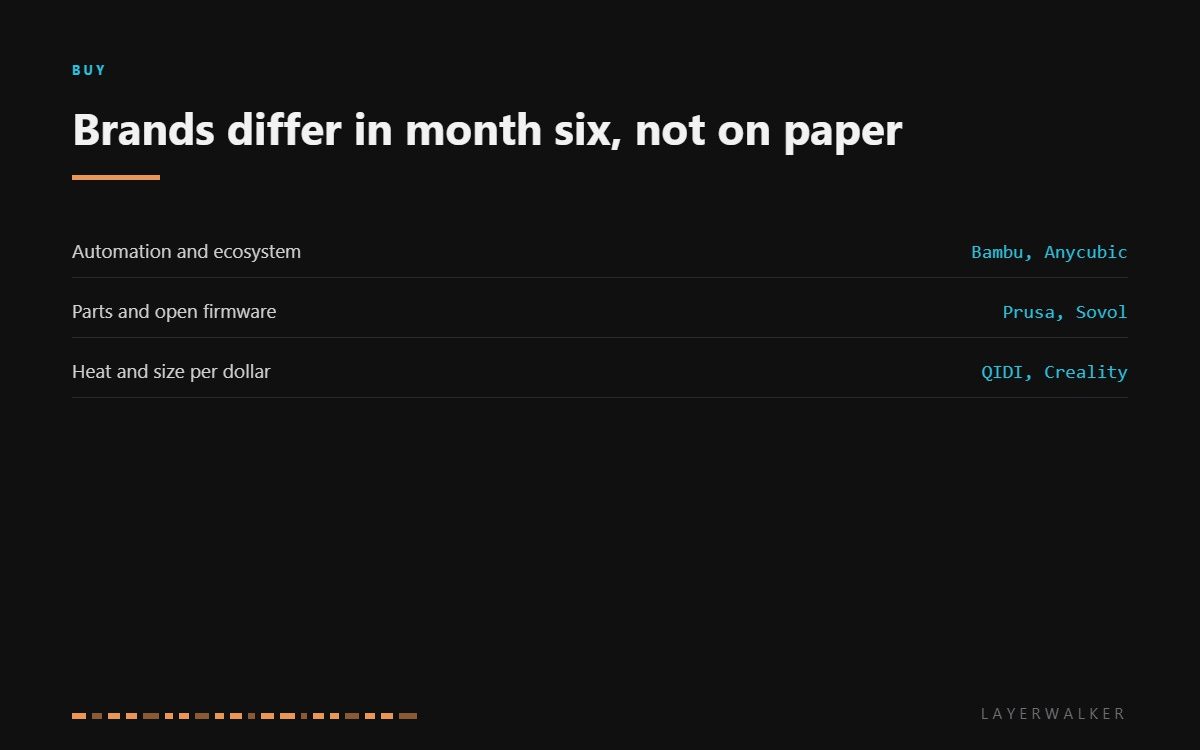
Choosing between 3D printer brands is a choice about what you want handled for you. Bambu and Anycubic sell automation and an ecosystem. Prusa and Sovol sell parts you can replace and firmware you can read. QIDI and Creality sell heat and build volume per dollar. On a spec sheet these machines look interchangeable. What differs is month six.
Where to buy


What actually separates the 3D printer brands
Every brand below ships an enclosed CoreXY machine that runs past 500 mm/s and levels itself. The frame, the hotend and the motion system are close enough that comparing spec sheets tells you almost nothing about which one you should own.
Four things survive a year of use. Whether the chamber is actively heated or merely enclosed, because that decides whether ABS, ASA and nylon are realistic. Whether the multi-material system dries filament or only stores it. Whether spare hotends and plates are listed where you shop, or only on the maker’s own site. And whether the firmware lets you change anything when a profile does not suit your part.
Availability matters more than it should. Prusa sells most of its range direct, and the assembled CORE One+ is the one current model you will reliably find on Amazon. Snapmaker lists the Artisan and the U1 but not the rest. QIDI, Creality, Sovol, Elegoo and Anycubic list nearly everything. Where you buy narrows the field before any specification does.
The flagships, and what each one is for
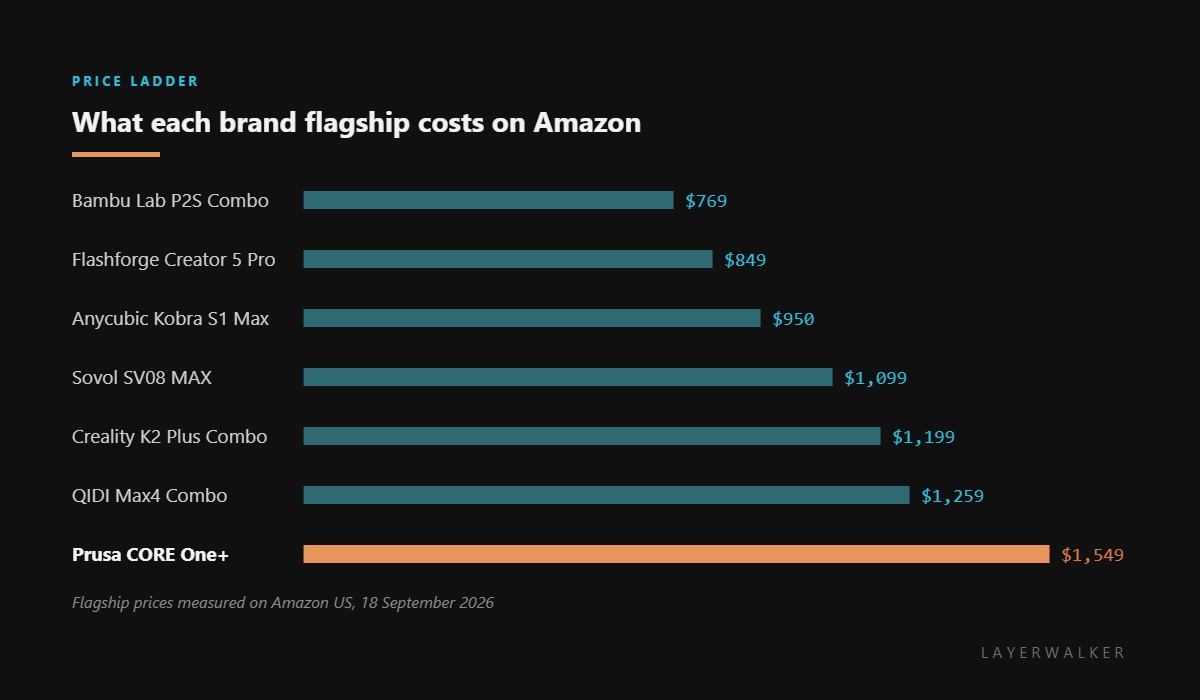
These are the current top models on Amazon US, priced on 18 September 2026. They are not equivalent machines, and the price order is not a ranking.
| Brand | Flagship | What the money buys |
|---|---|---|
| Bambu Lab | P2S Combo, $769 | The most finished software and the AMS 2 Pro with drying. Smallest envelope here at 256 mm |
| Flashforge | Creator 5 Pro, $849 | Four toolheads and an actively heated chamber, for multi-material engineering work |
| Anycubic | Kobra S1 Max Combo, $950 | 350 mm enclosed with the ACE Pro drying feeder, at the lowest price for that pairing |
| Sovol | SV08 MAX, $1,099 | A Voron 2.4 derivative on Klipper. Open, large, and yours to modify |
| Creality | K2 Plus Combo, $1,199 | 350 mm cubed, 60 degC chamber and the CFS for sixteen colours |
| QIDI | Max4 Combo, $1,259 | 390 x 390 x 340 mm with 65 degC chamber heating and a 370 degC nozzle |
| Prusa | CORE One+, $1,549 | Open hardware, a managed 55 degC chamber, and support that answers |
Which brand suits which buyer
If you want to print rather than tinker, buy Bambu. The ecosystem is closed and the company has form for changing firmware terms, but nothing else gets a good first layer with this little input. The P2S Combo is the sensible entry; the H2D is the one to look at only if you genuinely need two nozzles.
If you want to own what you bought, buy Prusa or Sovol. Prusa publishes its hardware, sells every spare part, and answers support tickets with people; you pay roughly double for that. Sovol takes the open Voron design and sells it assembled on Klipper, which is the cheapest honest route into a machine you can change.
If you want materials and size per dollar, buy QIDI or Creality. QIDI has quietly become the temperature brand: a 65 degC chamber and a 370 degC nozzle at under half the price of anything comparable. Creality sells the most machines of anyone and the support depth is thinner than the catalogue suggests, but the K2 Plus Combo is a lot of enclosed volume for the money.
Elegoo is the exception that does not fit the grid. Its Centauri Carbon undercuts everyone on enclosed CoreXY, and its resin line, topped by the Jupiter 2 at $1,299, is a separate business that happens to share a badge.
Where the brand stops mattering
Below about $350 the badge predicts very little. Machines at that price come from a small number of factories with different stickers, and the thing that decides your experience is whether the model you picked has a direct-drive extruder, an auto-levelling probe and spare parts on the shelf. An entry-level printer from a brand you have not heard of, with those three things, beats a famous badge without them.
Brand also stops mattering once you are willing to buy used. A three-year-old machine from any of these makers is a mechanical object; what you are really buying is the parts supply, which is why the open brands hold value better.
3D printer brands FAQ
Which 3D printer brand is the most reliable?
On current evidence Bambu and Prusa have the fewest reported failures in the first year, for opposite reasons: Bambu because so little is left to the owner, Prusa because everything that fails can be replaced.
Is Creality still worth buying?
For volume per dollar, yes. The K2 range is competitive. Expect thinner support and more variation between units than the price suggests.
Which brand has the best filament system?
The AMS 2 Pro on Bambu machines, because it dries as well as feeds. Anycubic’s ACE Pro is the closest rival and costs less in a bundle.
Do 3D printer brands lock you into their filament?
None of them refuse third-party spools. Bambu and Creality read an RFID tag on their own filament and set a profile automatically, which is convenience, not a lock.
Which brand should a small business buy?
QIDI or Flashforge, for the heated chamber and the engineering materials that come with it. See our small business picks for the full reasoning.

LayerWalker
Print defect diagnosis, calibration procedures and parts that actually fit. Corrections welcome through the contact page.