Conveyor Belt 3D Printer: Infinite Z, and the One Brand You Can Buy
LayerWalker is a participant in the Amazon Services LLC Associates Program. We may earn a commission when you buy through links on our site, at no extra cost to you.
A conveyor belt 3D printer replaces the flat plate with a belt that runs at an angle through the frame. Two things follow. A part can be longer than the machine, because it keeps rolling out of the back. And a queue of parts can run unattended, because each finished one drops off before the next starts. The catch in 2026 is that one brand is still the only one you can order.
Where to buy


What a conveyor belt 3D printer actually changes
On a normal printer the Z axis is a hard ceiling. On a belt machine there is no ceiling in that direction at all: the belt carries the part backwards as it grows, so length is limited by the belt and the room behind the printer, not by the frame. People use that for extrusions, rails, conduit, cable chain and long brackets.
The second use is the one that pays. Because a finished part slides off the end, you can queue thirty of the same part and walk away. No plate clearing, no operator between jobs. That is the reason a belt printer shows up in small workshops that sell the thing they print.
The cost of both is geometry. The nozzle sits at an angle to the belt, usually 45 degrees, so every layer is a slanted slice. Overhangs behave differently, the first layer is a belt rather than glass, and slicer support is limited to a handful of profiles. You are giving up surface quality and simplicity to buy length and unattended time.
The one brand you can actually buy
This is the honest part. Creality’s CR-30 put belt printing in front of hobbyists and is no longer listed. Blackbelt sells into industry at industrial prices. On Amazon today the choice is IdeaFormer, and effectively two versions of one machine.
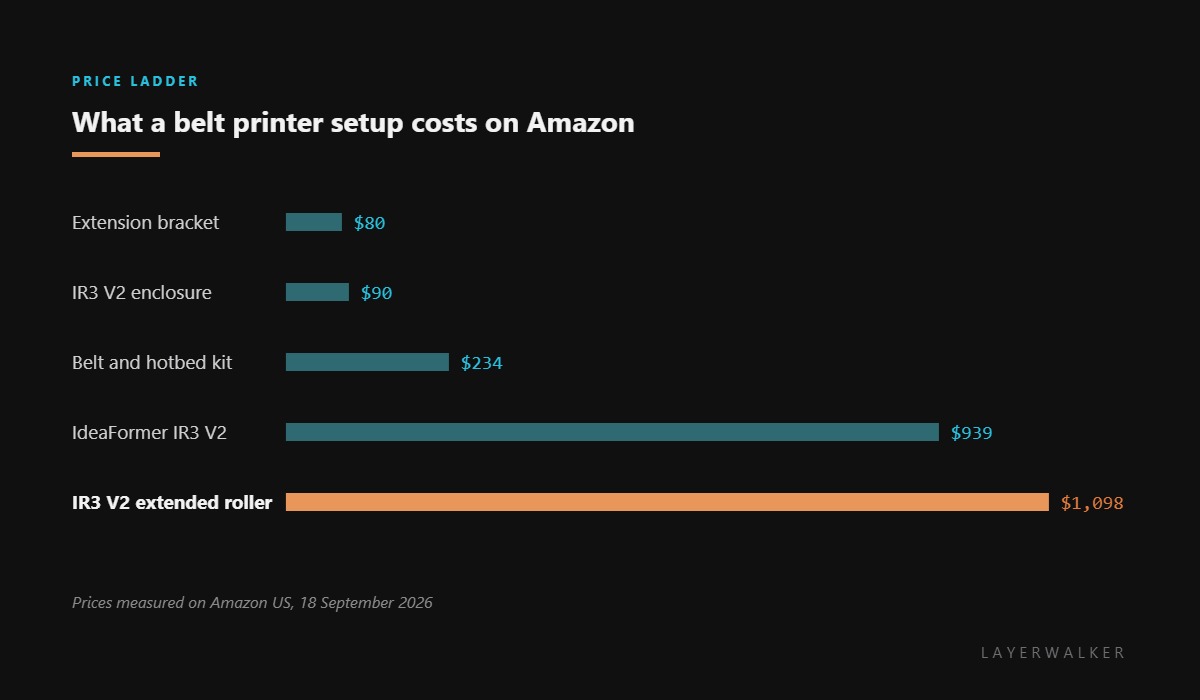
The IR3 V2 at $939 is the standard build. The extended roller version at $1,098 adds the longer output support, which is not a luxury if you intend to print anything past about half a metre: without it a long part droops off the back and skews.
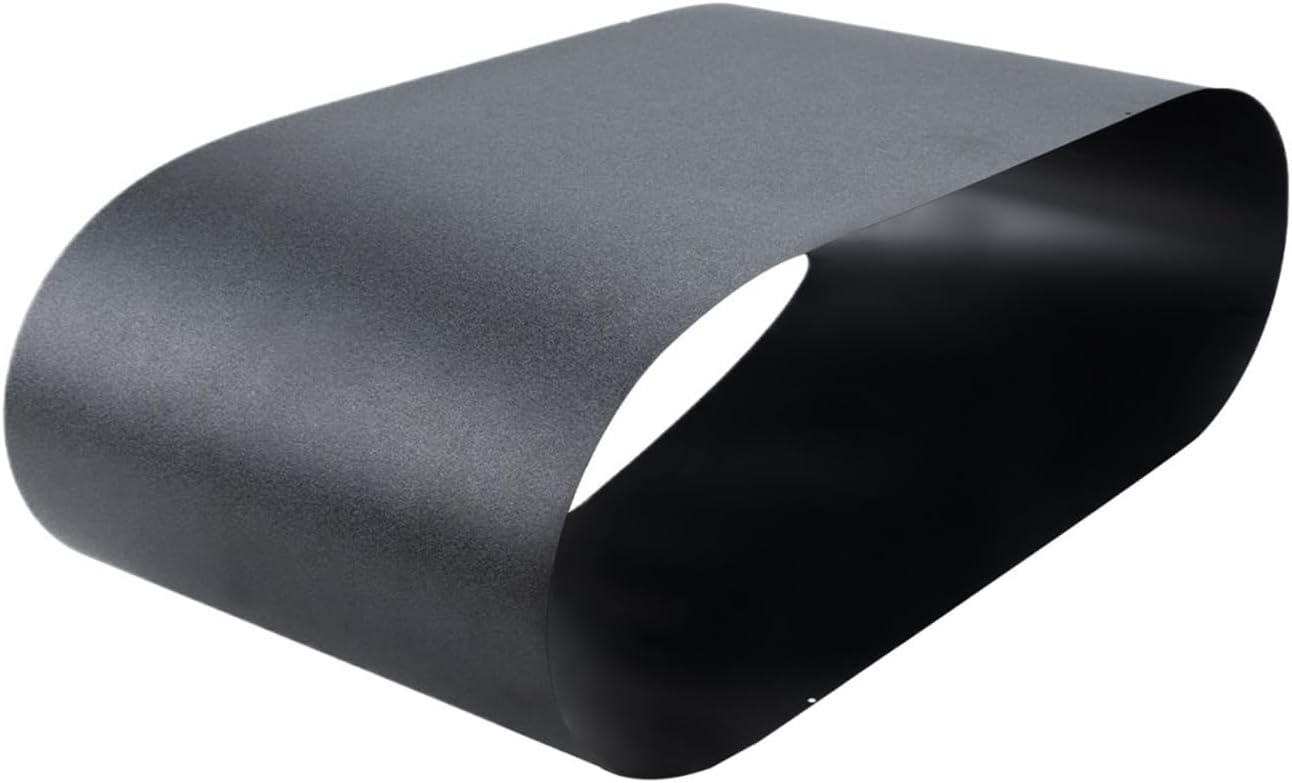
The accessories are worth understanding before you buy. The enclosure at $90 is the difference between printing PLA and printing anything that warps, because a belt machine is open on two sides by design. The metal extension bracket at $80 holds the output end steady. The belt and hotbed kit at $234 is a consumable, not an upgrade: belts stretch and scar, and a worn belt is the usual cause of a batch that slowly drifts out of square.
Where belt printing goes wrong
Slicing is the first wall. You need a profile built for an angled bed, and the mainstream slicers treat it as a special case rather than a first-class mode. Budget an evening before the first good part.
Adhesion is the second. The belt surface is not PEI and does not behave like it. Too little grip and the part lifts as the belt pulls; too much and it refuses to release at the end, which defeats the whole point. This is the one place where a belt machine needs more attention than a normal printer, not less.
Finally, accuracy along the belt depends on belt tension staying constant over hours. The same rules as any other machine apply, only with more consequence: see belt tension for how to judge it by hand.
Who should buy one
Buy a belt printer if you sell a part you print, and the bottleneck is someone clearing the plate. That is the case where the machine pays for itself, and it is why this sits closer to the small business question than to the hobby one.
Buy one if you genuinely need length: a 900 mm bracket on a belt machine costs $939, and on a normal printer costs a redesign with joints.
Do not buy one as a general-purpose printer. For everything else, an enclosed CoreXY in the same money is better in every dimension that is not length. If unattended batch work is the appeal but the parts are small, a large-format printer that fits thirty of them on one plate does the same job with better surfaces.
Conveyor belt 3D printer FAQ
How long a part can a conveyor belt 3D printer make?
As long as you can support behind the machine. The practical limit is the output roller and the table it lands on, not the printer.
Can I convert a normal printer into a belt printer?
Conversion kits exist for older Ender frames but the result is a project, not a printer. The angled gantry, the belt tensioner and the slicer profile all have to be right together.
Does a conveyor belt 3D printer need an enclosure?
For PLA and PETG, no. For ABS or ASA, yes, and it has to be the enclosure made for the machine because two sides are open by design.
What surface quality should I expect?
Visible slanted layer lines on every face, because the layers are cut at the belt angle. Functional parts are fine. Display pieces are not what this machine is for.
Is the belt a consumable?
Yes. Treat it like a build plate that wears: a scarred or stretched belt shows up as parts that drift out of square across a long batch.

LayerWalker
Print defect diagnosis, calibration procedures and parts that actually fit. Corrections welcome through the contact page.