3D Printer Belt Tension: How Tight, and What Loose Belts Actually Cause
LayerWalker is a participant in the Amazon Services LLC Associates Program. We may earn a commission when you buy through links on our site, at no extra cost to you.
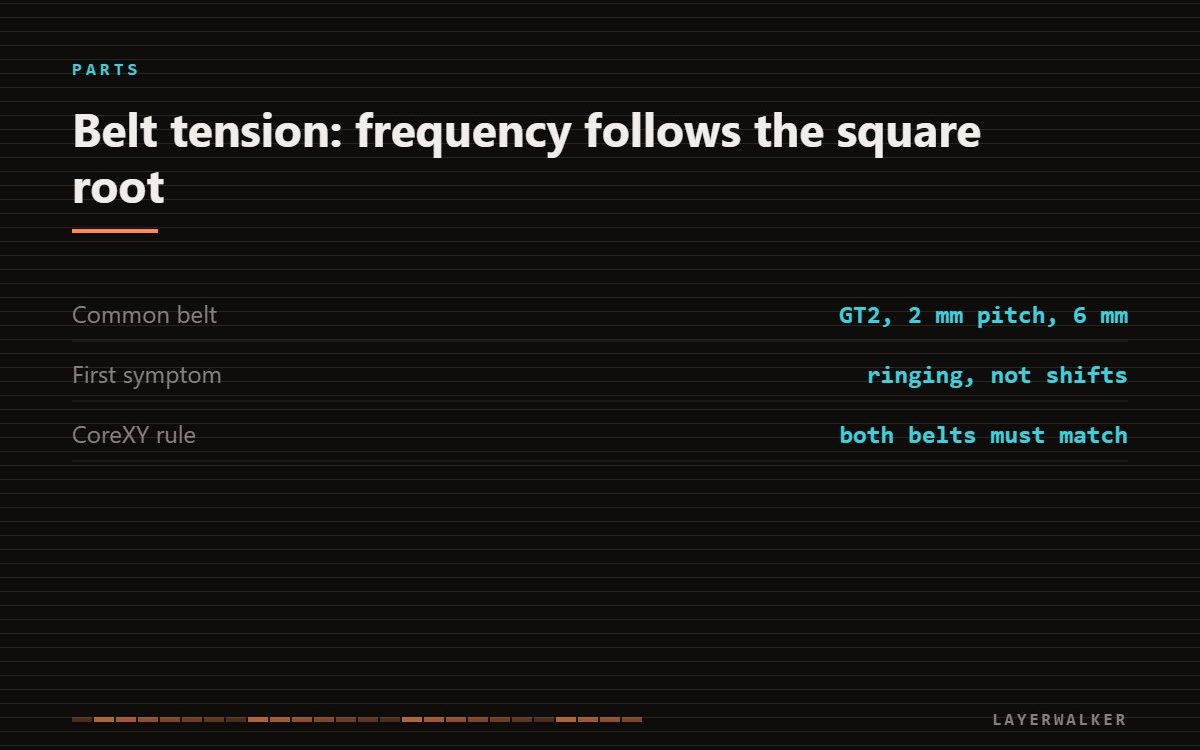
A timing belt behaves like a guitar string: its natural frequency rises with the square root of tension. That is why a belt does not have to look slack to cause problems, and why the first symptom is usually ringing on vertical edges rather than anything dramatic.
Where to buy


What to look for
GT2 with a 2 mm pitch and 6 mm width covers almost every consumer machine. Buy a closed loop only if your printer uses one; most use open belt cut to length and clamped at the carriage. Fibreglass or steel reinforcement matters more than the brand name, because a belt that stretches under load will not hold whatever tension you set.
What loose belts actually cause
In order of appearance: ringing and ghosting on vertical faces, then rounded corners, then dimensional error on one axis, then finally layer shifts when a tooth skips. People usually notice the last one and assume the belt just failed, when the earlier symptoms had been visible for weeks.
How to judge tension without a meter
Pluck the belt near the middle of its longest free span. A correctly tensioned belt gives a clear, short note; an under-tensioned one gives a dull thud you can barely hear. Both belts on a CoreXY machine should sound the same as each other, and that comparison is more reliable than any absolute judgement. If one sounds lower, tension that one rather than both.
Too tight is a real failure mode
Over-tensioning loads the motor bearings and the idler pulleys continuously, and it does not stop when the printer does. Symptoms are a warm stepper at idle, a whining idler, and premature bearing play that shows up as the same ringing you were trying to remove. If you cannot deflect the belt at all by hand, it is too tight.
Check the pulley grub screws first
A pulley that slips on the motor shaft flat mimics low tension exactly, and tensioning the belt will not fix it. Before adjusting anything, hold the pulley and try to turn the shaft. Any movement means the grub screw needs seating on the flat, not on the round. After any belt work, re-run resonance measurement, because the shaping values stored from before no longer match the machine.
FAQ
How often should I check tension? Belts settle in the first few weeks, then change slowly. Check after the first month and then if ringing appears.
Should both belts be identical on CoreXY? Yes. Matching them to each other matters more than hitting a specific number.
Can I use a phone app to measure frequency? It gives a repeatable number to compare against, which is more useful than the absolute value.

LayerWalker
Print defect diagnosis, calibration procedures and parts that actually fit. Corrections welcome through the contact page.

