How to Calibrate a 3D Printer: The Order That Stops You Going in Circles
LayerWalker is a participant in the Amazon Services LLC Associates Program. We may earn a commission when you buy through links on our site, at no extra cost to you.
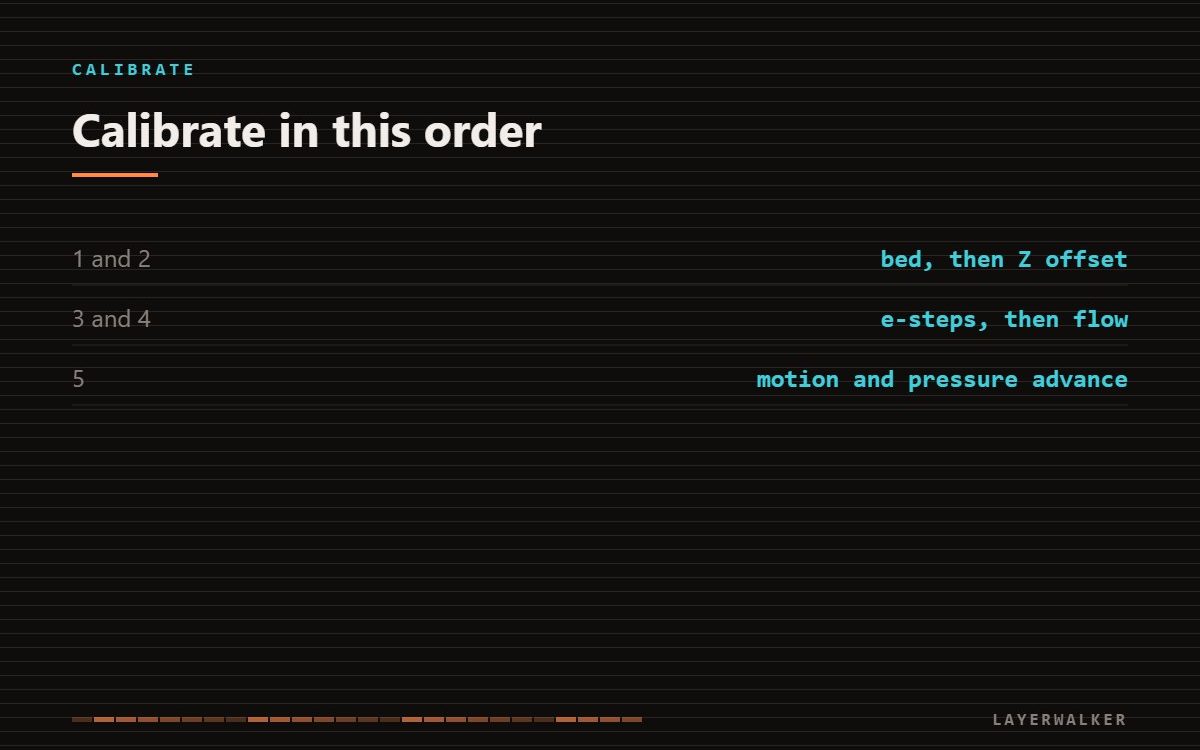
Calibration steps are not independent. Each one assumes the step before it is already correct, so doing them in the wrong order means every result is measured against a moving baseline. Work mechanically outwards: geometry first, then extrusion, then motion.
Where to buy


Clockwise Tools IP54 Grade Digital Caliper, DCLR-0605 0-6" /150mm, Inch/Metric/Fractions Conversion, Stainless Steel, Large LCD Screen

What to look for
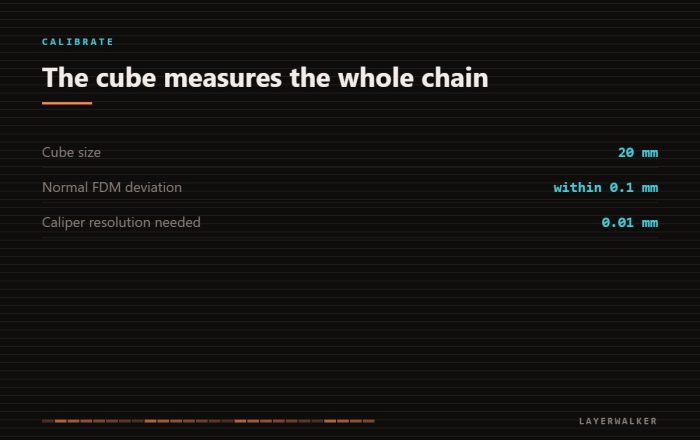
You need very little hardware. A digital caliper reading to 0.01 mm covers flow and dimensional work, and a general tool kit with nozzle cleaning needles covers the rest. The caliper is the one that matters, because flow work depends on measuring a wall to two hundredths of a millimetre.
Step one, geometry
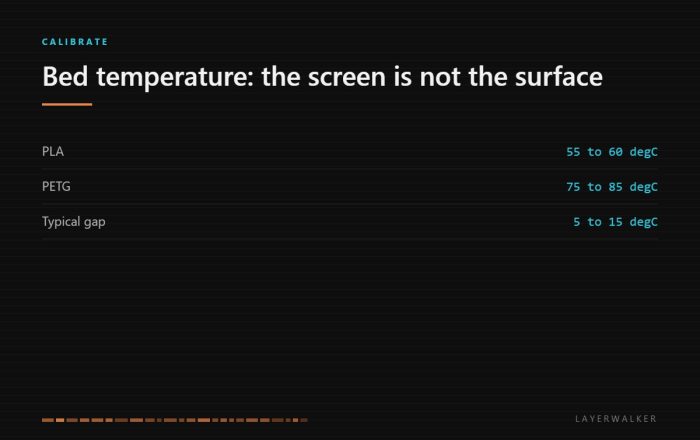
Start with the bed. A levelled bed and a valid mesh are the foundation, because every later measurement is taken from a first layer that sits on it. Then set first layer squish. If the base of a test print is spreading, every wall thickness you measure afterwards is wrong at the bottom, and you will chase that error into the flow setting.
Step two, extrusion
Extruder steps come before flow: steps decide whether 100 mm commanded is 100 mm delivered, and flow trims what happens to that plastic once it is out. Set them in that order and the flow test measures only extrusion width. Set them the other way and you fold a steps error into your flow number and have to redo it whenever you change filament.
Step three, heat and motion
Tune the heater loop so temperature is stable, then run a temperature tower per filament. After that comes motion: resonance measurement and input shaping, then pressure advance, then retraction. Pressure advance depends on a stable flow rate, so it belongs after extrusion rather than before it.
What to redo when something changes
Change filament brand or type and you redo temperature, flow and retraction, because they are material properties. Change a nozzle and you redo flow. Move the machine or change a belt and you redo motion calibration. Nothing else needs touching, which is the practical payoff of calibrating in order.
FAQ
How long does a full pass take? A couple of hours of mostly waiting. It is worth doing once properly rather than repeatedly in fragments.
Do I need to calibrate a modern machine? Less than an older one, but flow and temperature are still per filament no matter how good the printer is.
My prints look fine. Should I bother? If dimensions matter to you, yes. If they do not, tune only what is visibly wrong.

LayerWalker
Print defect diagnosis, calibration procedures and parts that actually fit. Corrections welcome through the contact page.