3D Printer Stepper Motors: Sizes, Torque, and When One Has Actually Failed
LayerWalker is a participant in the Amazon Services LLC Associates Program. We may earn a commission when you buy through links on our site, at no extra cost to you.
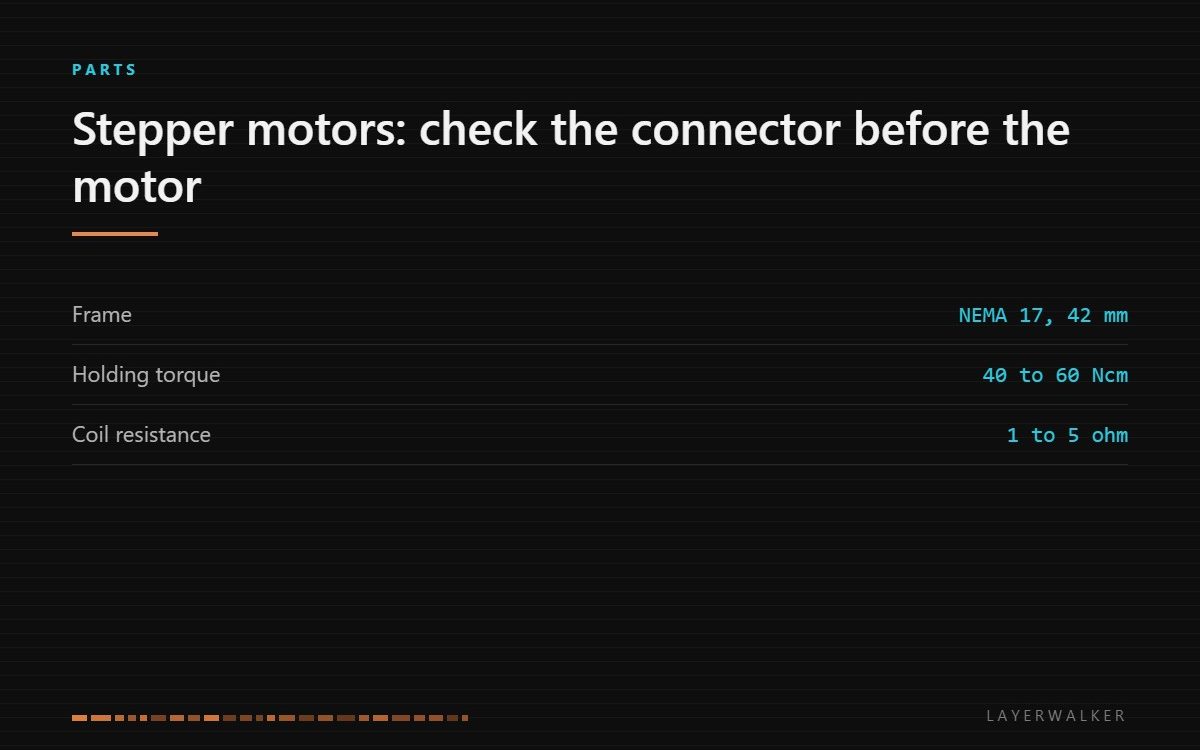
Almost every consumer printer uses NEMA 17 motors on X, Y and Z, and a smaller or geared one on the extruder. A motor that is silent and cold is usually a wiring fault; a motor that is hot and skipping is usually a driver current or mechanical binding problem.
Where to buy


What to look for
Buy by frame size and holding torque, in that order. NEMA 17 describes the mounting face, not the power: the same face comes in bodies from about 20 mm to 60 mm long, and the longer the body the more torque it holds. A generic 59 Ncm motor covers X and Y on almost any bed slinger or CoreXY, and it is the sensible spare to keep on a shelf.
The extruder is the exception. Many machines use a geared or short-body motor there, and a full-size NEMA 17 will not fit the toolhead. Buy an extruder assembly that includes the correct motor rather than the bare motor, unless you have already confirmed the shaft length and gear. On a closed machine the answer is simpler still: buy the manufacturer part for your model, because the connector pinout and cable length are specific and a generic motor will need the plug swapped.
What the numbers mean
Three figures appear on every listing, and only two of them matter for a repair.
| Figure | Typical | What it changes |
|---|---|---|
| Frame size | NEMA 17 (42 mm face) | Whether it bolts on at all. Must match. |
| Holding torque | 40 to 60 Ncm | How much force before it skips. Higher is safer, and heavier. |
| Rated current | 1.5 to 2 A | What the driver must be set to. Set too high, the motor cooks. |
| Step angle | 1.8 degrees | 200 full steps per revolution. 0.9 degree motors exist and halve that. |
Step angle is where people overspend. A 0.9 degree motor doubles the step count per revolution, and the marketing claim is finer detail. In practice the limiting factor on a printer is the nozzle width and the mechanical slop in the belts, not the step angle, so the visible improvement is close to nothing on a machine that has not already been tuned to death.
Telling a dead motor from a dead driver
Most motors that get replaced were working. The failure was somewhere else in the chain, and the motor was the most visible part of it.
Work through the chain in this order. First the connector: unplug and reseat both ends, because the toolhead cable flexes on every travel move and a crimp that has backed out of its housing looks perfectly seated. Second, measure the coils. A stepper is two coils, and each should read a low resistance, typically between 1 and 5 ohm; an open reading on either coil means the motor or its lead has failed. Third, swap the driver or the connector with a known-good axis. If the fault follows the driver, the motor is fine.
A motor that runs hot is not necessarily faulty. Steppers hold position by drawing current continuously and they are designed to run warm, often too warm to hold comfortably. What matters is whether it is hot and skipping, which points at driver current set too high, or hot and quiet, which is normal.
Skipping is usually mechanical
A motor that loses steps under load makes a distinctive sound, and a layer shift is the result. Before touching the current, check what the motor is fighting. A binding lead screw, a belt tensioned to the point of drag, a bearing that has picked up debris, or a gantry that is out of square will all consume torque the motor was counting on.
Our pages on belt tension and lead screws cover the two most common sources of that drag. Raising driver current to push through binding works for a while and then cooks either the driver or the motor, so it is worth ruling out the mechanics first even when the electrical fix is quicker.
Which axis uses what
On a bed slinger, X moves the toolhead, Y moves the bed, and both usually carry the same NEMA 17. Z drives one or two lead screws and is often a slightly weaker motor because it moves rarely and slowly. On a CoreXY, two motors work as a pair to produce both X and Y movement, which is why a single failed motor on that layout does not lose one axis cleanly but makes both behave strangely.
That difference matters for diagnosis. On a bed slinger a dead motor produces an axis that does not move. On a CoreXY it produces diagonal movement, grinding, or a head that drives into a corner, and the fault is easy to misread as a belt or a homing problem.
FAQ
Can I use a stronger motor everywhere? You can, but a heavier motor on a moving axis adds mass the other motors have to accelerate. Stronger is not free.
How do I know my driver current is right? Start at the motor rated current and reduce until it skips, then add a margin back. Most boards are set at the factory and do not need touching.
Do stepper motors wear out? Rarely. Bearings and wiring fail long before the windings do, which is why the connector is the first thing to check.
Is a 0.9 degree motor worth it? Not on a machine that still has untuned belts or a worn nozzle. Fix those first and the step angle stops mattering.

LayerWalker
Print defect diagnosis, calibration procedures and parts that actually fit. Corrections welcome through the contact page.

