HMS 0300-0900-0001-0003: extruder servo motor resistance abnormal
LayerWalker is a participant in the Amazon Services LLC Associates Program. We may earn a commission when you buy through links on our site, at no extra cost to you.

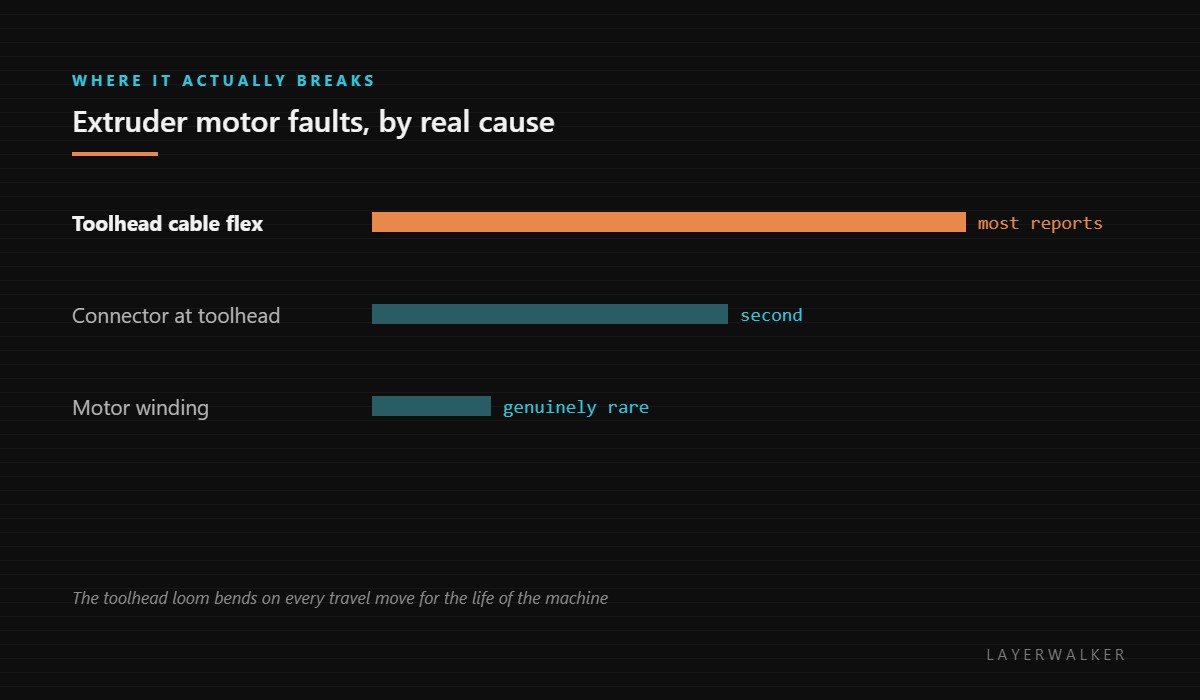
The driver sees the extruder motor outside its expected resistance. Check the toolhead connector before condemning the motor: these leads sit in the most-flexed cable bundle on the machine and they fail long before the windings do.
Affected machines: A2L, H2, H2S, P2S, X1 series. The extruder motor is the small stepper on the toolhead that drives the filament into the melt zone, not one of the motion motors.
Where to buy


The toolhead loom is the hardest-worked cable on the machine
Every travel move bends it. Over thousands of hours that flexing works crimps out of their housings and breaks individual strands inside the insulation, and both produce exactly the reading this code reports. The motor itself sits still inside its bracket and is rarely the part that fails.
So the order of work is: connector, then cable, then motor. Reversing that order is how people end up with a spare motor on the shelf and the same fault on the machine.
Fault appears mid-print or during a filament load, sometimes clearing after a restart
Crimp backed out at the toolhead connector, broken strand in the flexed loom, or a failed winding
- Power off at the wall and let the hotend cool before working on the toolhead.
- Unplug the extruder motor connector and measure across each coil pair. Roughly 1 to 5 ohm is normal and the two coils should match each other.
- Flex the toolhead loom gently while watching the meter. A reading that jumps as you move it is a broken strand.
- Tug lightly on each wire at the connector housing; a crimp that has backed out looks seated and reads open.
- If the readings are steady and matched, the motor is fine and the fault is downstream at the driver.
- If a coil reads open or wildly out of range with the cable still, fit a replacement motor for your machine generation.
If the extruder is also stiff to turn by hand, check for a jam before blaming the electrics: a motor fighting a blockage draws abnormally and can report faults that look electrical.
Our page on 3D printer stepper motors covers the coil measurement in detail and how to separate a motor fault from a driver fault. If the axis is stiff rather than electrically faulty, lubrication covers what belongs where, and the troubleshooting index covers the wider picture.
FAQ
Can I use any NEMA 17 motor? No. The extruder motor is usually a short-body or geared unit specific to the toolhead.
The fault comes and goes. That pattern is wiring, not a winding. Measure while flexing the cable.
Could a clog cause this? Indirectly. A motor fighting a blockage behaves abnormally, so clear jams first.
Do both coils need to match? Closely, yes. A mismatch between them is as telling as an out-of-range value.

LayerWalker
Print defect diagnosis, calibration procedures and parts that actually fit. Corrections welcome through the contact page.