3D Printer Thermistor: What It Reads, and What a Wrong One Does
LayerWalker is a participant in the Amazon Services LLC Associates Program. We may earn a commission when you buy through links on our site, at no extra cost to you.
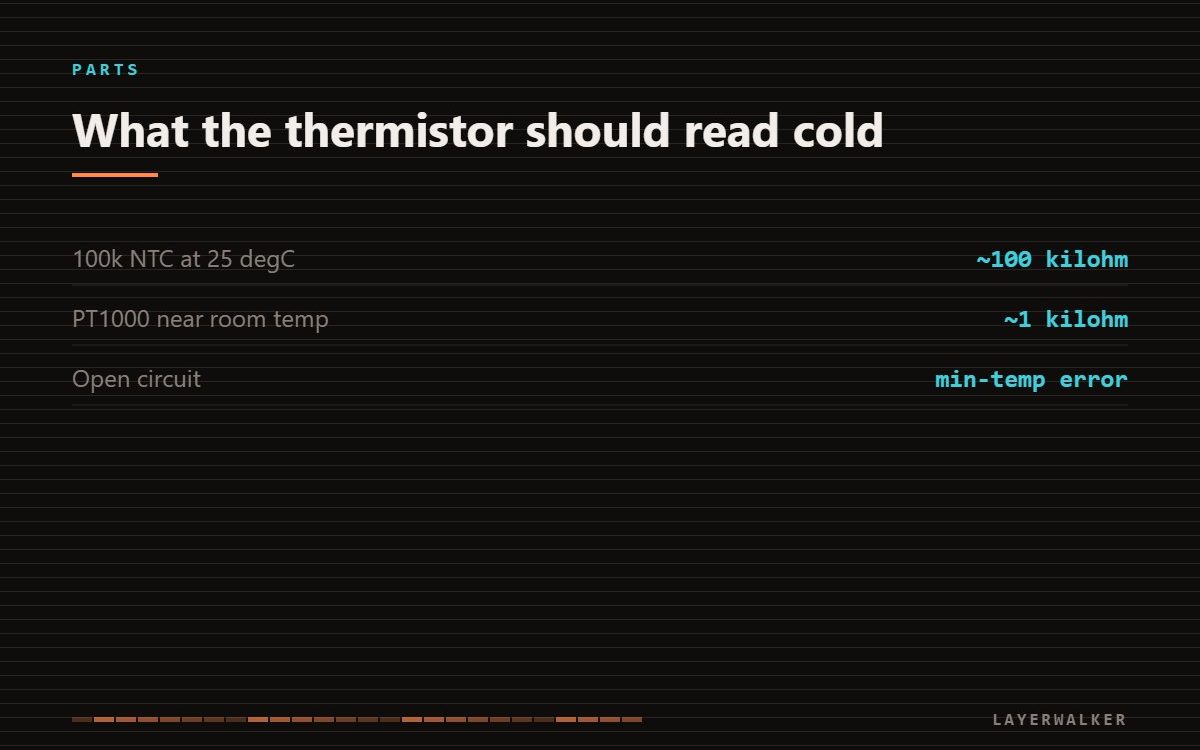
The thermistor is how the printer knows the nozzle temperature. A standard 100k NTC reads close to 100 kilohm at 25 C and its resistance falls steeply as it warms. Measure it cold before replacing anything, and never substitute a different sensor type just to get running again.
Where to buy


What to look for
Buy the type your firmware expects. Most machines use a 100k NTC in a glass bead or a screw-in cartridge; some newer ones use PT1000, which reads about 1 kilohm near room temperature and needs a firmware setting to match. The two are not interchangeable. Prefer the cartridge format if your heater block takes one, because a bare bead held in with thermal paste is the version that works loose.
What the meter should show
Cold, a healthy 100k NTC reads near 100 kilohm. Open circuit means the element or its wiring is broken, which usually surfaces as a minimum-temperature error at power-on. A reading near zero means a short. Both stop the printer immediately, and correctly so: with no valid reading the controller has no safe way to manage a heater. On Bambu machines the hotend sensor reports as its own code, separate from the heatbed sensor.
Why the wrong type is worse than a dead one
A dead sensor stops the machine. A wrong sensor lets it run. The controller converts resistance to temperature using a fixed curve; feed it the wrong curve and the reading is confidently, quietly wrong, and the heater chases a target it has already passed. This is the mechanism behind hotends that overheat with no error on screen, and it is why the firmware setting must change at the same time as the part.
The wires break before the bead does
Thermistor leads are the thinnest wires on the machine and they flex on every move. Most failures are a broken conductor where the lead leaves the heater block, not a failed element. Flex the lead gently while watching the reported temperature: a value that jumps or drops out confirms the wiring rather than the sensor. The same lead routing matters when you replace the hotend assembly.
FAQ
Can I test it without removing it? Unplug it at the board and measure across the two pins with the hotend cold. That tests the sensor and its lead together.
Why does my printer show room temperature when hot? Usually the sensor has fallen out of the heater block. It is reading the air, not the metal.
Is PT1000 better? It is more stable at high temperature and less noisy, but only if the firmware is configured for it.

LayerWalker
Print defect diagnosis, calibration procedures and parts that actually fit. Corrections welcome through the contact page.

