Food Safe 3D Printer Filament: What the Certification Covers, and What It Does Not
LayerWalker is a participant in the Amazon Services LLC Associates Program. We may earn a commission when you buy through links on our site, at no extra cost to you.
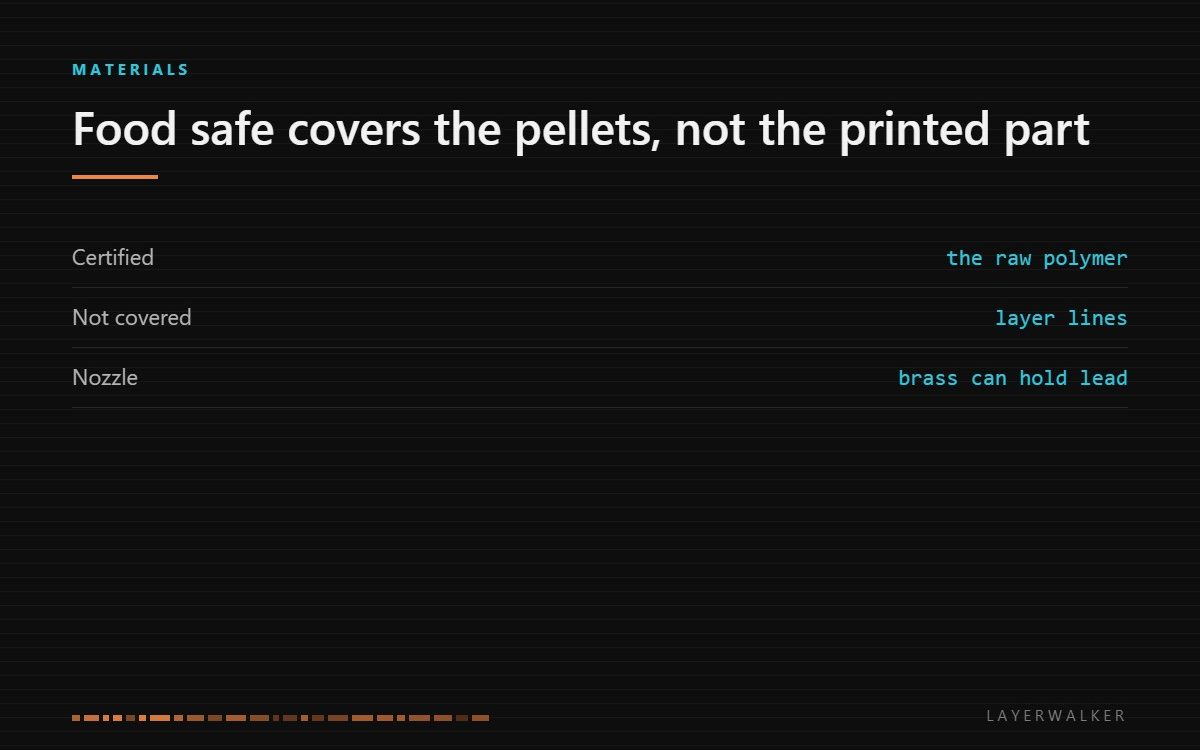
A food grade certificate describes the pellets, not your printed part. The plastic is only one of four things that decide whether an object is safe to eat off, and it is the one least likely to be the problem.
Where to buy


What to look for
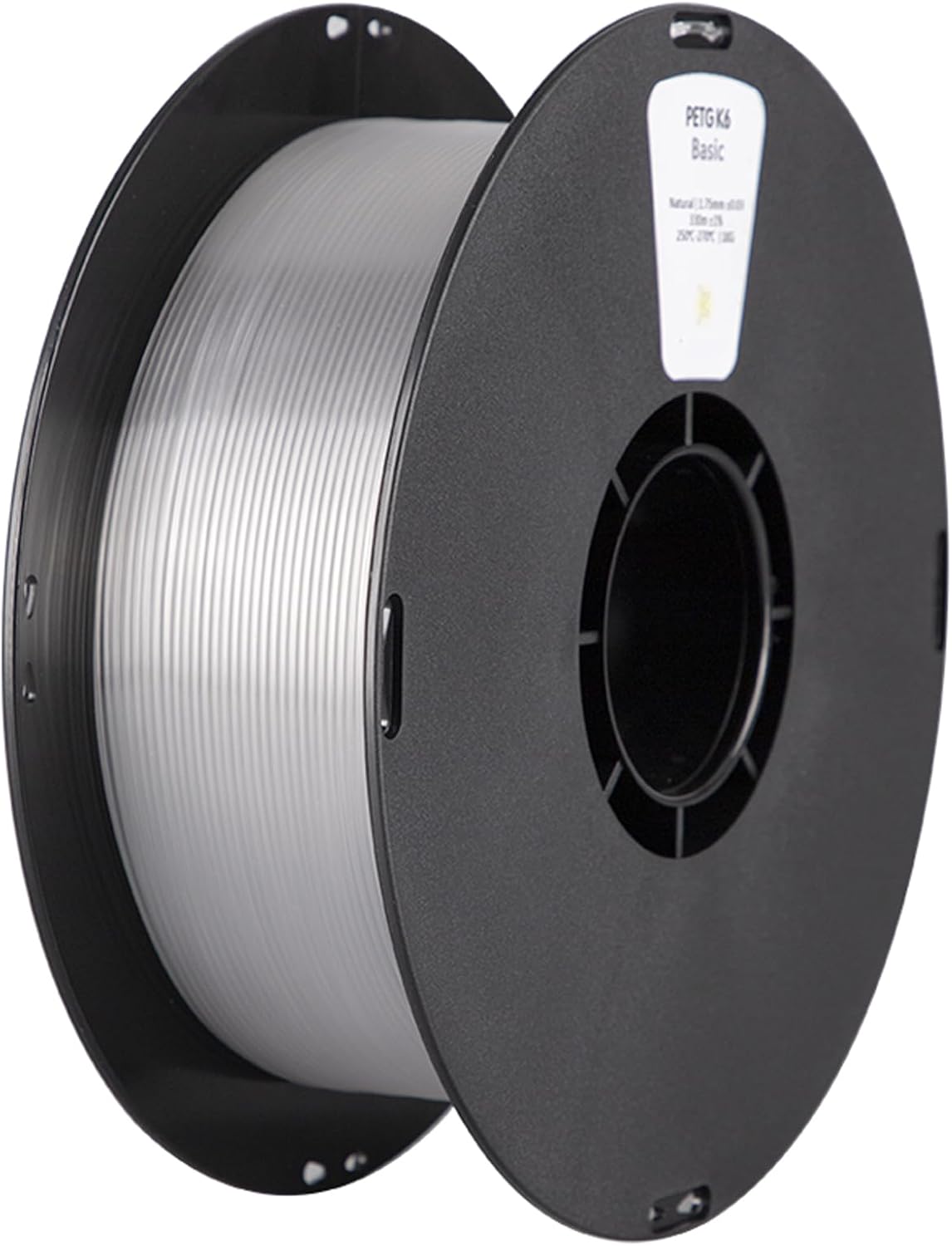
If you are buying for this purpose, buy PETG rather than PLA. PETG is the same family of plastic as a drinks bottle, it survives a wash in hot water, and it does not soften at temperatures a dishwasher or a mug of tea will reach. PLA is nominally food safe as a raw material but deforms somewhere around 60 degrees, which rules out anything warm and most cleaning methods that would actually sanitise it.
Look for a specific standard named on the listing rather than the phrase food safe on its own. A certificate referencing food contact regulations, or a biocompatibility standard such as ISO 10993, means someone tested the material. A listing that only says food safe in the title has told you nothing, because nobody audits that phrase. Antibacterial additives are a genuine feature rather than marketing, though they address surface growth, not the structural problem described below.
The certificate covers the pellets, not the part
This is the whole of the confusion, and it is worth stating plainly. A filament manufacturer can certify that the raw polymer and its colourants are approved for food contact. That is a real claim about a real thing. It says nothing about the object that comes out of your printer, because three of the four risks are introduced after the plastic leaves the spool.
| Source | Fixed by a food grade filament? | Notes |
|---|---|---|
| The polymer itself | Yes | The one thing the certificate does cover |
| Layer lines harbouring bacteria | No | The main practical problem; a printed surface is porous at the microscopic scale |
| Brass nozzle wear | No | Standard brass nozzles can contain lead; the part picks up traces |
| Residue from earlier prints | No | The hotend retains material from whatever you printed last |
Layer lines are the real issue
An FDM part is built from stacked extrusions, and the valleys between them are exactly the scale that bacteria colonise and that washing does not reach. A smooth injection-moulded beaker can be wiped clean. A printed one cannot, because the geometry that gives it strength also gives it several hundred sheltered grooves per square centimetre.
That is why the sensible rule is not about the material at all. Dry contact and single use are fine: a cookie cutter you wash and dry immediately, a chocolate mould, a jig that touches food for seconds. Wet contact and repeated use are not: a cup you drink from daily, a container that holds food between meals, anything stored damp. No filament certificate changes that distinction.
The nozzle matters more than most people expect
Standard brass nozzles are a copper and zinc alloy that often contains a small percentage of lead to make it machinable. In normal use that is irrelevant. In a part meant for food contact it is a second source of contamination that no amount of filament certification removes.
If you are going to do this at all, print through a stainless steel or hardened steel nozzle, and run a purge of the intended material first so that whatever was in the melt zone from the previous job is gone. That last point catches people: the hotend does not empty itself between prints, and a hotend that ran a carbon-filled or unknown filament last week still holds some of it.
When it is defensible, and when to stop
Printing for food is reasonable for moulds, cutters, funnels, stencils and any tool that touches food briefly and is cleaned at once. It is reasonable for a form you line with parchment or foil, which removes the contact question entirely. It is a bad idea for anything that holds liquid for hours, anything that goes in a dishwasher unless you have confirmed the material survives it, and anything a child will chew.
A common middle path is to print the shape and then coat it, but food safe coatings have their own certification problem and an imperfect coat is worse than none, because it traps residue under a layer you cannot see. If the part matters, the honest answer is often that a printed one is the prototype and a bought one is the product. Our comparison of PLA and PETG covers the temperature and durability side of the choice, and printing PETG covers getting clean results out of it.
FAQ
Is PLA food safe? The raw polymer generally is. The printed object usually is not, for the layer line and nozzle reasons above, and PLA softens too low to sanitise properly.
Does a food grade certificate mean the part is safe? No. It means the pellets were tested. Three of the four risks appear after that.
Will a smooth coating solve it? Only if the coating is itself certified and applied without gaps. A partial coat traps residue where you cannot clean it.
What about a stainless nozzle? It removes the lead question and is worth fitting, but it does not address layer lines, which remain the larger problem.

LayerWalker
Print defect diagnosis, calibration procedures and parts that actually fit. Corrections welcome through the contact page.