PLA Filament: What Makes a Good Spool, and Why Most Print Problems Are Not the Filament
LayerWalker is a participant in the Amazon Services LLC Associates Program. We may earn a commission when you buy through links on our site, at no extra cost to you.
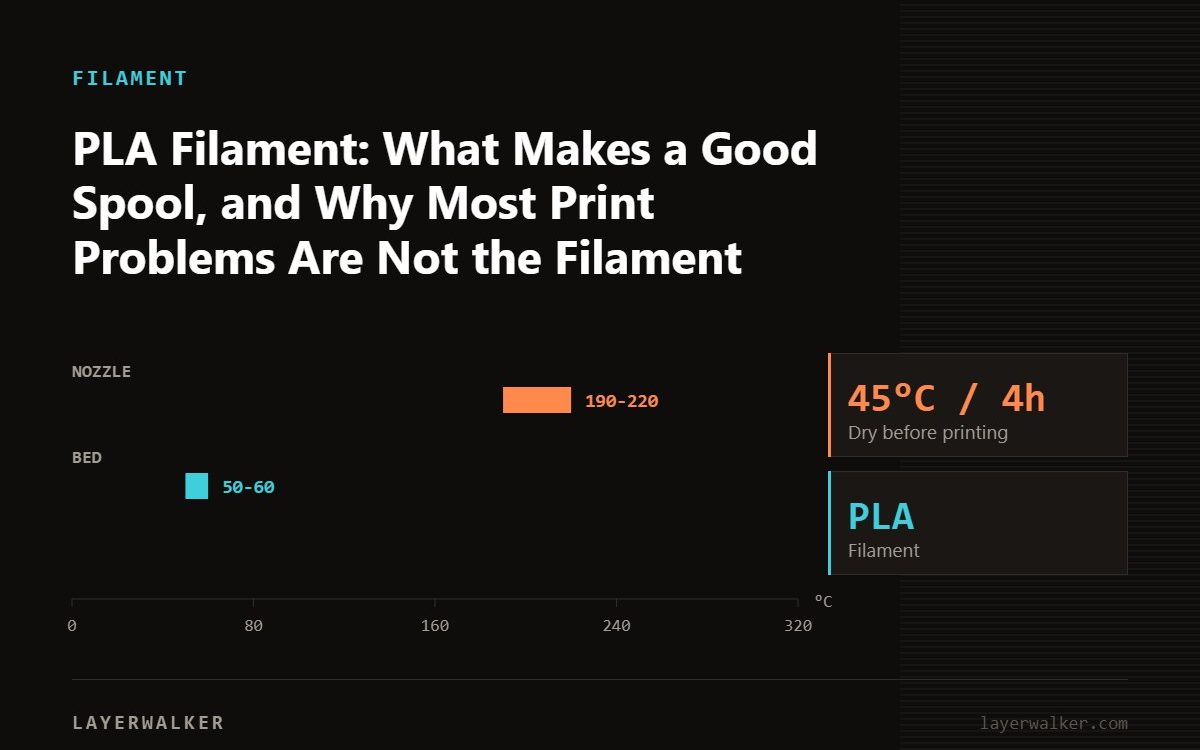
Any PLA with a stated diameter tolerance of ±0.03 mm from a maker that vacuum-seals the spool will print well at 200 to 215 °C on a 55 to 60 °C bed. Pay extra for PLA+ if parts get handled, and for a premium brand only if you print fine models or multi-part assemblies where colour and diameter consistency show.
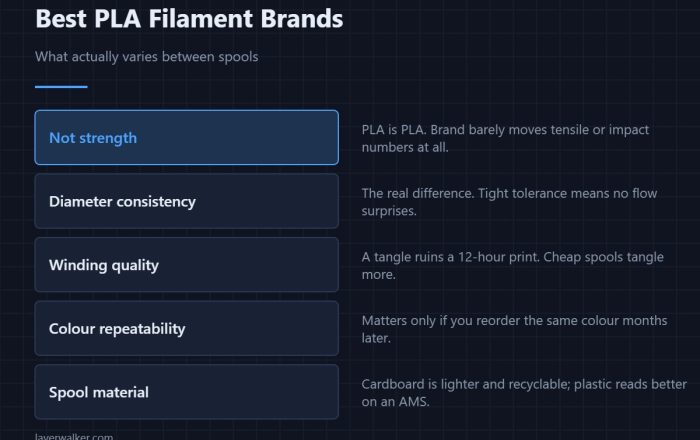
PLA is where every printer starts and where most stay. It prints on an open desk with no enclosure, sticks to a plain PEI sheet, does not smell, and holds detail better than any other common filament. Because it is so forgiving, differences between brands show up less than they do in PETG or ABS; a mid-priced spool with a stated tolerance is, for most parts, indistinguishable from a premium one. Where PLA does vary is toughness, colour consistency and how well it has been kept dry before it reached you.
Where to buy


SUNLU PLA+ 3D Printer Filament, 16 Color Bundle Multicolor, 1.75mm
What to look for
- Tolerance ±0.03 mm or tighter. This is the number. Below it, extrusion width wanders and top surfaces look uneven.
- Vacuum bag with desiccant. PLA is the least hygroscopic common filament, but a spool that has sat open in a warehouse still prints brittle and snaps in the Bowden tube.
- Plain PLA or PLA+. Plain PLA is stiffer and sharper on detail; PLA+ has impact modifiers, bends before it snaps and wants 10 to 15 °C more heat. Models: plain. Parts: plus.
- Spool material. Plastic spools run in every dryer and multi-material unit. Cardboard spools are lighter and greener, and shed dust into a feed path.
- Colour consistency. Only matters for assemblies printed over months. Premium brands are better at it; budget brands vary between batches.
The spools in the box
SUNLU’s black PLA is the calibration and prototype spool: cheap, consistent, and the one to tune a new printer on. Creality’s 2 kg black-and-white bundle is the same idea in the two colours a workshop uses most. SUNLU’s PLA+ sixteen-colour set is the parts spool for anything that gets handled, with a colour for each job and one set of settings once you have tuned a spool.
Settings that work everywhere
- Nozzle 200 to 215 °C for plain PLA, 215 to 230 °C for PLA+. Print a temperature tower once per brand and stop guessing.
- Bed 55 to 60 °C on PEI. Above 65 °C the bottom layers soften and you get elephant’s foot.
- Part cooling 100 % after the first two layers. PLA loves fan.
- Retraction 0.8 to 1.5 mm on direct drive, 4 to 6 mm on Bowden. If it still strings, dry the spool before you change anything else.
- Run a flow calibration per brand; PLA+ usually wants slightly less flow than plain PLA.
When PLA is the wrong material
Anything in a hot car or in sunlight: PLA softens at 55 °C and sags. Anything under sustained load: PLA creeps. Anything that flexes repeatedly: it snaps. For those, read the PLA versus PETG guide; for outdoor parts, ASA.
3D PLA filament FAQ
Does expensive PLA print better?
On fine models and colour-matched assemblies, noticeably. On brackets and prototypes, no.
Why does my old PLA snap in the tube?
It has absorbed water and gone brittle. Dry it at 50 °C for six hours; it comes back.
Is PLA biodegradable?
Industrially compostable at 60 °C in a facility; in a garden or landfill it behaves like any plastic.

LayerWalker
Print defect diagnosis, calibration procedures and parts that actually fit. Corrections welcome through the contact page.