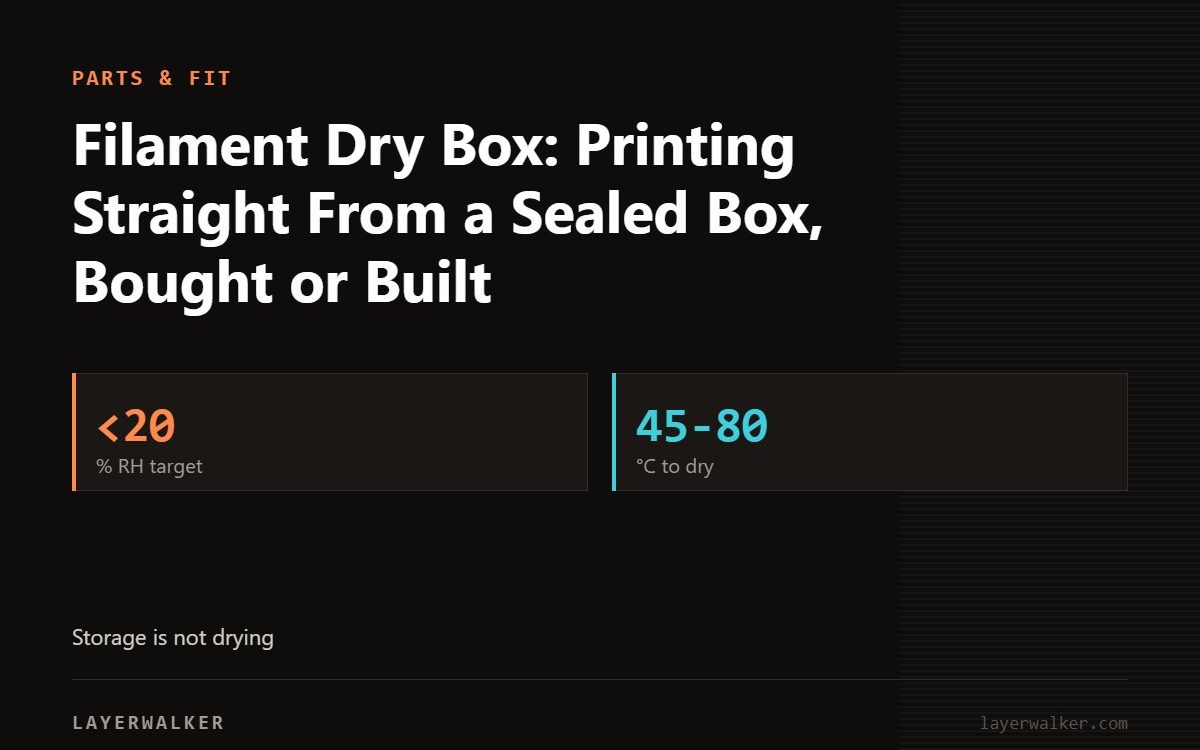
Filament Dry Box: Printing Straight From a Sealed Box, Bought or Built
LayerWalker is a participant in the Amazon Services LLC Associates Program. We may earn a commission when you buy through links on our site, at no extra cost to you.
A dry box is a sealed spool container with desiccant and a PTFE tube outlet, so you print PETG, TPU or nylon without the spool ever sitting in room air. Buy one if you print those materials on a Bowden or long-path printer; a heated dryer with print-through feed does the same job and also dries the spool.
The problem a dry box solves is the twenty-hour print. You can dry a spool of PETG perfectly, mount it on an open holder, and by hour twelve in a humid room it is stringing again. A dry box keeps the spool sealed while it feeds, so the state you dried it to is the state it prints at. It does not add heat, so it cannot dry a wet spool; it keeps a dry one dry.
Where to buy


What a good dry box has
- A real seal. Gasketed lid or a screw-down clamp. Snap lids leak.
- A PTFE outlet with a pneumatic fitting so a Bowden tube can run straight to the extruder without a gap that lets air in.
- A spool that turns freely. Bearings or a rolling axle; a spool that drags makes the extruder skip and gives you gappy walls mid-print.
- Desiccant tray and a hygrometer. Colour-indicating silica gel, 50 to 100 g per spool, and a display you can read without opening the lid.
- Internal width for your spools. Most fit a standard 1 kg spool; 2 kg and 3 kg spools need a purpose-built box.
Bought box, heated dryer or DIY
A passive dry box is cheap and silent, and it is the right answer for TPU and PETG on a printer that sits in a humid room. A heated dryer with print-through holes costs more, uses power, and both dries and stores, which makes it the better single purchase for nylon or for anyone who does not want to run two devices. A DIY box from a cereal container, a bearing axle and a pneumatic fitting works exactly as well as a bought one for a fraction of the price if you have a printer to make the parts, and is the classic first upgrade project.
The boxes in the box
The three sets listed, YOOPAI, Comgrow and Bestery, are six-packs of sealing storage boxes with desiccant trays. They are storage first: check whether the model you pick has a PTFE outlet before relying on it as a feed box, because some in these ranges are sealed storage only. For a true print-from box with a heater, look at a dryer with print-through feed instead.
Using one
- Dry the spool first in a dryer, then move it into the box while warm.
- Run the PTFE tube directly from the box outlet to the extruder inlet; every open centimetre of filament is a centimetre absorbing water.
- Check the hygrometer at the start of every print. Above 20 % relative humidity, recharge the desiccant.
- Keep the box near the printer at the same height as the extruder so the filament path does not bind.
When a dry box is not the fix
If a spool already strings and pops, the box will not cure it; heat will. And if you print PLA only in a dry climate, an open spool holder is fine for the two months a spool usually lasts.
Filament dry box FAQ
Can I print from a dry box on a direct-drive printer?
Yes; run the PTFE tube to the toolhead inlet and let the spool turn freely.
How much desiccant?
50 to 100 g of silica gel per spool-sized box, recharged when the indicator changes colour.
Does a Bambu AMS count as a dry box?
Partly. It seals and holds desiccant, and the newer heated version dries; the original does not heat and its seal is modest.

LayerWalker
Print defect diagnosis, calibration procedures and parts that actually fit. Corrections welcome through the contact page.