3D Printers for PETG: What the Hardware Needs, and Which Ones Have It
LayerWalker is a participant in the Amazon Services LLC Associates Program. We may earn a commission when you buy through links on our site, at no extra cost to you.
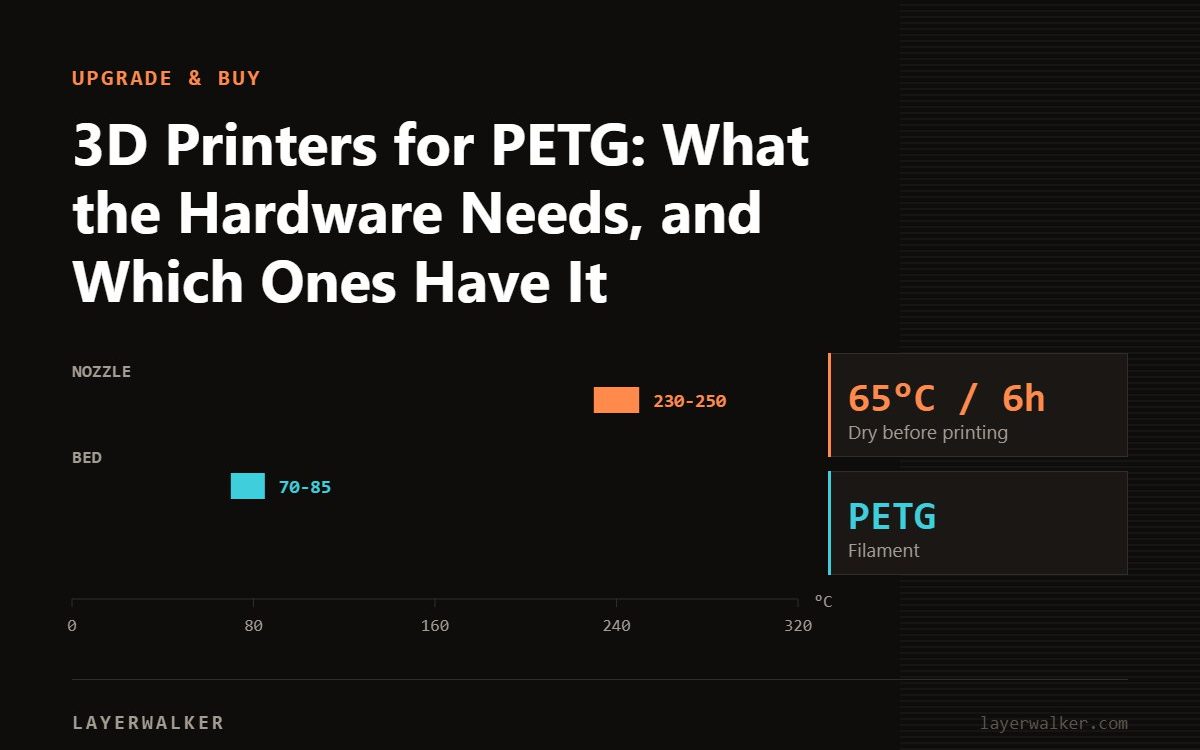
PETG is undemanding of the printer and demanding of the setup. Any current machine with a 250 °C hotend prints it; what matters is a textured PEI plate so it releases, part-cooling control so it bonds, a dry spool so it does not string, and a direct-drive extruder. An enclosure is optional. The Bambu A1, Creality K1C and Flashforge AD5M all print PETG well out of the box; the printers that struggle are old Bowden Enders and anything with a smooth glass bed and no release agent.
Where to buy


What PETG asks of the printer
| Requirement | Why | Look for |
|---|---|---|
| Hotend 230 to 250 °C | PETG melts higher than PLA | Any current printer; legacy 240 °C hotends are marginal |
| Textured PEI plate | PETG welds to smooth PEI and glass | Textured plate stock, or buy one |
| Part cooling control | Too much cooling weakens layers; too little sags | Slicer fan curve; strong fans help on overhangs |
| Direct drive | Retraction control against stringing | All current machines; avoid Bowden |
| Dry filament | PETG absorbs moisture and strings | Dryer or heated AMS |
| Enclosure | Not needed under 256 mm | Optional; helps large parts |
Printers that make PETG easy
- Bambu A1 and A1 mini: textured plate stock, auto flow calibration, tuned PETG profiles.
- Creality K1C: enclosed, 300 °C, hardened nozzle for PETG-CF.
- Flashforge AD5M: double-sided PEI plate, 280 °C, good cooling.
- Bambu P2S Combo: the AMS 2 Pro dries PETG in place, which solves the most common PETG complaint.
Printers that make PETG hard
- Legacy Ender 3, 3 Pro and V2 with Bowden extruders and 255 °C PTFE-lined hotends: stringing and heat creep.
- Any printer shipped with a smooth glass or smooth PEI bed and no textured option; PETG rips the coating.
Settings and materials
Start with the manufacturer PETG profile, add a textured plate if needed, dry the spool. See PETG filament, PETG and enclosures and plates for PETG.
The units in the box
The listings are the Bambu A1, the Creality K1C and the Flashforge AD5M.
3D printer for PETG FAQ
Does PETG need an enclosure?
Not under 256 mm; it helps on large parts.
Does PETG need a hardened nozzle?
No; PETG-CF does.

LayerWalker
Print defect diagnosis, calibration procedures and parts that actually fit. Corrections welcome through the contact page.