Does PETG Need an Enclosure? No, But Here Is When One Helps
LayerWalker is a participant in the Amazon Services LLC Associates Program. We may earn a commission when you buy through links on our site, at no extra cost to you.
No. PETG prints reliably on an open printer: it shrinks far less than ABS, does not crack in room air, and prefers some airflow. An enclosure helps in two cases only: a cold or draughty room where tall parts lift at the corners, and a workshop where dust and fumes matter. If PETG is failing on your open printer, the fix is drying, bed temperature and plate choice, not walls.
PETG sits between PLA and ABS on the shrinkage scale, closer to PLA. That is why it has become the default functional material for open-frame printers: it gets toughness and heat resistance without the chamber ABS demands. People asking whether PETG needs an enclosure usually have a PETG problem they have blamed on temperature. Almost always it is water, bed temperature or the plate.
Where to buy


YOOPAI 3D Printer Enclosure for Creality Ender 3 with Ventilation Kit & LED

What PETG actually needs
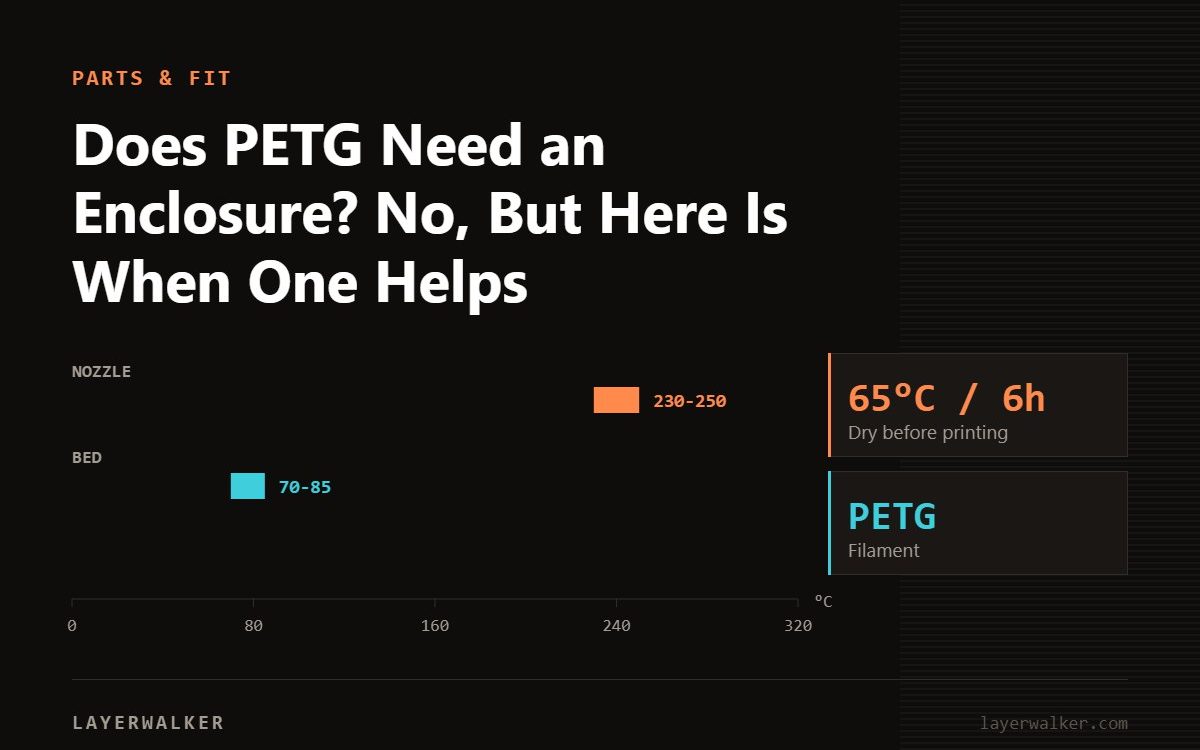
- Dry filament. Wet PETG strings, bubbles and prints weak layers that look like a cooling problem. Dry it at 65 °C first.
- Bed at 70 to 85 °C on textured PEI, or smooth PEI with glue stick.
- Nozzle at 230 to 250 °C so layers bond.
- Some fan, 30 to 50 %, for overhangs, but not full fan.
- Still air. Not warm air; just not a draught across the bed.
When an enclosure helps
- A cold room, under about 18 °C, where tall thin parts lift at the base. A tent with the door cracked open stops the draught without heating the chamber much.
- Dust and pet hair landing on a 20-hour print.
- Noise and the small amount of odour PETG gives off.
When an enclosure hurts
A sealed enclosure holding 40 °C is ABS territory. PETG in that chamber sags on overhangs and, on a PTFE-lined hotend, heat creeps and clogs. If you already have an enclosure, print PETG with the door open or a vent flap up. See PLA versus PETG for what each material wants.
The enclosures in the box
The listed tents are the general-purpose enclosures that suit a bed-slinger if you decide the draught or dust case applies. For PETG alone they are optional; a filament dryer is the better first purchase.
FAQ: Does PETG need an enclosure
My PETG cracks between layers; is that the room?
More likely wet filament or too much fan. Dry it and drop fan to 30 %.
Does a Bambu P1S print PETG with the door closed?
It works; Bambu recommends the door open or top glass off for PETG.
Do I need an enclosure for PETG-CF?
No; same rules as PETG, plus a hardened nozzle.

LayerWalker
Print defect diagnosis, calibration procedures and parts that actually fit. Corrections welcome through the contact page.