Warping: corners lifting off the bed
LayerWalker is a participant in the Amazon Services LLC Associates Program. We may earn a commission when you buy through links on our site, at no extra cost to you.
Warping is thermal contraction, not an adhesion failure. The bottom layers cool and shrink while the top stays hot, and the difference peels the corners up. Keep the whole part warm — an enclosure fixes what glue cannot.
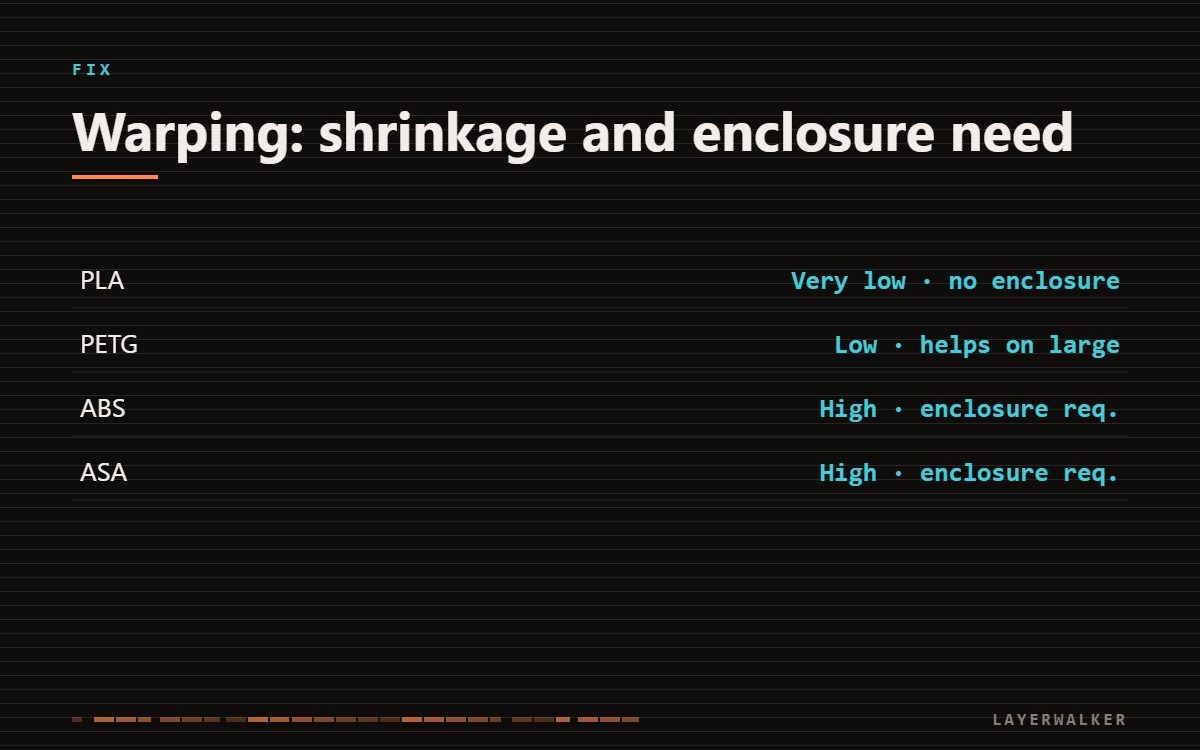
Different materials warp by wildly different amounts. PLA barely does. ABS and ASA warp so readily that printing them open is close to pointless for anything larger than a few centimetres.
| Property | Value |
|---|---|
| PLA | very low, enclosure not needed |
| PETG | low, enclosure helpful for large parts |
| ABS | high, enclosure required |
| ASA | high, enclosure required |
| PA / Nylon | high, plus severe moisture sensitivity |
| PC | very high, needs a hot chamber |
Where to buy


Multifunctional 3D Printer Enclosure Ventilation Eliminate Odors Tent Cover
3D print warping: the fix is heat, in this order
Corners curl up, the part detaches at the edges partway through
The lower layers cool and contract while the upper layers are still hot
- Close the machine. If it has no enclosure, a cardboard box over the top makes a measurable difference on ABS and ASA.
- Remove draughts. A vent or an open window blowing across the plate will beat any other measure you take.
- Raise the bed temperature 5-10 degC.
- Turn part cooling down. For ABS and ASA it should be at or near zero.
- Add a brim of 5-8 mm. This buys mechanical hold while the part is most vulnerable.
- Round or chamfer sharp corners in the model. Stress concentrates at sharp corners and that is where lifting starts.
Why turning the fan down feels wrong but works
Cooling improves overhangs and small details, so the instinct is to leave it on. For high-shrinkage materials that cooling is exactly what creates the temperature gradient causing the warp. Accept slightly softer detail on ABS and ASA in exchange for a part that stays on the plate.
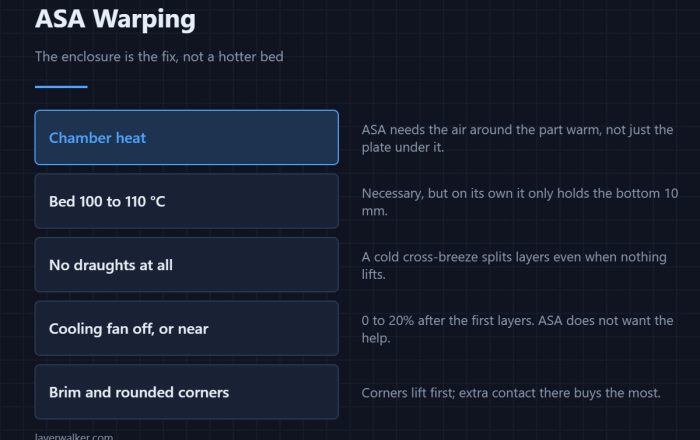
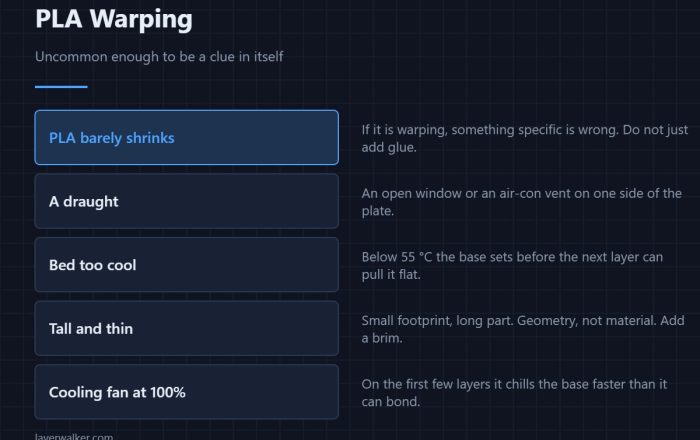
Two material-specific cases worth reading separately: PLA warping, which is uncommon enough to point at a draught or a cold bed, and ASA warping, which needs a warm chamber rather than a hotter plate.
Design changes that help
Large flat bottoms warp the most. If you control the model, break a big flat base into a lattice, add a chamfer at the base, or split the part and join it after printing. A part that never had a 200 mm flat face cannot warp along one.

LayerWalker
Print defect diagnosis, calibration procedures and parts that actually fit. Corrections welcome through the contact page.