Brim vs raft: which one and when
LayerWalker is a participant in the Amazon Services LLC Associates Program. We may earn a commission when you buy through links on our site, at no extra cost to you.
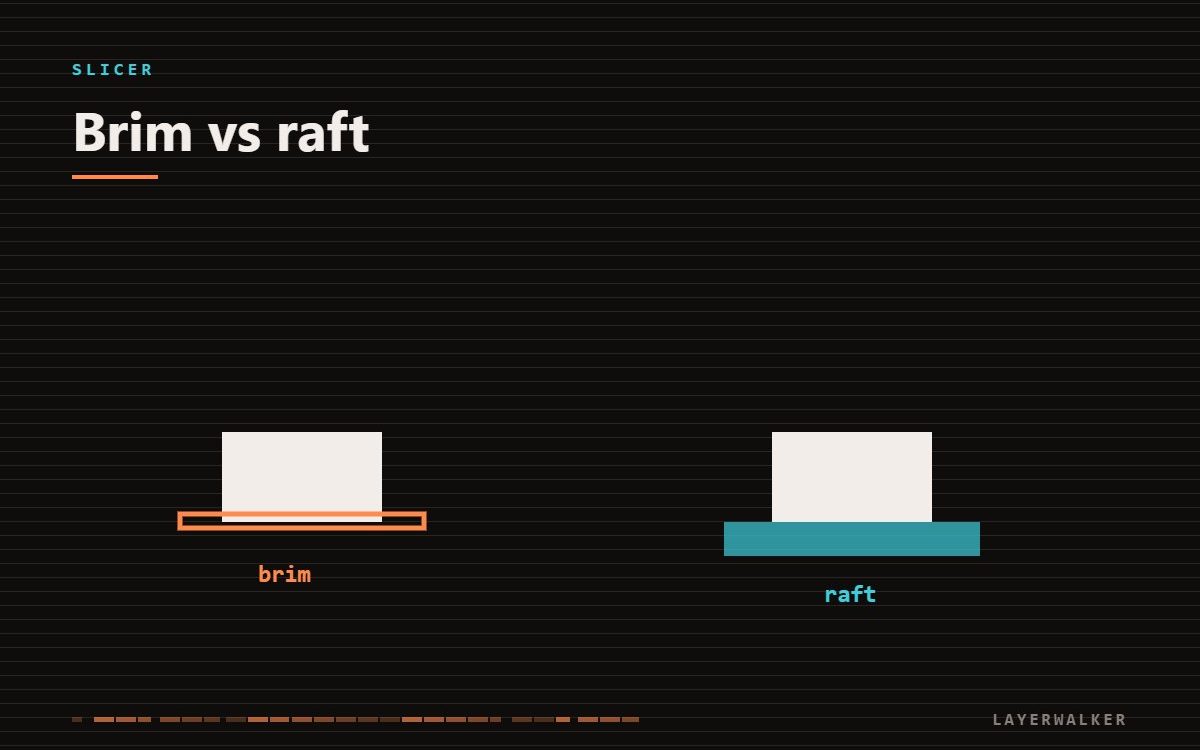
Use a brim. It costs a few grams, fixes most adhesion and warping problems, and peels off in one piece. A raft wastes material, adds print time and leaves a rough bottom — it is a workaround for a plate you should fix.
| Property | Value |
|---|---|
| Material use | brim minimal, raft significant |
| Print time added | brim seconds, raft many minutes |
| Bottom surface | brim unaffected, raft rough |
| Removal | brim peels off, raft can be stubborn |
| Warping resistance | brim good, raft moderate |
| Fixes an uneven plate | brim no, raft yes |
Brim vs raft: when a brim is the right answer
Small footprint parts that could tip. Tall thin parts with leverage. Sharp-cornered parts in materials that warp. Anything printed in ABS or ASA. Five to eight millimetres is enough for most cases.
Increase width for high-shrinkage materials rather than adding a raft.
The narrow case for a raft
A raft gives the model a printed surface to sit on instead of the plate, so it hides plate imperfections. That makes it useful on a damaged sheet, on a plate you cannot get level, or for materials that will not stick to your plate at all and where you have no better plate available.
All three of those are problems worth fixing directly. A raft is what you use while you wait for the replacement sheet to arrive.
Do not use a brim to hide a dirty plate
If parts only stick with a brim, the plate needs washing or the Z offset needs setting. A brim buys mechanical hold at the edges and leaves the middle of the first layer just as badly attached.

LayerWalker
Print defect diagnosis, calibration procedures and parts that actually fit. Corrections welcome through the contact page.