3D Printers for TPU: Direct Drive, Slow Feeds and No Filament System
LayerWalker is a participant in the Amazon Services LLC Associates Program. We may earn a commission when you buy through links on our site, at no extra cost to you.
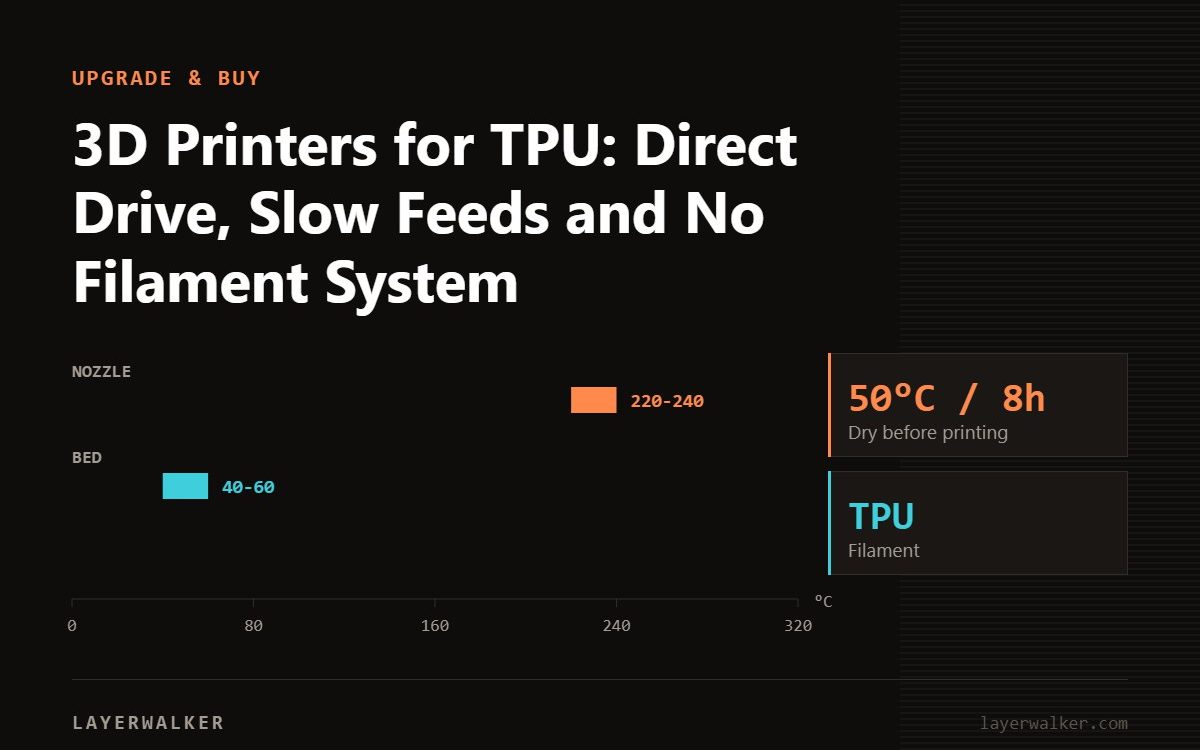
TPU is decided by the extruder, not the printer. A direct-drive extruder with a fully constrained path from gears to nozzle prints 95A TPU on almost any current machine at 30 to 60 mm/s. Bowden extruders cannot. Four-slot filament systems (AMS, CFS, ACE) do not feed TPU; it goes through the external spool holder, or the Bambu AMS HT. The Bambu A1, Creality Ender-3 V3 KE and Bambu P1S all print 95A TPU well; softer than 90A wants a dedicated flexible-filament extruder.
Where to buy


What TPU asks of the printer
| Requirement | Why | Look for |
|---|---|---|
| Direct drive | Soft filament buckles in a Bowden tube | All current machines; avoid legacy Enders |
| Constrained filament path | TPU escapes gaps between gears and melt zone | Extruders designed for flexibles; most modern units |
| Slow speed | TPU cannot be pushed fast | 30 to 60 mm/s for 95A; slower for softer |
| Minimal retraction | Retraction stretches TPU and clogs | Short or zero retraction, low travel |
| Bypass the feeder | AMS, CFS and ACE jam on TPU | External spool holder or AMS HT |
| Dry filament | TPU absorbs moisture fast | Dryer before printing |
Shore hardness matters more than the printer
| Shore | Feel | Printability on stock direct drive |
|---|---|---|
| 98A to 95A | Firm, like a shoe sole | Good; most printers |
| 90A to 85A | Flexible | Possible slowly; some extruders slip |
| Below 85A | Very soft | Needs a flexible-specific extruder; not a stock-printer job |
Printers that handle TPU
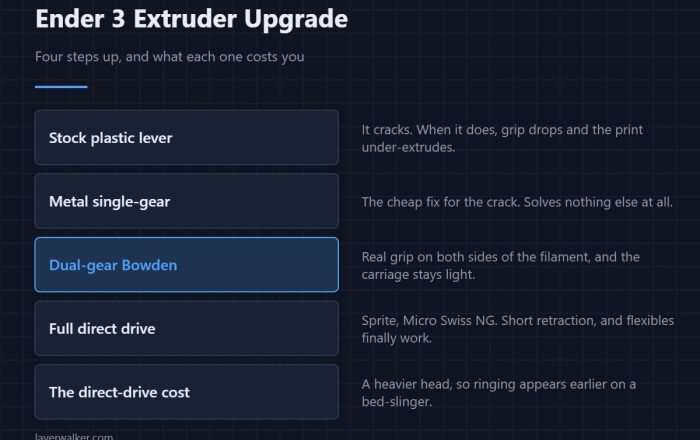
- Bambu A1 / A1 mini: direct drive, tuned TPU profiles, external spool. The AMS lite does not take TPU.
- Creality Ender-3 V3 KE / V3: Sprite direct drive prints 95A well at low speed.
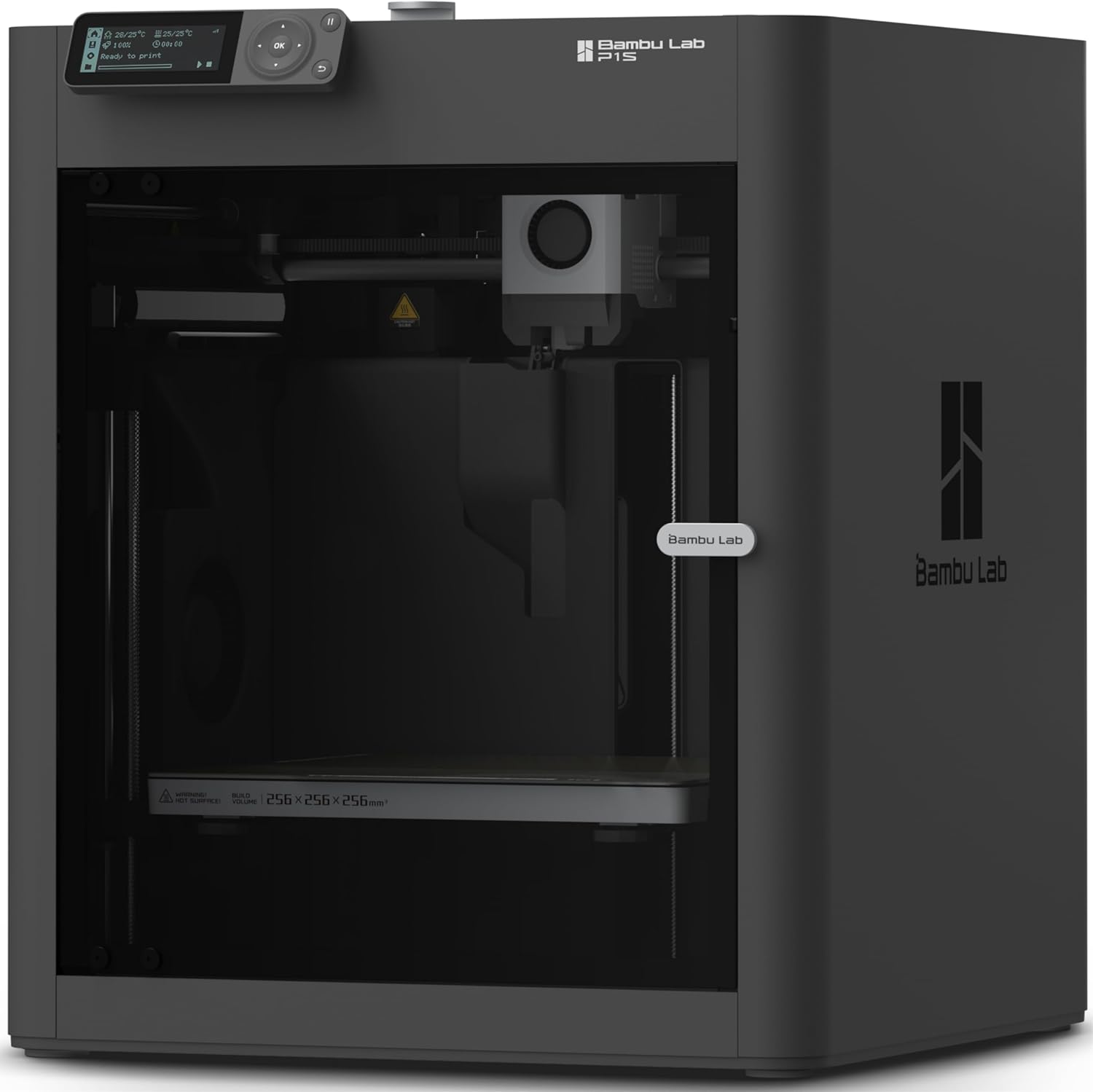
- Bambu P1S / P2S: 95A through the external spool; the AMS HT adds a heated TPU-capable slot on the P2S.
- Flashforge AD5M: Flashforge lists TPU as supported; slow it down.
Settings and filament
See TPU filament for temperatures and retraction, Creality TPU for a specific brand, and direct drive vs Bowden for why old printers fail at it.
The units in the box
The listings are the Bambu A1, the Ender-3 V3 KE and the Bambu P1S.
3D printer for TPU FAQ
Can the AMS feed TPU?
Four-slot units cannot; the AMS HT can.
Why does TPU string so much?
Moisture and retraction; dry it and cut retraction.

LayerWalker
Print defect diagnosis, calibration procedures and parts that actually fit. Corrections welcome through the contact page.