TPU Printer Filament: Shore 95A Explained and How to Print Flexible Parts
LayerWalker is a participant in the Amazon Services LLC Associates Program. We may earn a commission when you buy through links on our site, at no extra cost to you.
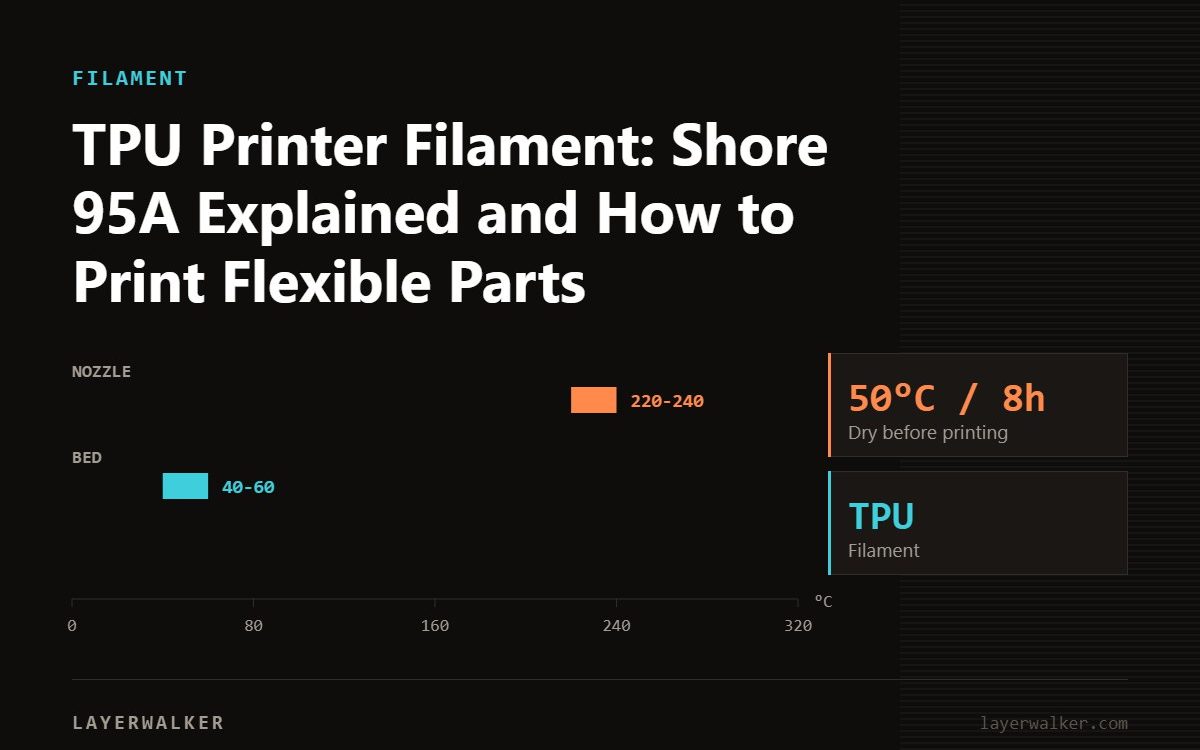
For a first flexible filament buy TPU rated Shore 95A: it is soft enough for phone cases, gaskets and grips but firm enough to push through a direct-drive extruder without buckling. Print it slow (20 to 40 mm/s on a Bowden or 60 to 80 mm/s on a good direct drive), dry, with minimal retraction and no Z-hop.
TPU, thermoplastic polyurethane, is the rubber of 3D printing. A printed TPU part stretches, bounces back and takes abuse that would shatter PLA. The catch is that a soft filament behaves like pushing a rope: any gap between the extruder gear and the hotend, any long Bowden tube, any fast retraction, and the filament folds instead of feeding. Almost all TPU frustration is mechanical, not thermal, and it is solved by choosing the right hardness and slowing down.
Where to buy
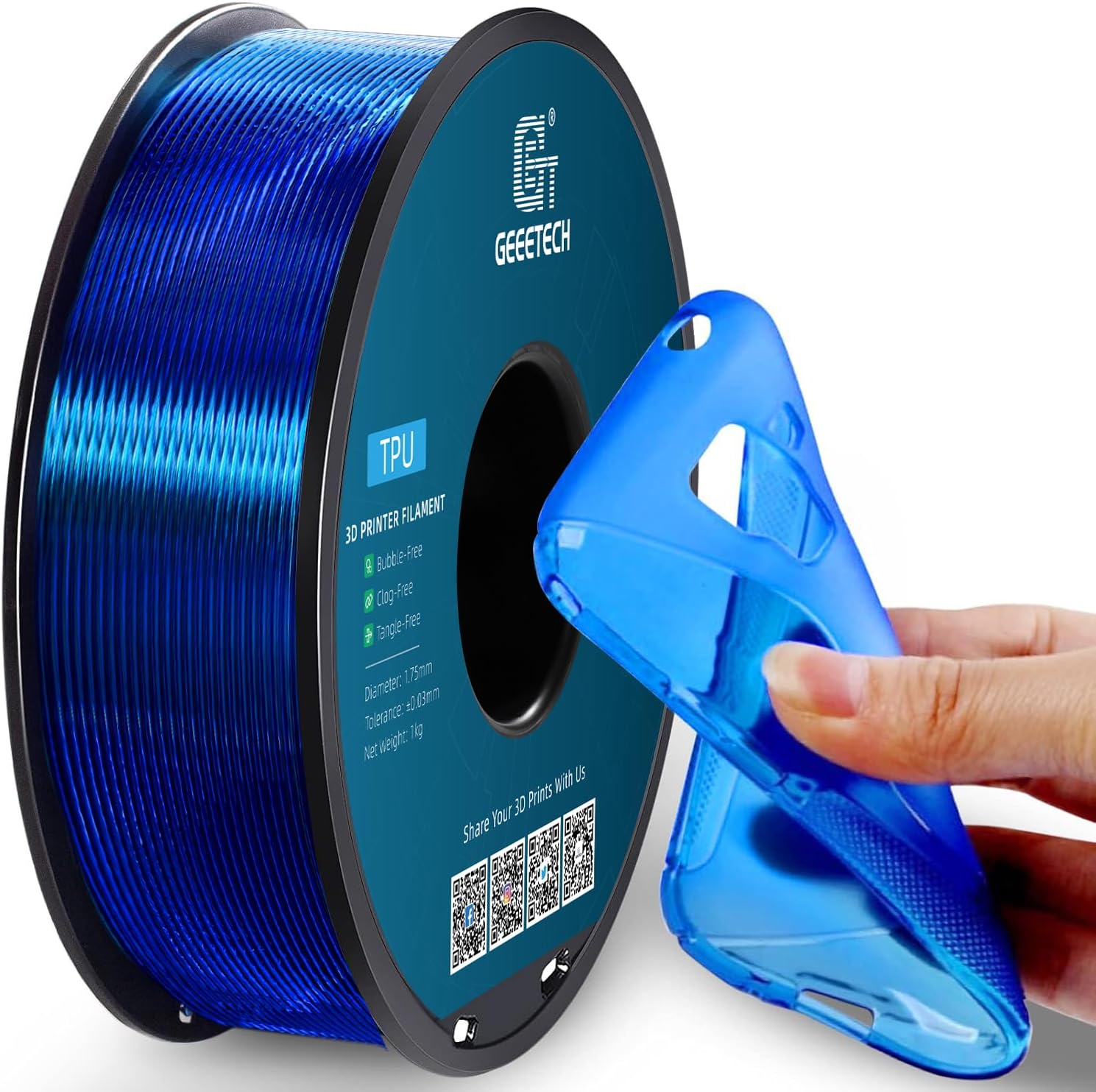
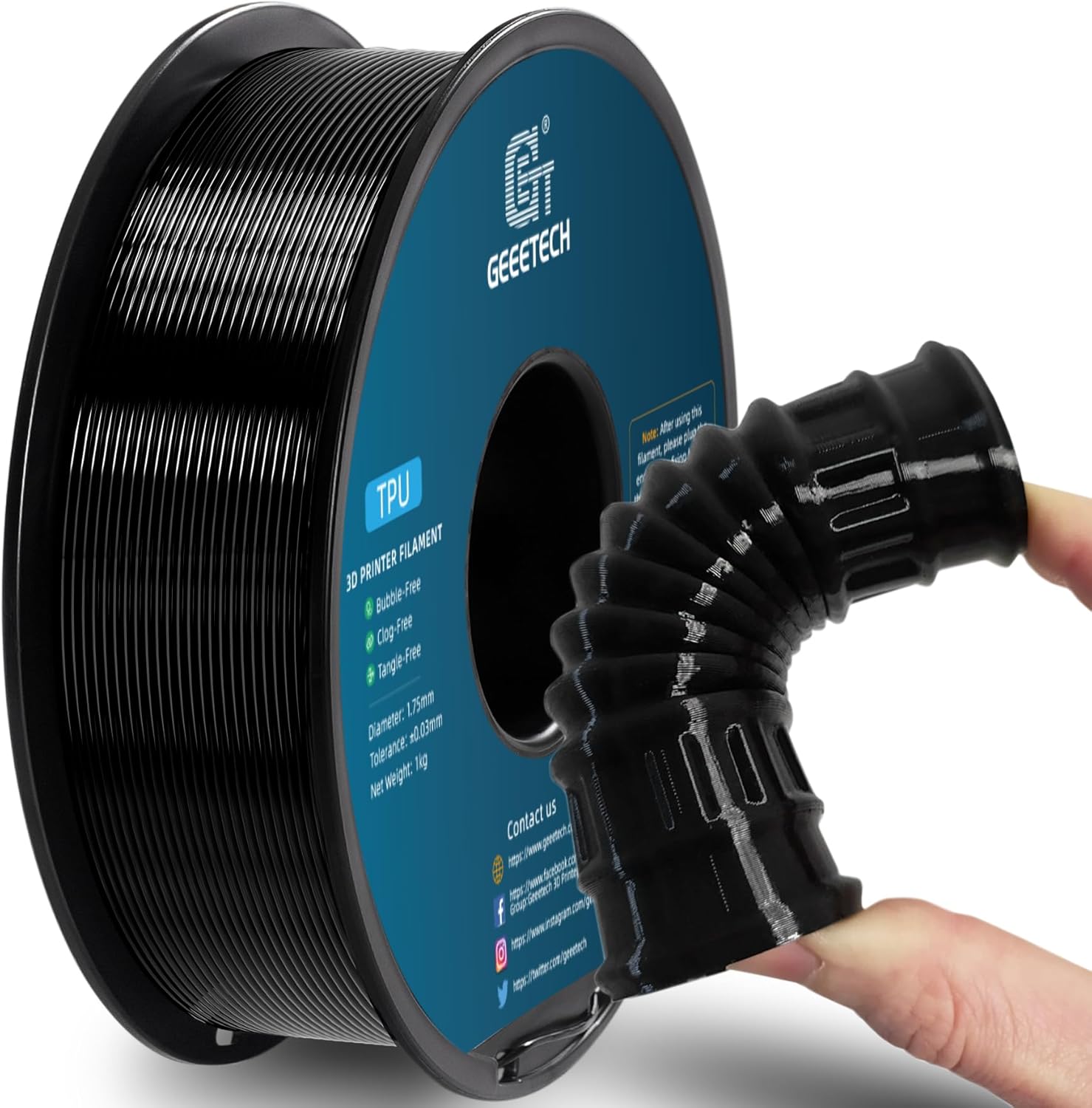
Geeetech TPU Filament 1.75mm, Shore 95A Flexible 3D Printer Filament with High Elasticity, 1KG (2.2lbs) Spool, Dimensional Accuracy ±0.03mm, Fits Most FDM Printers (Black)

Reading the Shore number
Flexibility is rated on the Shore A scale. 95A is the stiffest common TPU and the easiest to print; it feels like a shoe sole. 85A is noticeably softer, prints only on direct-drive extruders with a tight filament path, and needs speeds under 30 mm/s. Below 80A you are in specialist territory. If a listing does not state a Shore hardness, assume 95A and read reviews to confirm.
What to look for on the spool
- Shore 95A stated clearly, plus a temperature range. Most 95A prints at 220 to 235 °C.
- Tolerance ±0.03 mm. Oversize TPU jams in the PTFE tube; undersize TPU slips on the drive gear.
- Vacuum packed. TPU is as hygroscopic as nylon. Wet TPU strings badly, pops in the nozzle and prints with a foamed, matte surface.
- Small spools for colour variety. 250 g spools cost more per kilogram but you rarely use a full kilo of one colour in TPU.
The spools in the box
Geeetech’s 95A TPU is the reference budget flexible: consistent diameter and a wide colour range, listed twice for two colour sets. SUNLU’s 250 g eight-pack is the sampler for gaskets, feet and bumpers where each job needs a few grams of a specific colour and a full spool would sit absorbing water for a year.
The settings that make TPU work
- Dry it first: 50 to 55 °C for 4 to 6 hours. Wet TPU is the single biggest cause of failed flexible prints; see the filament drying guide for times by material.
- Speed: 20 to 40 mm/s on a Bowden printer, 50 to 80 mm/s on a direct drive with a constrained path. Keep travel speed normal.
- Retraction: 0.5 to 1.5 mm on direct drive, 2 to 4 mm on Bowden, at 20 to 30 mm/s. Turn Z-hop off; the pause lets the nozzle ooze.
- Temperature 220 to 235 °C, bed 40 to 60 °C on bare PEI or a glue-stick layer. TPU sticks well; too hot a bed and it fuses to smooth PEI.
- Cooling 30 to 60 %. Some fan is needed for bridges and overhangs; none is needed for the first layers.
- Extrusion multiplier slightly high, 1.02 to 1.05, and disable coasting and wipe. Gappy walls in TPU are almost always the extruder slipping, not a flow setting.
When TPU is the wrong answer
Parts that need to hold a precise dimension: TPU compresses, so a 10 mm peg prints at 10 mm and then squeezes to fit anything from 9.6 to 10.2 mm. Anything load-bearing over time: TPU creeps. And if your printer is a stock Bowden machine with a loose extruder arm, budget for a direct-drive kit before you budget for more TPU.
TPU printer filament FAQ
Can a Bambu Lab AMS feed TPU?
No, the AMS is not rated for flexible filament. Feed 95A from the external spool holder directly into the toolhead; softer grades are not recommended.
Why does my TPU string so much?
Water first, retraction second, temperature third. Dry the spool before you touch a setting.
Is TPU the same as TPE?
TPE is a broader family; TPU is the version formulated for filament. Spools sold as TPE are usually softer and harder to print.

LayerWalker
Print defect diagnosis, calibration procedures and parts that actually fit. Corrections welcome through the contact page.