Creality K1C Review: The Carbon-Fibre K1
LayerWalker is a participant in the Amazon Services LLC Associates Program. We may earn a commission when you buy through links on our site, at no extra cost to you.
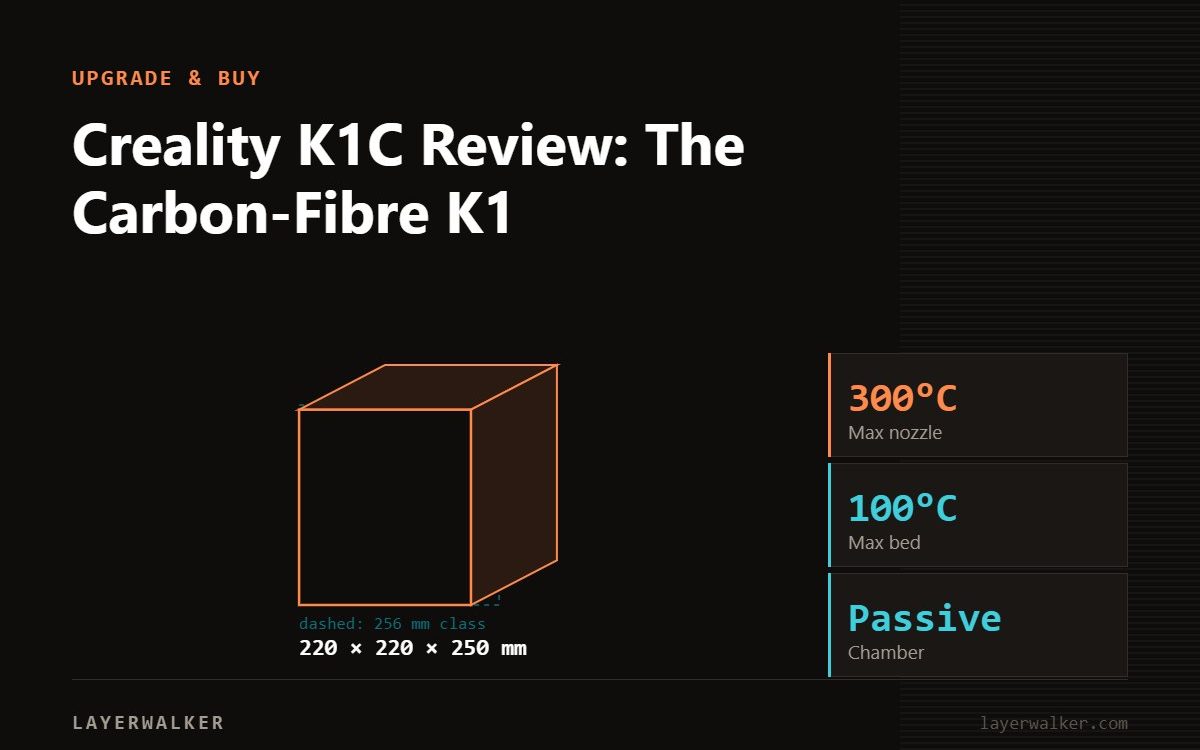
The K1C is the abrasive-filament version of the K1: 220 x 220 x 250 mm, 300 degC nozzle, 100 degC bed, up to 600 mm/s and 20,000 mm/s2, 12.4 kg, with a tri-metal hardened-steel-tipped Unicorn quick-swap nozzle, an activated carbon filter, an AI camera and a quiet mode under 45 dB. Buy it over the plain K1 if carbon-fibre filament is on your list, which is exactly what the C is for.
This assessment is from Creality’s published specification rather than a hands-on test here. The K1C is a narrow, sensible product: take the K1 and fix the two things that stop an enclosed CoreXY from running filled filament, namely the nozzle and the fumes.
Where to buy


Specification
| Spec | K1C |
|---|---|
| Build volume | 220 x 220 x 250 mm |
| Max nozzle temp | 300 degC |
| Max bed temp | 100 degC |
| Max speed / acceleration | 600 mm/s / 20,000 mm/s2 |
| Nozzle | Tri-metal Unicorn quick-swap, hardened steel tip |
| Plate | Flexible PEI |
| Filtration | Activated carbon filter |
| Camera | AI camera |
| Noise | Under 45 dB in silent mode |
| Size / weight | 355 x 355 x 482 mm, 12.4 kg |
| Display | 4.3 inch touchscreen |
What the C actually buys you
The nozzle. It is a tri-metal design with a hardened steel tip on a copper alloy body and a titanium alloy heatbreak, and it swaps quickly. That combination is the correct answer to abrasive filament: hardened steel survives it, copper moves heat, and the titanium heatbreak limits heat creep. On a brass nozzle, carbon-filled filament will visibly widen the orifice within tens of hours; see our page on hardened nozzles for what that looks like in practice.
The filter. An enclosed printer running filled or styrenic filament concentrates fumes, and an activated carbon stage is the minimum sensible response if the machine shares a room with you.
Everything else is K1: same 220 x 220 x 250 mm envelope, same 600 mm/s ceiling, same 20,000 mm/s2. Our K1 vs K1C comparison is the direct read if you are choosing between them.
The honest limitations
The plate is small for the class. 220 x 220 x 250 mm is noticeably tighter than the 256 mm cube that has become the norm, and much tighter than the K1 Max at 300 mm cubed. If your models are large, that is the first thing you will hit.
The bed tops out at 100 degC, which is enough for ABS and ASA in an enclosed chamber but is not generous. And there is no native multi-material system on the K1 family; Creality’s CFS belongs to the K2 and Hi machines.
Quiet mode under 45 dB is a real figure and a real feature, but note it is a mode. Running at 600 mm/s will not be quiet.
Who should buy it
Buy the K1C if you want an enclosed CoreXY that runs PLA-CF, PETG-CF and similar filled filaments out of the box without a nozzle purchase, and 220 x 220 x 250 mm is enough space. Buy the K1 Max if you need 300 mm cubed. Step up to the K2 Plus if you want 350 mm cubed, a 350 degC nozzle and CFS multi-colour. Our K1C overview and K1C vs K1 Max cover both directions.
Creality K1C Review FAQ
What is the difference between the K1 and the K1C?
The nozzle and the filtration. The C ships with a tri-metal hardened-steel quick-swap nozzle and an activated carbon filter, for abrasive filament.
Can the K1C print ABS?
Yes. It is enclosed, with a 300 degC nozzle and a 100 degC bed.
Does the K1C support multi-colour?
Not natively. Creality’s CFS is for the K2 and Hi machines.
Is it really under 45 dB?
That is the quoted figure for silent mode, not for printing at 600 mm/s.
An enclosed chamber is a feature with a ceiling. Push past it and the printer says so with Creality K1 error 2511, which protects the electronics under the print rather than the print itself.

LayerWalker
Print defect diagnosis, calibration procedures and parts that actually fit. Corrections welcome through the contact page.