PETG-CF: The Everyday Engineering Filament, and What It Asks of Your Printer
LayerWalker is a participant in the Amazon Services LLC Associates Program. We may earn a commission when you buy through links on our site, at no extra cost to you.
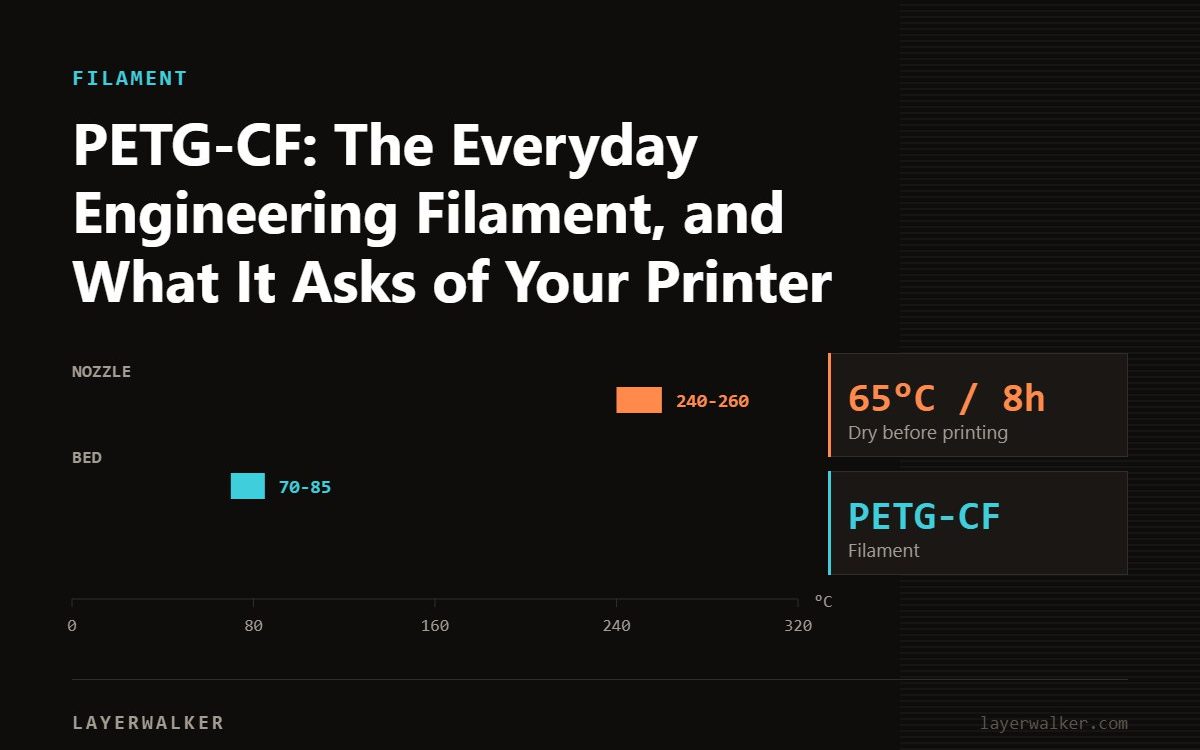
PETG-CF is the carbon-fibre filament most people should start with: it prints on an open printer at 240 to 260 °C, stays flat where plain PETG warps, and comes out stiff and matte. It needs a hardened steel nozzle and a dry spool, and it trades some of PETG’s toughness for that stiffness.
Plain PETG is tough but a little floppy and prone to warping on large flat parts. Add 15 to 20 % chopped carbon fibre and both problems go: the part is noticeably stiffer, shrinks less as it cools, and has the matte, layer-hiding surface that makes printed brackets look manufactured. It keeps PETG’s heat tolerance and chemical resistance and prints without an enclosure, which is why PETG-CF has become the default engineering filament for anyone who does not need nylon’s temperature range.
Where to buy



Official CREALITY PETG Filament, 3D Printer Filament 1.75mm 1KG Black
What it is for
- Brackets, mounts and frames that must stay flat and stiff.
- Enclosures and covers that see moderate heat.
- Jigs and fixtures where dimensional stability matters.
- Anything you would print in PETG but wanted stiffer and better-looking.
What it is not for
Parts that need impact toughness; the fibre makes it a little more brittle than unfilled PETG. Parts above about 75 °C; that is PA-CF territory. Fine detail; the fibre and matte finish soften small features.
What to check on the spool
- Fibre content. 15 to 20 % is typical; higher is stiffer and more abrasive.
- Tolerance ±0.03 mm.
- Vacuum sealed. PETG-CF absorbs water like PETG; wet spools string and print weak.
- Recommended nozzle stated as 0.4 mm hardened or 0.6 mm; makers who say so have tested it.
The spools in the box
Flashforge’s carbon-fibre PETG is the reference PETG-CF for this box: stated fibre content, tight tolerance, and documented settings. The other two spools listed are plain PETG from Elegoo and Creality, included as the unfilled comparison point for parts that need toughness over stiffness; if your part must survive impact, print those instead.
Settings that work
- Hardened steel nozzle, 0.4 or 0.6 mm. Brass wears in one spool; see brass versus hardened.
- Nozzle 240 to 260 °C; 5 to 10 °C above your plain PETG setting.
- Bed 70 to 85 °C on textured PEI. Releases cleanly when cool.
- Fan 30 to 50 %, as for PETG.
- Speed 10 to 20 % lower than plain PETG.
- Dry at 65 °C for 6 hours before the first print and feed from a dry box.
PETG CF FAQ
PETG-CF or PLA-CF?
PETG-CF for anything that sees heat or lives outdoors in shade. PLA-CF for indoor jigs and models where ease of printing matters most.
Can I print PETG-CF on a stock Ender 3?
Yes, with a hardened nozzle and a dry spool. The stock hotend reaches 250 °C.
Does it need an enclosure?
No. That is its main advantage over PA-CF.

LayerWalker
Print defect diagnosis, calibration procedures and parts that actually fit. Corrections welcome through the contact page.