Prusa CORE One Review: 55 °C Chamber, Loadcell
LayerWalker is a participant in the Amazon Services LLC Associates Program. We may earn a commission when you buy through links on our site, at no extra cost to you.
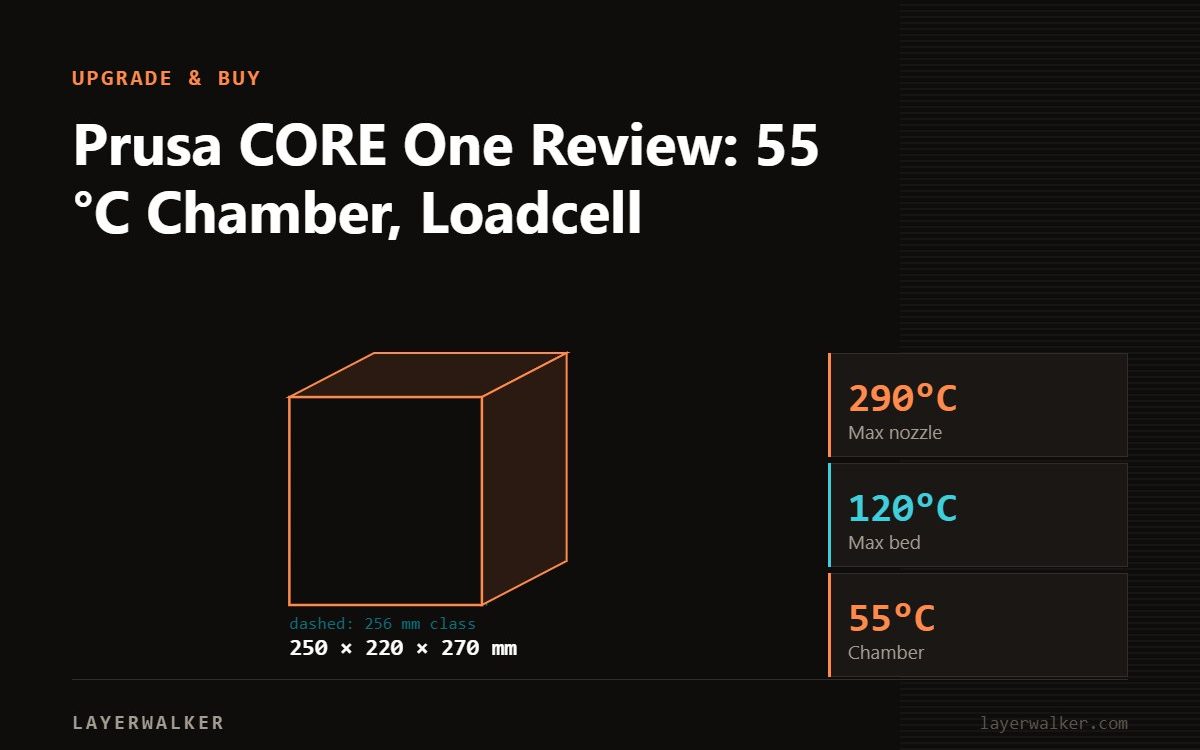
The CORE One+ is Prusa’s enclosed CoreXY, and the heated chamber is the reason to buy it: 55 degC with Smart Ventilation, on a 250 x 220 x 270 mm plate (14.9 litres) with a 290 degC Nextruder and a 120 degC bed. It is 22.5 kg in a 415 x 444 x 555 mm footprint, has a loadcell for fully automatic first-layer calibration, an integrated nozzle wiper, and takes MMU3 for five filaments or INDX for eight. Note that Prusa’s plain CORE One page now resolves to the Gen 2 CORE One+.
This assessment is from Prusa’s own technical parameters rather than a workshop test. The CORE One+ is the machine that moved Prusa from the i3 lineage to CoreXY, and it is worth reading the spec sheet closely because several of the interesting parts are not headline numbers.
Where to buy


Original Prusa CORE One+ DIY Enclosed High-Speed CoreXY 3D Printer Kit

Specification
| Spec | CORE One+ (Gen 2) |
|---|---|
| Build volume | 250 x 220 x 270 mm (14.9 L) |
| Max nozzle temp | 290 degC |
| Max heatbed temp | 120 degC |
| Max chamber temp | 55 degC, Smart Ventilation |
| Layer height | 0.05-0.30 mm |
| Extruder | Nextruder direct drive, 10:1 planetary gearbox, E3D V6 compatible with adapter |
| Nozzle | High-flow Prusa brass CHT 0.4 mm, quick-swap system |
| Hotend | All-metal, aluminium heatsink |
| Calibration | Loadcell sensor, fully automatic first layer; Input Shaper |
| Sensors | Two filament sensors, nozzle wiper |
| Display | 3.5 inch 65k colour, touch |
| Connectivity | Ethernet, Wi-Fi, Prusa Connect |
| Multi-material | MMU3 (5 filaments) or INDX (up to 8) |
| Options | HEPA filtration, in-chamber camera |
| Size / weight | 415 x 444 x 555 mm, 22.5 kg |
| Power | 240 W PSU with Power Panic; PLA 90 W, ABS 110 W |
The chamber, and Smart Ventilation
55 degC of actively managed chamber is the headline. What makes it more interesting than a number is the ventilation logic: the printer monitors chamber temperature continuously and adjusts, rather than simply trapping heat. That matters because PLA hates a hot chamber as much as ABS needs one, and a single enclosed machine has to do both.
Paired with a 120 degC bed and an all-metal hotend, that puts ABS, ASA, HIPS and PA on the supported list, with PLA, PETG, Flex, PVA, PC, PP, CPE and PVB as the everyday set. 290 degC is the ceiling, so the very high temperature blends are out; that is a real difference from machines quoting 350 degC.
Details that matter more than they sound
The loadcell. First-layer calibration is done by measuring force at the nozzle rather than probing with a separate sensor, which is why Prusa can call it fully automatic. If you have ever spent an evening on Z-offset and squish, this is the feature that removes that job.
The nozzle wiper. It cleans filament off the nozzle before printing, which is the fix for the stray blob that lands in the middle of an otherwise perfect first layer.
E3D V6 compatibility with an adapter. That is unusual and useful: it means the hotend is not a closed ecosystem, and it fits Prusa’s broader stance on repairability and parts availability.
Quick-swap nozzles and a 10:1 planetary gearbox on the Nextruder round it out. For abrasive filament you still want a hardened nozzle, since the standard one is brass.
Where it sits against the alternatives
Against Prusa’s own MK4S, the CORE One+ trades an open frame for CoreXY motion and the heated chamber, at the price of 22.5 kg instead of 7 kg. Against the enclosed machines from Bambu and Creality at similar money, Prusa’s pitch is repairability, open documentation and long parts support rather than top speed; those competitors quote higher speeds and, in some cases, hotter nozzles.
Read MK4S vs CORE One for the in-range decision, and CORE One vs Bambu X1C for the cross-brand one.
Prusa CORE One Review FAQ
How hot does the chamber get?
55 degC, managed by Smart Ventilation rather than passively trapped.
Can it print ABS and ASA?
Yes. Those are on Prusa’s advanced materials list, alongside HIPS and PA.
How many filaments for multi-material?
Five with MMU3, up to eight with INDX.
Is the CORE One the same as the CORE One+?
Prusa’s CORE One product page now resolves to the Gen 2 CORE One+, so check which revision a listing is offering.

LayerWalker
Print defect diagnosis, calibration procedures and parts that actually fit. Corrections welcome through the contact page.