Prusa XL Review: Real Tool Changing at 360 mm
LayerWalker is a participant in the Amazon Services LLC Associates Program. We may earn a commission when you buy through links on our site, at no extra cost to you.
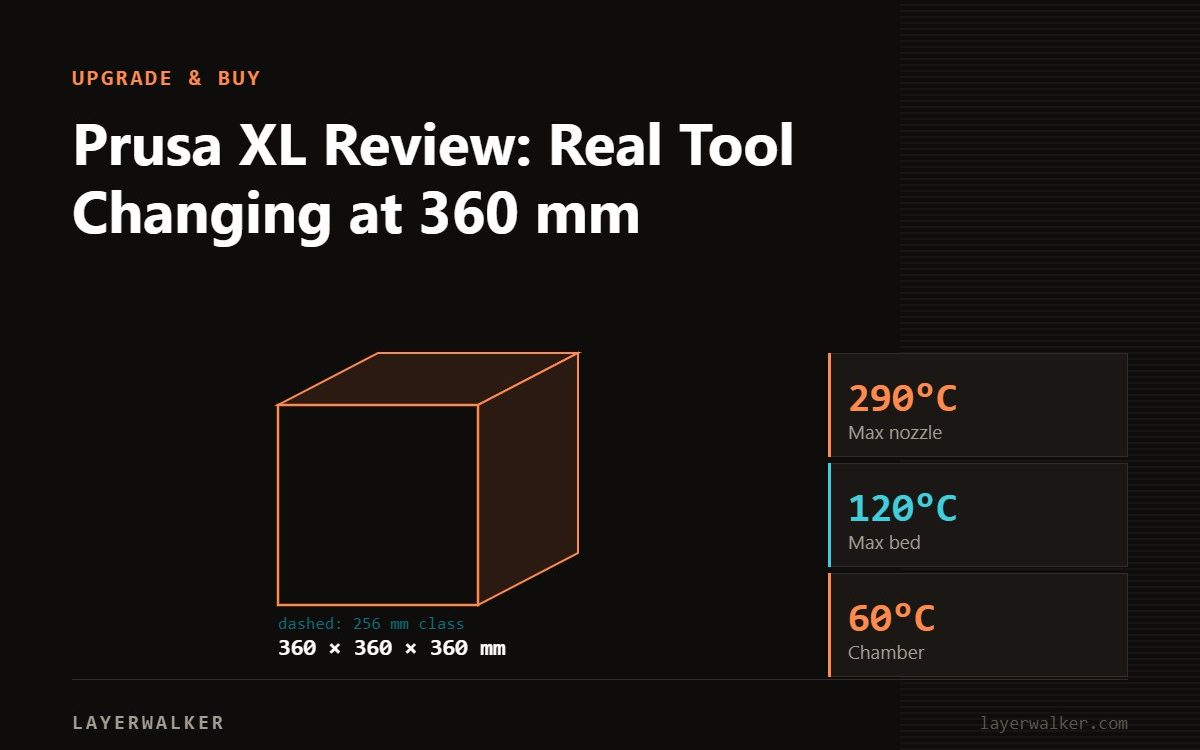
The Prusa XL is a tool-changing CoreXY with 360 x 360 x 360 mm of build volume, 46.7 litres, and one to five independent toolheads. That is the feature: real tool changing, not a filament changer, so each material has its own hotend and there is no purge between changes. It is a big machine, roughly 700 x 900 x 720 mm and around 30 kg, with a 290 degC nozzle and a chamber that reaches 50 degC with the enclosure or 60 degC with the heater.
This assessment is drawn from Prusa’s published specifications rather than a workshop test. The XL is the only desktop machine in common use that solves multi-material by changing the whole toolhead, and understanding that distinction is most of the buying decision.
Where to buy


Specification
| Spec | Prusa XL |
|---|---|
| Build volume | 360 x 360 x 360 mm (46.7 L) |
| Toolheads | 1 to 5, independently changed |
| Max nozzle temp | 290 degC |
| Motion | CoreXY with 1.5 mm GT belts |
| Motion quality | Input Shaper plus Phase Stepping |
| Chamber | 50 degC with enclosure, 60 degC with chamber heater |
| Physical size / weight | Around 700 x 900 x 720 mm, about 30 kg |
Tool changing versus filament changing
A filament changer such as an AMS or a CFS feeds several spools into one hotend. Every change means purging that hotend: heat, push the old material through, wipe, resume. It works, it wastes filament, and it limits you to materials that print at similar temperatures.
A tool changer swaps the entire toolhead. Each material keeps its own nozzle at its own temperature, so PLA and a dissolvable support, or PETG and TPU, coexist without compromise. There is no purge block. For soluble support work in particular, that is the difference between a technique and a chore.
The cost is hardware: five toolheads is five hotends to buy, maintain and calibrate. Prusa’s Phase Stepping and Input Shaper implementations are there to keep a heavy moving gantry accurate, which is the engineering problem a machine this size creates.
Size, and what it demands
46.7 litres is a lot of printable space, and it is genuinely useful for large single-piece parts. Be realistic about the room, though: roughly 700 x 900 x 720 mm of footprint and around 30 kg is furniture, not an appliance, and you want it on something that does not transmit vibration.
Chamber temperature is the other planning item. 50 degC with the enclosure covers ABS and ASA reasonably; 60 degC with the heater is the configuration for the more demanding materials. Neither is included by default, so price the machine as you intend to use it. Our large-format guide covers the general trade-offs of printing at this scale.
Who should buy it
Buy the XL if multi-material with dissolvable supports is central to your work, or if you need 360 mm cubed with Prusa’s software and repairability. It is also a sensible choice where a machine has to run for years with parts available, which is Prusa’s long-standing strength.
Do not buy it for speed or for colour. A 600 mm/s CoreXY with a filament changer is faster and cheaper for multi-colour models. And if you want an enclosed Prusa without the size, the CORE One+ gives 250 x 220 x 270 mm with a 55 degC heated chamber as standard. Our XL vs H2D comparison covers the other route to multi-material, and the XL overview has more detail.
Prusa XL Review FAQ
How many toolheads can the XL take?
Up to five, changed independently.
Does it waste filament on colour changes?
No purge block, because each material keeps its own nozzle. That is the main advantage over a filament changer.
Can it print ABS?
Yes with the enclosure at 50 degC, and better with the chamber heater at 60 degC.
Is it faster than a Bambu H2D?
No. The XL’s advantage is tool changing and build volume, not speed.

LayerWalker
Print defect diagnosis, calibration procedures and parts that actually fit. Corrections welcome through the contact page.