Bambu Lab H2D Review: Dual Nozzle and 350 °C
LayerWalker is a participant in the Amazon Services LLC Associates Program. We may earn a commission when you buy through links on our site, at no extra cost to you.
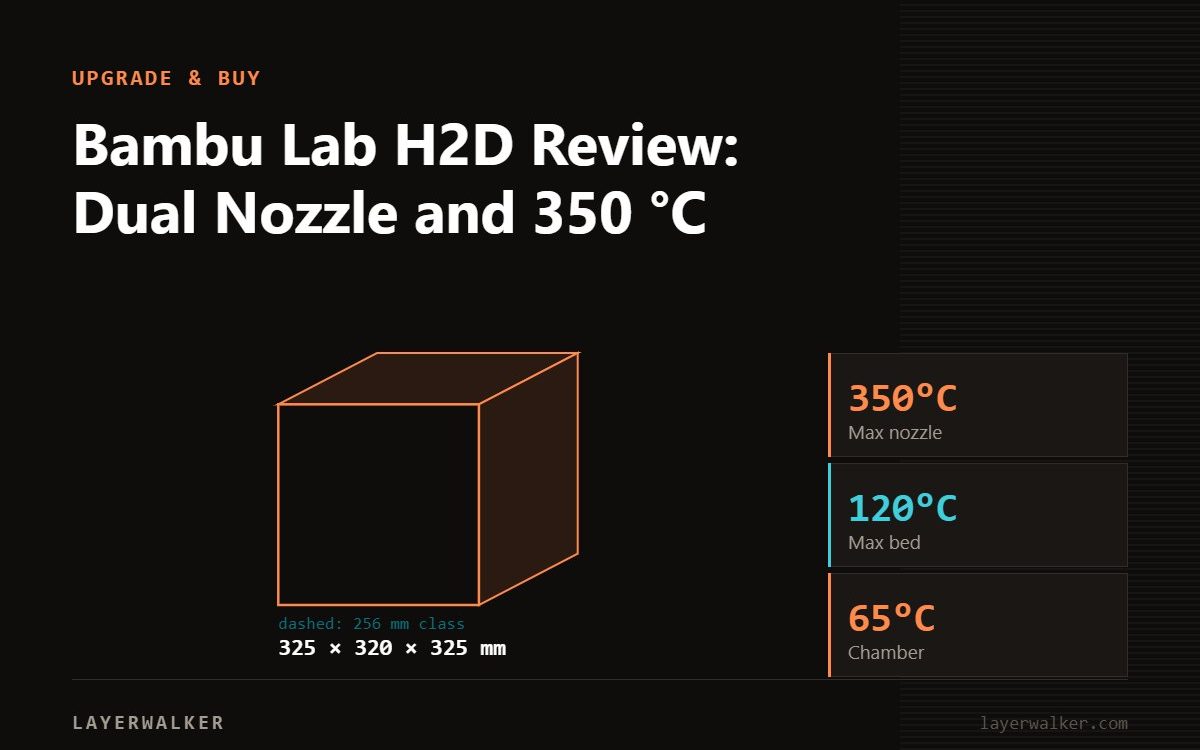
The H2D is the top of the Bambu range and the only one that reaches PPS-CF and PPS-GF. Dual nozzles held under 25 microns apart, 350 degC at the nozzle, a 120 degC plate, a 65 degC actively heated chamber, 600 mm/s, and 325 x 320 x 325 mm single-nozzle. It also has flame sensors and a proper filtration stack. Buy it if you need two materials at once or high-temperature engineering filament; otherwise the P2S covers most work for far less.
This assessment is from Bambu’s published comparison and specification pages rather than a hands-on test here. The H2D is a different class of machine from the rest of the range, and it is worth being precise about which of its features you would actually use.
Where to buy


Specification
| Spec | H2D |
|---|---|
| Build volume, single nozzle | 325 x 320 x 325 mm |
| Build volume, dual nozzle | 300 x 320 x 320 mm |
| Total addressable volume | 350 x 320 x 320 mm |
| Max nozzle temp | 350 degC |
| Max plate temp | 120 degC |
| Chamber | 65 degC, actively heated |
| Max speed | 600 mm/s |
| Nozzle offset | Under 25 microns between the two nozzles |
| Air filter | G3, H12, coconut shell carbon, VOC and particulate |
| Cameras | Live 1920 x 1080, nozzle 1920 x 1080, toolhead 1920 x 1080, BirdsEye 3264 x 2448 on the laser edition |
| Display | 5 inch 720 x 1280 touchscreen |
| Safety | Flame sensors |
| Exclusive materials | PPS-CF, PPS-GF |
Dual nozzle is the reason to buy it
Two independent nozzles change the economics of multi-material printing. On a single-nozzle machine, every material change purges the hotend, and that purge is wasted filament and wasted time. Here one nozzle can hold support material or a second material permanently while the other prints.
The offset figure matters: under 25 microns between nozzles is what makes the two-material result align rather than ghost. Note the material split though. Bambu documents the auxiliary nozzle as not recommended for TPU, and advises caution with brittle or abrasive filament and with PETG-CF on that nozzle. Plan which material goes where.
The cost is envelope: 325 x 320 x 325 mm drops to 300 x 320 x 320 mm once both nozzles are in play. Our H2D AMS notes cover how a changer stacks on top of that.
The 65 degC chamber and what it unlocks
Actively heated to 65 degC, against 60 degC on the X1 Carbon and no chamber heating at all further down the range. Paired with 350 degC at the nozzle, that is what puts PPS-CF and PPS-GF on the supported list, materials no other Bambu printer claims. ABS, ASA, PA, PAHT, PC, PET and PPA are all in scope as well.
The filtration is unusually thorough for a desktop machine: a G3 pre-filter, an H12 stage and granulated coconut shell carbon for VOCs and particulates. If the printer lives in an occupied room and you print styrenics, that is not a luxury. Flame sensors are the other safety item worth naming, given a 65 degC chamber and a 350 degC hotend.
Where the money goes if you do not need it
Be honest about the use case. If you print PLA, PETG and the occasional ABS part, the P2S gives you 256 x 256 x 256 mm at 600 mm/s with the AMS 2 Pro for a fraction of the outlay, and the X1 Carbon adds lidar calibration in the same envelope. The H2D’s advantages are dual-nozzle work, high-temperature materials and the laser edition’s extra capabilities. None of those are cheap to have idle.
Our X1C vs H2D and P1S vs H2D comparisons make that call in numbers, and the H2D overview has the rest of the machine.
Bambu Lab H2D Review FAQ
What can the H2D print that other Bambu printers cannot?
PPS-CF and PPS-GF, thanks to the 350 degC nozzle and 65 degC heated chamber.
Does dual-nozzle printing cost build volume?
Yes: 325 x 320 x 325 mm single-nozzle, 300 x 320 x 320 mm dual.
Is the auxiliary nozzle as capable as the main one?
No. TPU is not recommended on it, and brittle or abrasive filament including PETG-CF needs caution.
Is it faster than a P2S?
Both are rated 600 mm/s. The H2D’s advantages are materials and dual-nozzle, not speed.
Swapping hotends automatically has its own maintenance. HMS 1A00-0100-0002-0025 means one dropped during nesting, and Bambu names filament residue at the top of the hotend as the cause.

LayerWalker
Print defect diagnosis, calibration procedures and parts that actually fit. Corrections welcome through the contact page.