Bambu Lab A2L Review: Big Plate, 80 °C Bed Limit
LayerWalker is a participant in the Amazon Services LLC Associates Program. We may earn a commission when you buy through links on our site, at no extra cost to you.
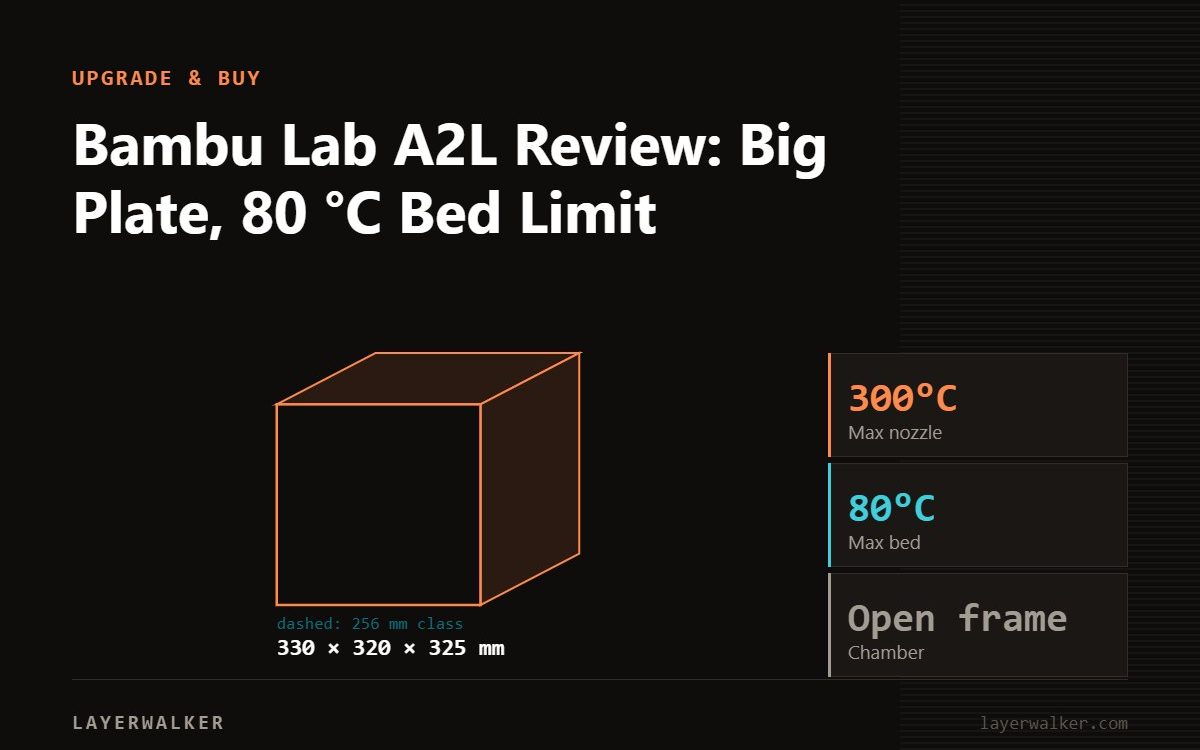
The A2L is the big open Bambu: 330 x 320 x 325 mm, which Bambu describes as 105% more space than the 256 mm class, at 12.8 kg with a 300 degC stainless nozzle and 500 mm/s. The catch is the heatbed, which tops out at 80 degC, so ABS and ASA are off the menu. Supported filament is PLA, PETG, TPU and PVA, plus PLA-CF and PETG-CF if you fit a hardened steel nozzle. It also has a 300 x 300 mm cutting module and a built-in filament cutter.
This assessment comes from Bambu’s own technical specification page rather than a hands-on test here. The A2L is an unusual machine in the range, and reading the bed temperature is the fastest way to understand who it is for.
Where to buy


Specification
| Spec | A2L |
|---|---|
| Build volume | 330 x 320 x 325 mm |
| Physical size / weight | 544 x 529 x 505 mm, 12.8 kg |
| Max nozzle temp | 300 degC, stainless steel nozzle |
| Max heatbed temp | 80 degC |
| Max speed / acceleration | 500 mm/s / 10 m/s2 |
| Max hotend flow | 28 mm3/s (PLA Basic, 220 degC, single wall) |
| Nozzle sizes | 0.2, 0.4, 0.6, 0.8 mm |
| Extruder | Servo motor, hardened steel gears, built-in filament cutter |
| Plate | Textured PEI flexible steel; also Engineering and Cool Plate SuperTack |
| Camera | Low-frame-rate, up to 1080p, timelapse |
| Screen / storage | 3.5 inch 240 x 320 touchscreen, 32 GB microSD |
| Cutting module | 300 x 300 mm cutting area |
| Power | 1000 W |
| Multi-material | Supports 2nd-generation AMS |
The 80 degC bed is the defining number
ABS and ASA want a plate at 100 to 110 degC and, more importantly, warm still air around the part. The A2L gives neither: 80 degC and no enclosure. Bambu’s own supported filament list reflects that honestly, naming PLA, PETG, TPU and PVA, with PLA-CF and PETG-CF once you fit a hardened steel nozzle.
Read that as a deliberate design, not a shortcoming. This is a large-format machine for PLA and PETG, aimed at people printing big cosplay pieces, props, enclosures and organisers rather than functional high-temperature parts. If you need ABS at this size, you are looking at an enclosed machine with a heated chamber instead.
What the extra volume actually gets you
330 x 320 x 325 mm against 256 mm cubed is roughly double the usable space, and the practical effect is fewer parts per model. A helmet that splits into four pieces on a 256 mm plate might split into two here, which saves glue seams, alignment work and finishing time. Our page on large-format printers covers how to think about that trade.
Two smaller features are worth noting because they are unusual. The built-in filament cutter removes the most common cause of failed loads, since a clean tip is what a changer needs. And the 300 x 300 mm cutting module puts vinyl and sheet cutting on the same machine, which is a genuinely different capability rather than a marketing bullet.
Speed in context
500 mm/s and 10 m/s2 are respectable, and the 28 mm3/s flow figure is the more honest limit for real prints: once a part is wide, flow rate and cooling decide print time, not the top speed of the toolhead. Bambu quotes that number with its test conditions, which is the right way to publish it.
Who should buy it
Buy the A2L if you print large PLA and PETG objects and want the biggest plate you can get without moving to an enclosed machine, or if the cutting module fits your work. Buy a P2S or above if ABS, ASA or nylon matter, because 80 degC and an open frame rule them out. Our A1 vs A2L comparison is the closest in-range decision, and the A2L overview has more.
Bambu Lab A2L Review FAQ
Can the A2L print ABS?
No. The bed tops out at 80 degC and there is no enclosure.
How much bigger is it than a 256 mm machine?
330 x 320 x 325 mm, described by Bambu as 105% more space.
Does it take an AMS?
Yes, it supports the second-generation AMS.
Can it print carbon fibre filament?
PLA-CF and PETG-CF, with a hardened steel nozzle fitted.

LayerWalker
Print defect diagnosis, calibration procedures and parts that actually fit. Corrections welcome through the contact page.