Bambu Lab A1 mini Review: Small, Fully Automatic
LayerWalker is a participant in the Amazon Services LLC Associates Program. We may earn a commission when you buy through links on our site, at no extra cost to you.
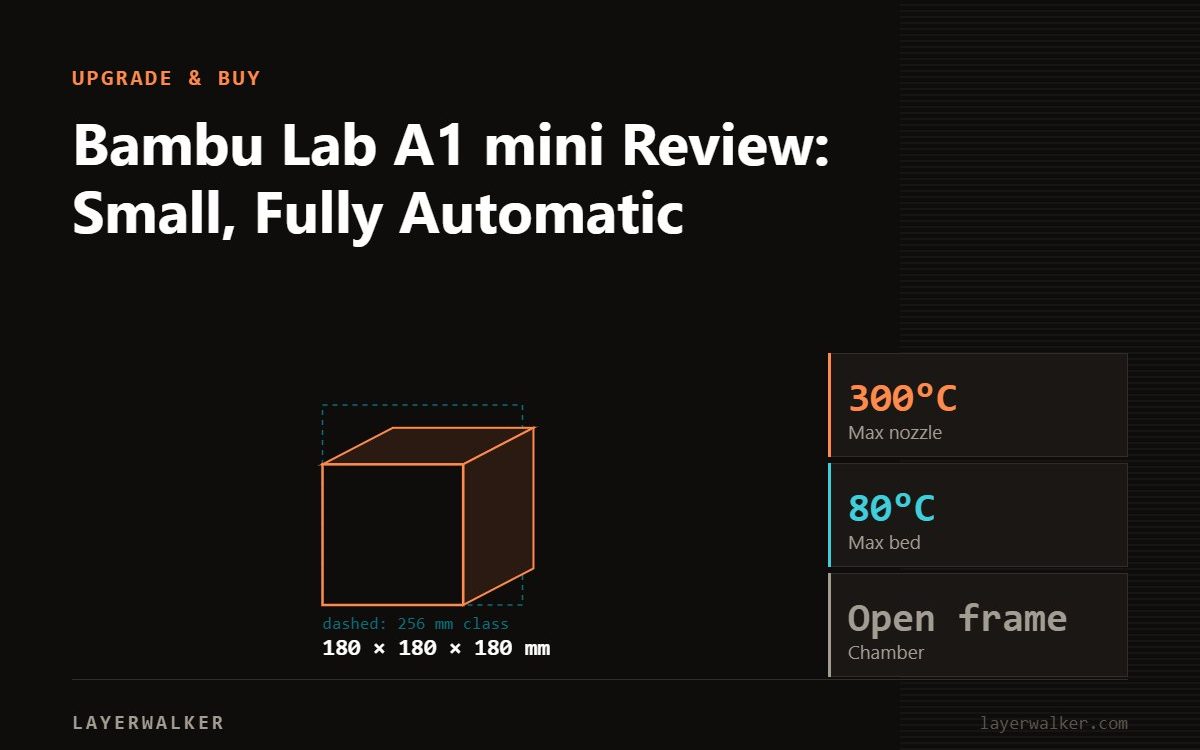
The A1 mini is the small-format version of the A1 and it keeps the parts that matter: 10,000 mm/s2 acceleration, a hotend that swaps with one clip, full automatic calibration of Z-offset, bed, resonance and flow, and the AMS lite for four colours. It is the best first printer in the range for anyone printing small parts in PLA and PETG. It is not for ABS, ASA or nylon, because there is no enclosure.
This assessment is drawn from Bambu’s published specifications and from how the A1 series is designed, not from a workshop test here. The A1 mini is often written off as the cheap one, which misses the point: the automation is identical to the full-size A1, and that automation is the actual product.
Where to buy

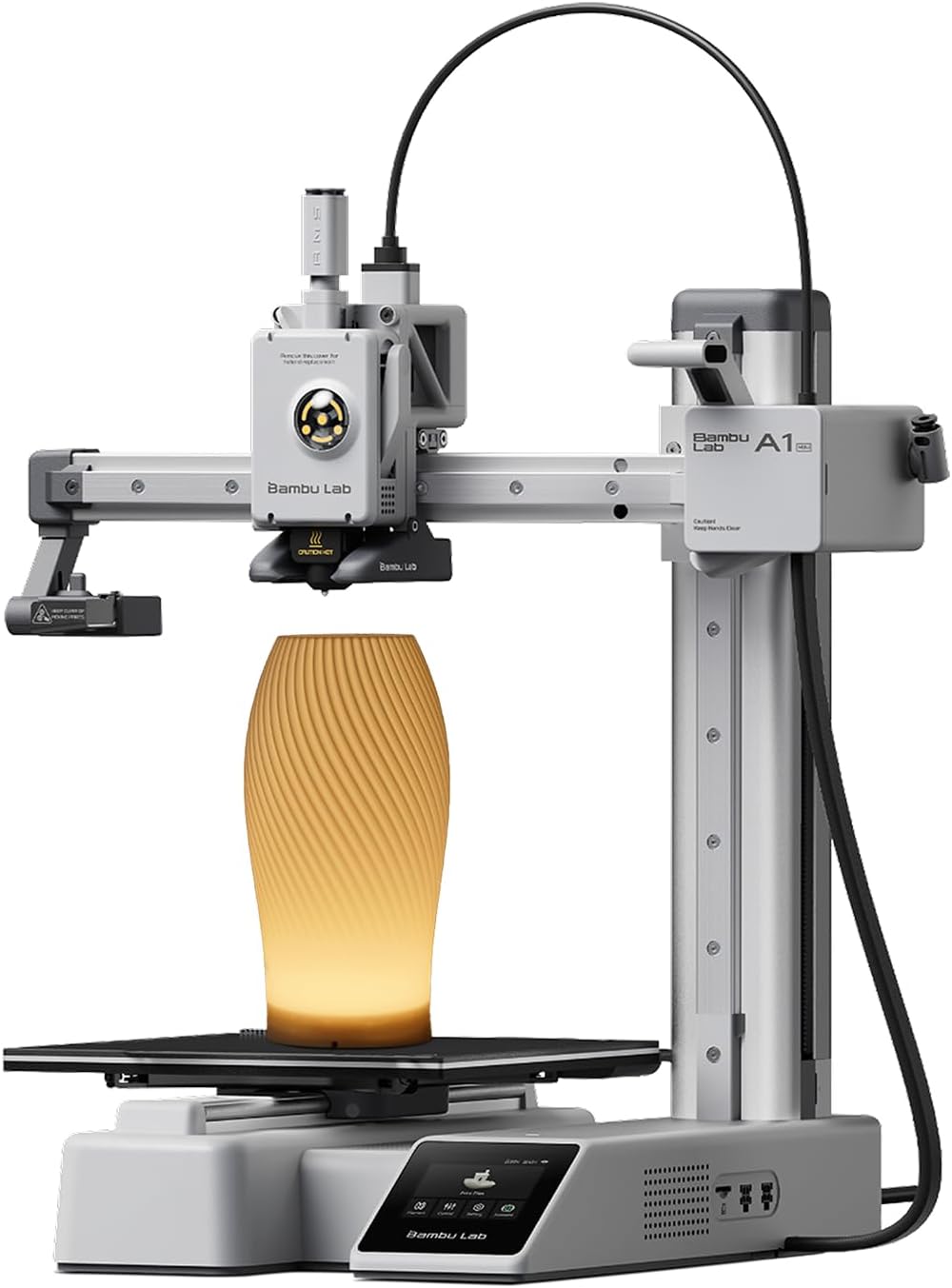
What it inherits from the A1
Acceleration of 10,000 mm/s2, which is high for a moving-bed machine and is what keeps print times respectable.
The quick-swap hotend, held by a single clip. Changing a nozzle diameter or replacing a worn one is a clip release rather than a heat-soak-and-wrench operation, and there is no re-levelling ritual afterwards.
Full automatic calibration: Z-offset, bed levelling, resonance compensation and flow, driven by an eddy-current sensor that measures nozzle pressure. This is the reason it suits a first-time owner. Most of the skill a beginner used to need was calibration skill, and this machine removes the need for it. If you want to understand what it is doing on your behalf, our pages on first-layer squish and input shaping cover the manual versions.
The honest limits
It is small. That is the trade you are making, and it is the right trade if your models are small: less desk space, less filament wasted on a failure, quicker heat-up. It is the wrong trade if you have a helmet or a planter in mind, in which case look at the A1 or a 256 mm class machine.
It is open. No enclosure means ABS and ASA warp at the corners and bond poorly between layers, and nylon adds moisture sensitivity on top. No amount of tuning fixes that; you need warm, still air. PLA, PETG and TPU are what this machine is for, and it does them well.
The AMS lite is larger than the printer. At 397 x 208 x 342 mm and 1.6 kg it takes more bench than the machine it feeds, which surprises people who chose the mini to save space. Plan roughly 700 mm of width for the pair. Our A1 mini AMS page covers the material limits, which are strict: no TPU, no TPE, no wet PVA or BVOH, and no carbon or glass filled filament.
Who should buy it
Buy the A1 mini as a first printer for someone who wants to print things rather than learn to maintain a printer, as a machine for a child or classroom with supervision, or as a second machine that quietly runs small PLA jobs. It is also the sensible choice if your desk genuinely cannot host a 256 mm cube.
Buy the A1 instead if you want the larger plate and expect to grow into bigger models, or a P1S or P2S if engineering materials are on the list. Our A1 vs A1 mini comparison is the direct one, and the A1 mini overview has more detail.
Bambu Lab A1 mini Review FAQ
Is the A1 mini slower than the A1?
Both accelerate at 10,000 mm/s2. Small parts finish quickly on either; the difference is plate size, not speed.
Can it print ABS?
No, not reliably. There is no enclosure.
What is its exact build volume?
Bambu publishes it on the current product page; we do not repeat figures we have not verified against the manufacturer, so check there for the number in your region’s listing.
Is the AMS lite worth it on the mini?
Yes for support material and filament backup, more than for colour. Just plan the bench space first.

LayerWalker
Print defect diagnosis, calibration procedures and parts that actually fit. Corrections welcome through the contact page.