Bambu X1C vs H2D: Flagship Then and Flagship Now
LayerWalker is a participant in the Amazon Services LLC Associates Program. We may earn a commission when you buy through links on our site, at no extra cost to you.
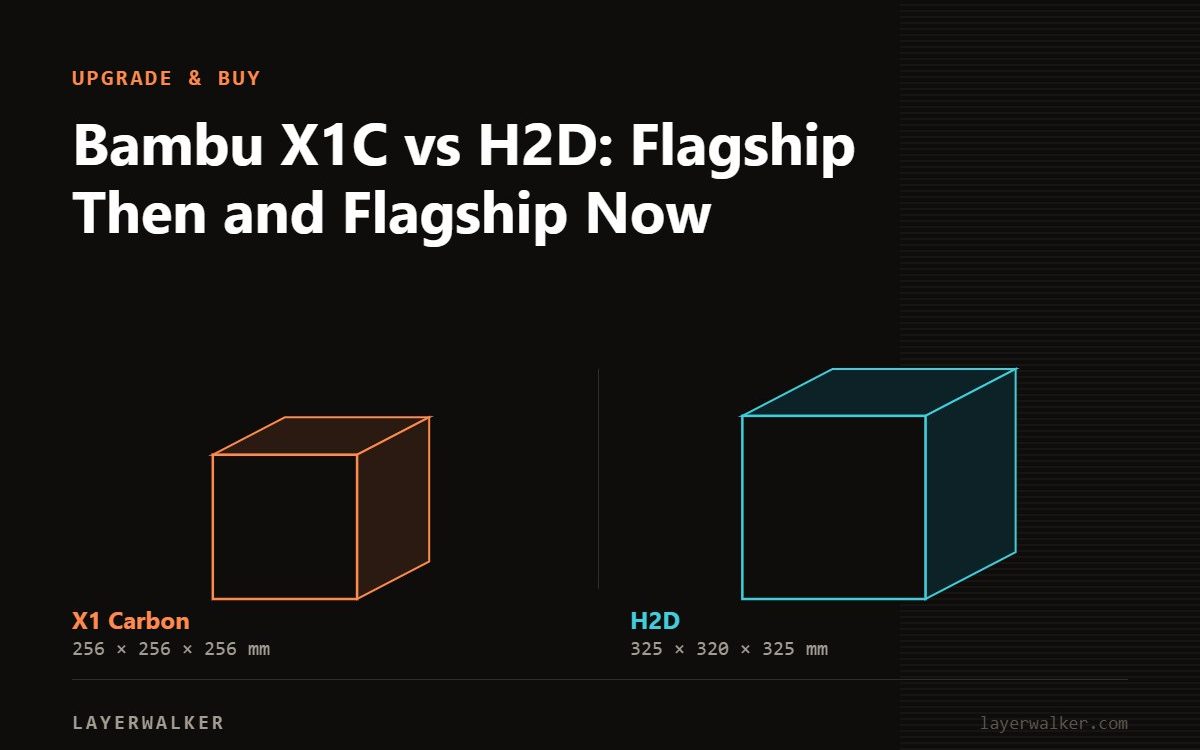
The H2D is a class above the X1C: 325 × 320 × 325 mm versus 256 mm, 350 versus 300 °C, a 65 °C heated chamber versus a passive one, and two nozzles. It is the machine for engineering filaments and purge-free dual material. The X1C remains a 256 mm lidar-equipped enclosed printer that does PLA through ASA well. If you do not need the chamber, the bed or the second nozzle, the X1C is over-served by the H2D and under-served by its own price against the P2S.
Where to buy


Side by side
| Spec | X1 Carbon | H2D |
|---|---|---|
| Build volume | 256 × 256 × 256 mm | 325 × 320 × 325 mm single; 300 × 320 × 320 mm dual |
| Nozzles | 1 | 2 |
| Max nozzle temperature | 300 °C | 350 °C |
| Max bed temperature | 120 °C | 120 °C |
| Chamber | Passive | 65 °C active |
| Speed / acceleration | 500 mm/s / 20000 mm/s² | 600 mm/s sustained / 20000 mm/s² |
| Inspection | Micro lidar | Vision encoder option, nozzle and toolhead cameras |
| Multi-material | AMS, AMS 2 Pro | AMS 2 Pro, AMS HT |
| Laser / cutting | No | Optional laser editions |
| Amazon US | No | No |
What the H2D adds that matters
- Heated chamber. Nylon, PC and PPA print without cracking; on the X1C they are marginal.
- Second nozzle. Soluble supports and two-material parts with no purge tower.
- Bed. 69 mm more on X and Y; helmets in one piece.
What the X1C keeps
- Lidar first-layer inspection, which the H2D handles differently through cameras.
- 256 mm plates shared with the P1S and P2S.
- Lower price, lower power draw, smaller footprint.
The honest recommendation
If your filaments are PLA, PETG, ABS and ASA, neither is the right buy: the P2S does that for less. If nylon, PC or dual material is the point, the H2D. The X1C makes sense at a discount or for owners already invested in its spares; see P1S vs X1C for the lower comparison and the H2D page for the full spec.
The units in the box
The X1 Carbon and the H2D are is not sold on Amazon US; it is bought directly from Bambu Lab. The listings show the Bambu machines that are on Amazon so the alternative can be compared.
Bambu X1C vs H2D FAQ
Do X1C hotends fit the H2D?
No.
Does the H2D print faster?
Sustained flow is higher with the high-flow hotend; on small parts both are similar.

LayerWalker
Print defect diagnosis, calibration procedures and parts that actually fit. Corrections welcome through the contact page.