H2D AMS: Dual Nozzle Plus 65 °C Drying
LayerWalker is a participant in the Amazon Services LLC Associates Program. We may earn a commission when you buy through links on our site, at no extra cost to you.
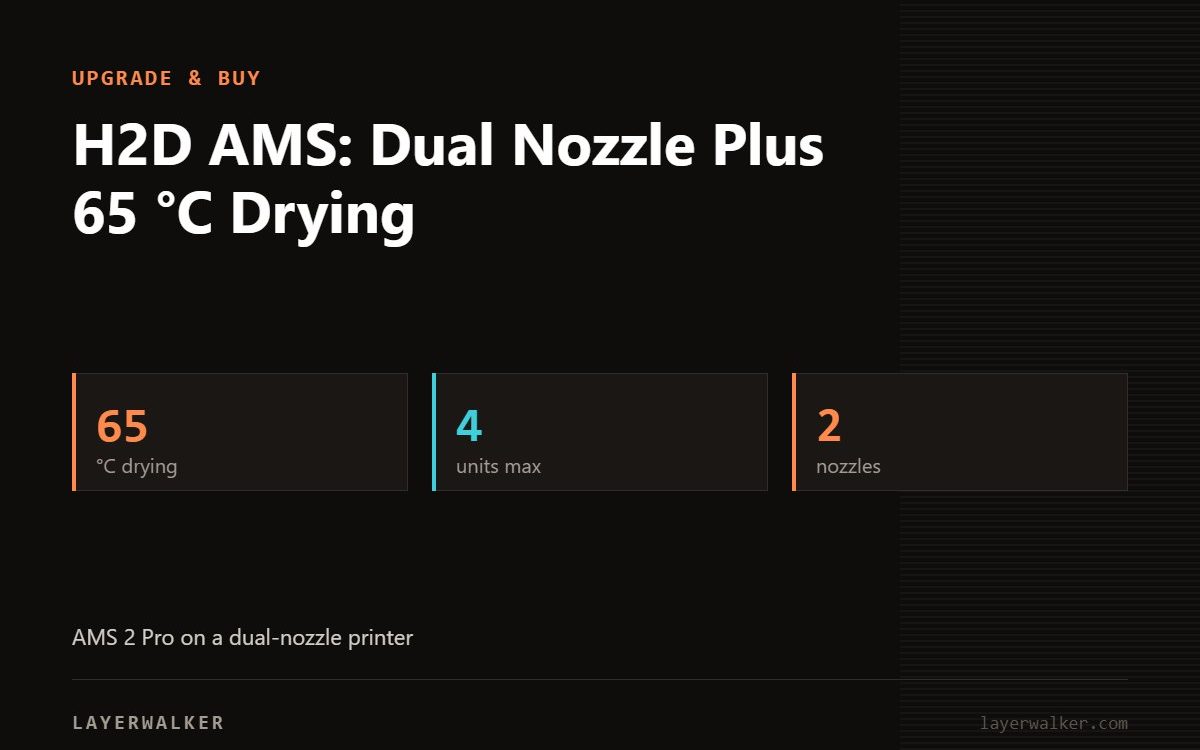
The H2D pairs with the AMS 2 Pro, the unit with 65 degC active drying, auto-rotating spools and automatic venting. Because the H2D is dual-nozzle, a changer on it is doing something the rest of the range cannot: two independent materials at the toolhead plus automated colour on top. Four AMS 2 Pro units chain with eight AMS HT units for twenty-four filaments.
The H2D is Bambu’s most capable machine on paper: 350 degC at the nozzle, a 120 degC plate, a 65 degC actively heated chamber, 600 mm/s, and the only printer in the range that lists PPS-CF and PPS-GF as supported. It is also dual-nozzle, with the two nozzles held to under 25 microns of offset.
That combination changes what a filament changer is for.
Where to buy


Why a changer behaves differently on a dual-nozzle machine
On a single-nozzle printer, every colour or material change means purging the hotend: heat up, push through the old material, wipe, resume. That purge is the tax on multi-colour printing, and it is why people print colour sparingly.
A dual-nozzle machine can keep two materials permanently loaded, one per nozzle, and switch between them without purging the same hotend. The classic use is a build material in one nozzle and support material in the other. Add an AMS 2 Pro and you get automated variety on top of that: several colours cycling through one nozzle while the second nozzle holds support or a second material throughout.
Note the H2D’s own material split, because it constrains what you should load where. The main nozzle handles the full list; the auxiliary nozzle is documented as not recommended for TPU, and brittle or abrasive filament should be run through it with caution. PETG-CF in particular is flagged for caution on the auxiliary nozzle.
AMS 2 Pro specifics
The unit is 372 x 280 x 226 mm and 2.5 kg. Drying runs to 65 degC, and the spools rotate during the cycle so the heat reaches them evenly rather than baking one side. An automated vent opens during dehumidification and reseals afterwards for airtight storage. RFID on Bambu filament sets the drying parameters without you entering anything.
It also fixed the original AMS’s worst ergonomic problem. Removing snapped filament from a Gen 1 unit means pulling every spool and undoing two shell screws, three to five minutes by Bambu’s own description. On the AMS 2 Pro the filament tubes are reachable from the top with no tools.
Supported filament covers PLA, PETG, ABS, ASA, PET, PA, PC, dried PVA, dried BVOH, PP, POM, HIPS, PLA-CF, PAHT-CF, PETG-CF and support material, at 1.75 mm. TPU is on the list for the AMS, which the open AMS lite cannot manage at all.
What to expect on build volume
Dual-nozzle printing costs you some envelope. The H2D gives 325 x 320 x 325 mm with a single nozzle, 300 x 320 x 320 mm when both nozzles are in play, and a total addressable volume of 350 x 320 x 320 mm. If maximum single-material volume is the goal, print single-nozzle.
The chamber is the other reason this machine suits multi-material work: 65 degC actively heated, with a G3 and H12 filter plus granulated coconut shell carbon for VOCs and particulates. That is the environment ABS, ASA and nylon need for the layer bonding to hold, and it is what makes multi-material engineering prints realistic rather than a gamble.
For the machine itself see our H2D overview, and X1C vs H2D if you are still choosing.
H2D AMS FAQ
Which AMS does the H2D use?
The AMS 2 Pro, with 65 degC drying. It is compatible across the Bambu range.
How many filaments can I reach?
Twenty-four, chaining four AMS 2 Pro and eight AMS HT units.
Can I run support material without an AMS?
Yes. The H2D is dual-nozzle, so one nozzle can hold support permanently. The AMS adds automated variety on the other nozzle.
Does dual-nozzle printing shrink the build volume?
Yes, from 325 x 320 x 325 mm single-nozzle to 300 x 320 x 320 mm with both in use.

LayerWalker
Print defect diagnosis, calibration procedures and parts that actually fit. Corrections welcome through the contact page.