3D Printer Retraction Settings: Distance, Speed, and What They Cannot Fix
LayerWalker is a participant in the Amazon Services LLC Associates Program. We may earn a commission when you buy through links on our site, at no extra cost to you.
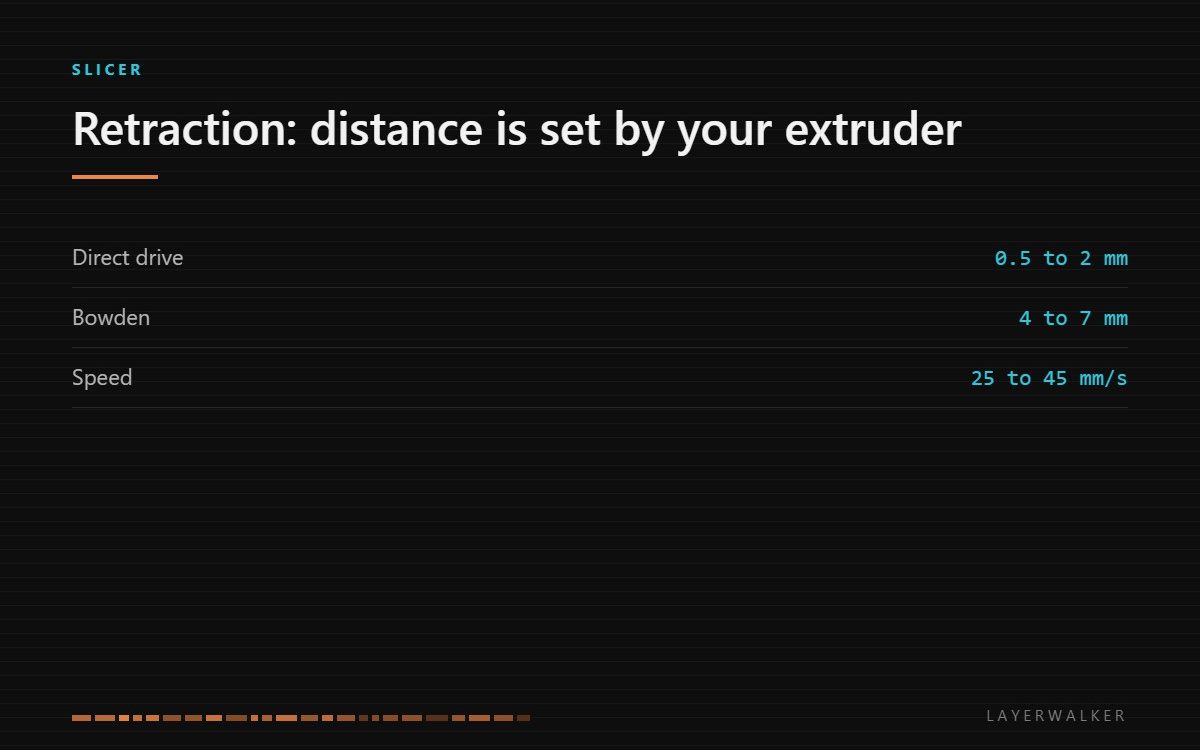
Direct drive wants 0.5 to 2 mm of retraction; Bowden wants 4 to 7 mm. Set speed around 25 to 45 mm/s and stop there. If strings remain, the cause is almost never the retraction number.
Where to buy


What to look for
Retraction is a setting, not a purchase, so the things worth buying are the ones that decide how well any setting can work. On a Bowden machine the tube is the variable: a low-friction PTFE liner with a tight, consistent bore lets the filament move when the extruder pulls, instead of flexing inside the tube and arriving late. Replacing a worn generic tube is the cheapest real improvement available to a Bowden printer, and the difference shows up as retraction that finally behaves predictably.
If you are tired of fighting the tube altogether, a direct drive conversion moves the extruder onto the toolhead and cuts the retraction distance by roughly a factor of four, because there is no longer a metre of springy filament between the gears and the melt zone. And before either of those, a filament dryer: wet filament produces stringing that looks exactly like a retraction problem and cannot be tuned away. Buy the dryer first if you own neither.
The two numbers, and which one matters
Retraction has two settings that matter and several that do not. Distance is how far the extruder pulls the filament back before a travel move. Speed is how fast it does it. Everything else in that section of the slicer is a refinement you should not touch until these two are right.
Distance is set by the mechanics of your machine, not by preference. It has to be large enough to relieve the pressure built up in the melt zone, and no larger. Too much distance pulls molten plastic up into the cold end of the hotend, where it cools, and the next extrusion has to push that plug back down. The symptom is a gap at the start of a line rather than a string in the middle of one, which is why people who chase stringing by raising the distance often end up with under-extrusion instead.
| Extruder | Distance | Speed | Why |
|---|---|---|---|
| Direct drive | 0.5 to 2 mm | 25 to 45 mm/s | Gears sit millimetres from the melt zone; almost no filament to compress |
| Bowden, short tube | 3 to 5 mm | 25 to 45 mm/s | Some filament flex between gears and nozzle |
| Bowden, long tube | 5 to 7 mm | 25 to 45 mm/s | More filament in the path, so more of the pull is absorbed as flex |
Speed has a narrower useful band than most guides suggest. Below about 20 mm/s the retraction takes long enough that the nozzle keeps oozing while it happens. Above about 60 mm/s the drive gear starts to grind a flat into soft filament, which shows up two hours later as inconsistent extrusion that has nothing obvious to do with retraction.
Why raising the distance usually makes it worse
The instinct when a print comes out hairy is to add a millimetre. That works for about one print in five. The other four have a different cause, and the extra distance quietly adds a new problem on top of the old one.
Three failures produce strings that no retraction value will remove. Wet filament is the most common by a wide margin: absorbed moisture flashes to steam at the nozzle and pushes plastic out regardless of what the extruder is doing. A nozzle running hotter than the material needs is second, because viscosity drops faster with temperature than most people expect. Third is a worn nozzle with a rounded orifice, which stops holding a clean break at the end of a line.
Our page on stringing and oozing works through those three in order, and that is the order to follow. Retraction is the last adjustment, not the first, and a machine with dry filament at the right temperature usually needs less retraction than the profile shipped with.
A calibration order that converges
Print a retraction tower, which is a pair of thin pillars with a gap between them, sliced so that each band up the tower uses a different distance. Change one variable per tower or you will not know which change did what.
Start at the low end of the band for your extruder type and work up in 0.5 mm steps on a Bowden machine, 0.2 mm on direct drive. Stop at the first value that gives a clean gap. Do not keep going to see whether more is better, because the failure mode of too much retraction does not appear on a retraction tower. It appears later, as under-extrusion at the start of lines on a real part.
Once distance is settled, leave speed alone unless you have a specific problem. The default in most slicers sits inside the useful band already, and moving it is how people spend an afternoon making things worse. If you want to adjust something else afterwards, the setting that actually earns its keep is the minimum travel distance before a retraction fires, which stops the extruder retracting hundreds of times per layer on a part with dense detail.
Materials change the answer
PETG and TPU both need different handling, and both get blamed on retraction. PETG strings more than PLA at any given setting because it stays viscous over a wider temperature range; the fix is a lower nozzle temperature and a slightly slower retraction, not a longer one. TPU is worse still: it is elastic, so a long retraction stretches the filament in the path rather than moving it, and on a Bowden machine it may not be possible to retract usefully at all. Flexible filament is one of the few genuine arguments for direct drive.
FAQ
What retraction distance should I start with? 1 mm on direct drive, 5 mm on Bowden. Then tune down, not up.
Does retraction speed cause grinding? It can, above roughly 60 mm/s on soft filament. Grinding shows up as extrusion that fades over a long print.
Why do I still get strings with retraction at maximum? Because the cause is moisture or temperature. Dry the spool and drop the nozzle 5 degrees at a time.
Should I use coasting or wipe instead? Only after retraction is tuned. Both mask symptoms and both cost you a small amount of material at the end of every line.

LayerWalker
Print defect diagnosis, calibration procedures and parts that actually fit. Corrections welcome through the contact page.