PTFE Tube for a 3D Printer: Bore, Temperature Limit and When to Replace It
LayerWalker is a participant in the Amazon Services LLC Associates Program. We may earn a commission when you buy through links on our site, at no extra cost to you.
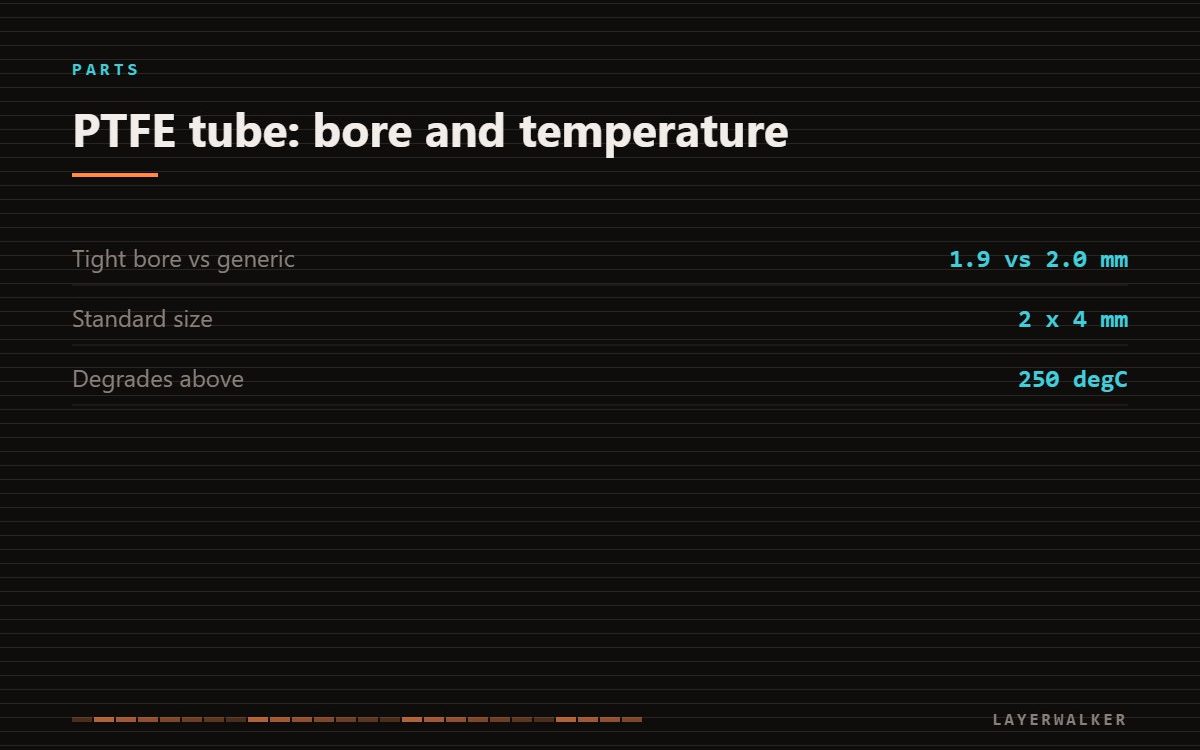
PTFE tube guides filament between the extruder and the hotend. Two things decide whether it helps or hurts: the inner bore, which should be close to 1.9 mm rather than a loose 2.0 mm, and the temperature it sees, because PTFE starts degrading above roughly 250 C.
Where to buy

Capricorn Bowden PTFE Tubing XS Series 1 Meter for 1.75mm Filament (Genuine Capricorn Premium Tubing)


What to look for
Buy tube by bore tolerance, not by colour. Generic 2 x 4 mm tube has a 2.0 mm bore that lets 1.75 mm filament wander; tighter XS-series tube reduces that slack and gives crisper retraction. Cut it square when you fit it, because a clean end face is what stops filament catching at the joint.
Why bore tolerance changes print quality
Filament that can move sideways inside the tube adds slack to every retraction. The extruder pulls, the filament shifts inside the bore before it starts moving back, and the retraction you configured in the slicer is not the retraction the nozzle experiences. On a long Bowden run this is the difference between clean travel moves and persistent stringing. Direct drive machines have a short tube or none at all, which is exactly why direct drive handles flexible filament better.
The 250 C ceiling nobody prints on the box
PTFE is stable at PLA and PETG temperatures. Push it past roughly 250 C and it begins to break down, which matters in two ways: the tube deforms and narrows where it meets the nozzle, and the decomposition products are not something you want in the room. This is the single reason all-metal hotends exist. If you intend to print ABS, ASA, nylon or polycarbonate at 260 C and above, the melt zone should not contain PTFE at all.
How to tell the tube is your jam
A tube that has cooked at the hotend end develops a flared, discoloured mouth. Filament catches on that lip, extrusion force climbs, and the symptom looks exactly like a clogged nozzle. Pull the tube and look at the end face: if it is no longer a clean square bore, replace it rather than cleaning it. The same check applies after any heat creep incident, because the heat that softened filament in the throat also cooked the tube.
Cutting and seating it properly
Cut square, deburr the inside edge, and push the tube fully home until it bottoms out against the nozzle. A gap of even half a millimetre between tube and nozzle becomes a cavity where molten plastic collects, cools and forms a plug. That plug is the most common cause of a jam that returns within a few prints of being cleared.
FAQ
Is Capricorn worth the premium? The tighter bore is a real difference on Bowden machines. On a direct drive printer with a short tube it changes very little.
How often should I replace it? When the end face is no longer clean, or after any incident that let the throat run hot. There is no fixed interval.
Can I print ABS with a PTFE-lined hotend? Not sustainably. The tube degrades at those temperatures and the bore closes up. Use an all-metal hotend instead.

LayerWalker
Print defect diagnosis, calibration procedures and parts that actually fit. Corrections welcome through the contact page.