3D Printers for Prototyping: Speed, Repeatability and Materials That Match Production
LayerWalker is a participant in the Amazon Services LLC Associates Program. We may earn a commission when you buy through links on our site, at no extra cost to you.
A prototyping printer needs three things: fast turnaround so a design can be revised the same day, repeatable dimensions so the third print matches the first, and materials that behave like the production plastic. For most product and mechanical work that means an enclosed CoreXY with auto-calibration: the Bambu P2S is the default, the Flashforge AD5M Pro the budget office option, and the Prusa MK4S or CORE One the choice where open documentation and long support matter. Resin covers cosmetic and fine-detail prototypes.
Where to buy


What prototyping asks
| Need | Why | Look for |
|---|---|---|
| Fast iteration | Several revisions a day | CoreXY, 20000 mm/s², 0.6 mm nozzle for drafts |
| Repeatability | Fit checks mean nothing if dimensions drift | Load-cell or nozzle probing; auto flow; stiff frame |
| Production-like materials | ABS, ASA, PC, nylon, PETG | Enclosure; heated for PC and nylon |
| Unattended reliability | Overnight runs | Camera, runout sensor, power-loss recovery |
| Fine detail | Cosmetic models, small features | Resin printer alongside |
| Low noise and fumes | Office or studio | Enclosed, filtered |
Picks
| Printer | Build volume | Chamber | Why |
|---|---|---|---|
| Bambu P2S Combo | 256 mm | Passive | Fastest path from CAD to part; AMS 2 Pro for material swaps; vision checks |
| Flashforge AD5M Pro | 220 mm | Passive + HEPA | Cheapest enclosed, filtered, quick-swap nozzles for draft vs detail |
| Prusa MK4S / CORE One+ | 250 × 210 × 220 / 250 × 220 × 270 mm | None / 55 °C | Open source, decade-long support, load-cell repeatability |
| Qidi Plus 4 | 305 mm | 65 °C | PC and nylon prototypes that match injection-moulded parts |
| Elegoo Saturn 4 Ultra (resin) | 218.88 × 122.88 × 220 mm | n/a | Cosmetic and fine-feature prototypes |
Workflow notes
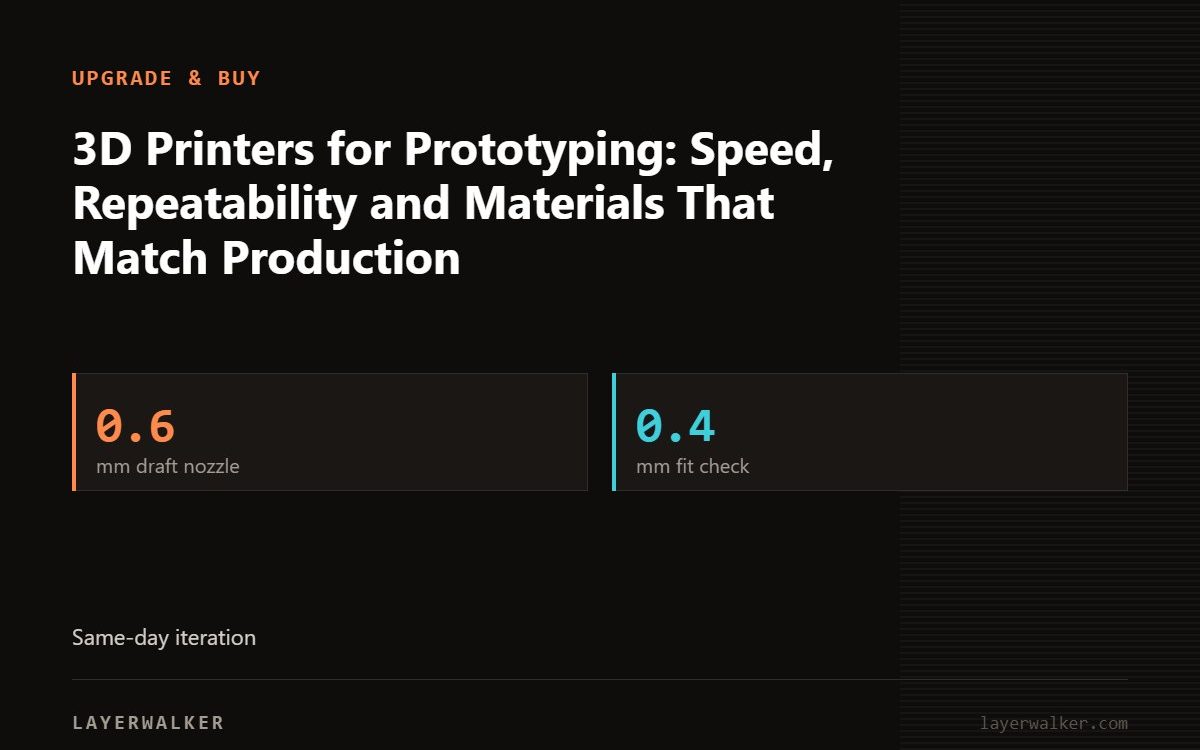
- Draft in 0.6 mm at 0.3 mm layers; switch to 0.4 mm for the fit check. Quick-swap hotends make this practical.
- Calibrate flow per filament and keep a printed tolerance gauge with each spool.
- Prototype in the production material where possible; PLA prototypes of ABS parts hide shrinkage problems.
Engineering teams should read printers for engineering prototyping and printers for functional parts.
The units in the box
The listings are the Bambu P2S Combo, the Flashforge AD5M Pro and the Prusa MK4S assembled.
3D printer for prototyping FAQ
FDM or resin for prototyping?
FDM for mechanical fit and strength; resin for appearance and small features.
Do I need multi-colour?
Rarely; the AMS is useful for switching materials without reloading.

LayerWalker
Print defect diagnosis, calibration procedures and parts that actually fit. Corrections welcome through the contact page.