Best 3D Printers for Engineering Prototyping: Tolerance, Materials, Uptime
LayerWalker is a participant in the Amazon Services LLC Associates Program. We may earn a commission when you buy through links on our site, at no extra cost to you.
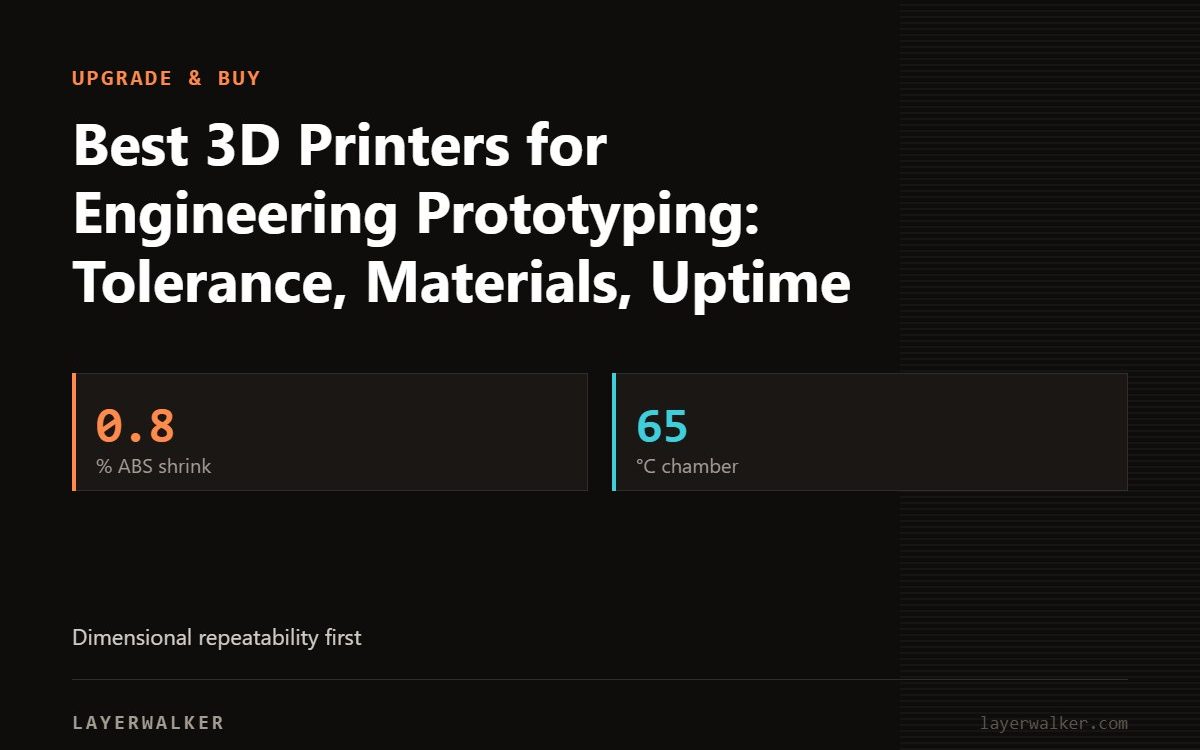
An engineering prototype has to be dimensionally right and made of something close to the production plastic. That rules in enclosed CoreXY machines with contact bed probing and calibrated flow, and it rules out open bedslingers for anything beyond PETG. The Bambu P2S covers ABS and ASA with the least effort; the Prusa CORE One+ adds a 55 °C chamber and open documentation; the Qidi Plus 4 and Creality K2 Plus bring 65 and 60 °C chambers for nylon and PC; the Bambu H2S and Prusa XL sit above for dual material.
Where to buy


Requirements
| Need | Why | Look for |
|---|---|---|
| Dimensional repeatability | Fit checks, press fits, threads | Load-cell or nozzle probing, auto flow, stiff frame, calibrated per material |
| Production-like materials | ABS, ASA, PC, PA, glass-filled | Enclosure; heated chamber for PC and PA; hardened nozzle |
| Unattended uptime | Overnight iterations | Camera, filament runout, power-loss recovery, spaghetti detection |
| Fast draft mode | Same-day revisions | Quick-swap 0.6 mm nozzle |
| Documentation and support | Team use, procurement | Prusa leads; Bambu has the most profiles |
| Two materials | Soluble supports for internal channels | Dual nozzle or toolchanger |
The machines
| Printer | Build volume | Chamber | Nozzle | Why |
|---|---|---|---|---|
| Bambu P2S Combo | 256 mm | Passive | 300 °C | Vision pre-print checks, AMS 2 Pro material swaps, best profiles |
| Prusa CORE One+ | 250 × 220 × 270 mm | 55 °C | 290 °C (400 °C option) | Load-cell repeatability, open source, INDX toolchanger path |
| Qidi Plus 4 | 305 × 305 × 280 mm | 65 °C | 370 °C | PC, PA-CF, PPA at the lowest price |
| Creality K2 Plus | 350 mm | 60 °C | 350 °C | Large prototypes in engineering filament |
| Bambu H2S / H2D | 340 / 325 mm | 65 °C | 350 °C | Polished software; H2D adds purge-free dual material (Bambu direct) |
| Prusa XL | 360 mm | Optional | 290 °C | Toolchanger for soluble supports and multi-material assemblies |
Process, not just hardware
- Calibrate flow and shrinkage per material; ABS shrinks about 0.8 percent, PLA barely.
- Keep a printed tolerance gauge per spool; re-print after a nozzle change.
- Prototype in the target material; a PLA prototype of a PC part hides shrink and warp.
- Dry engineering filament; nylon out of a wet spool is not the material you are testing.
See printers for prototyping for the general case and functional parts for the material ladder.
The units in the box
The listings are the P2S Combo, the Prusa CORE One+ assembled and the Qidi Plus 4.
Best 3D printer for engineering prototyping FAQ
Is resin better for engineering prototypes?
For appearance and small features; engineering resins are improving but FDM matches production thermoplastics more closely.
Do I need a heated chamber?
For PC, PA and their fibre blends, yes; for ABS and ASA, a passive enclosure is enough.

LayerWalker
Print defect diagnosis, calibration procedures and parts that actually fit. Corrections welcome through the contact page.