Sovol SV08 Review: 700 mm/s and 40,000 mm/s²
LayerWalker is a participant in the Amazon Services LLC Associates Program. We may earn a commission when you buy through links on our site, at no extra cost to you.
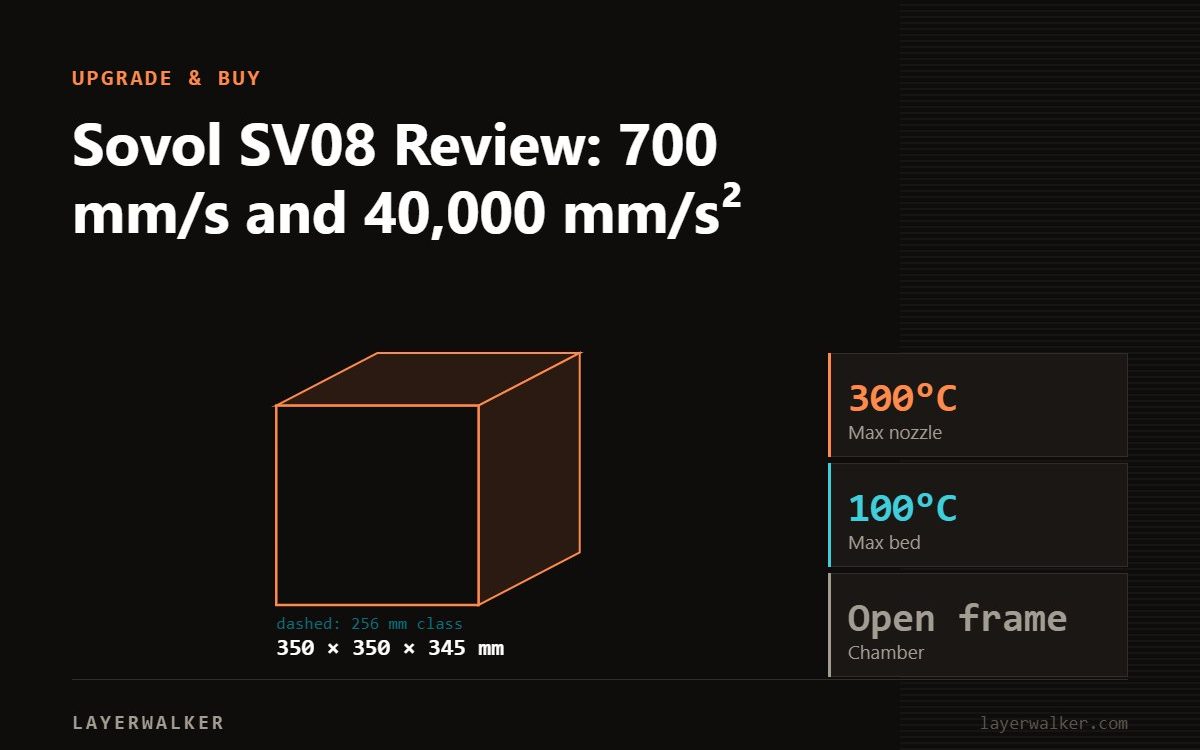
The SV08 is the fastest specification you can buy at this price: 350 x 350 x 345 mm, 700 mm/s and 40,000 mm/s2, a 300 degC nozzle and a 100 degC bed, on a CoreXY frame with four independent Z motors, arriving 90% pre-assembled with open-source firmware. It is a Voron 2.4 layout sold as a product. Buy it if you want that platform without building one; look elsewhere if you want a closed ecosystem that calibrates itself.
This assessment is from Sovol’s published specification rather than a workshop test. The SV08 is unusual in the market because it is not trying to be an appliance. It is a well-known open-source design, manufactured and sold assembled.
Where to buy


Specification
| Spec | Sovol SV08 |
|---|---|
| Build volume | 350 x 350 x 345 mm |
| Max speed | 700 mm/s |
| Max acceleration | 40,000 mm/s2 |
| Max nozzle temp | 300 degC |
| Max bed temp | 100 degC |
| Motion | CoreXY, four independent Z motors |
| Assembly | 90% pre-assembled |
| Firmware | Open source |
| Size | 550 x 537 x 575 mm |
Put 40,000 mm/s2 in context: the Creality K2 Plus quotes 30,000, most of the fast 256 mm machines quote 20,000, and the Creality Hi quotes 12,000. Nothing else at this money claims that figure, and the four independent Z motors are what makes a 350 mm gantry stay square while it does.
What open source actually buys you
Three concrete things. You can change anything in the firmware, because it is Klipper and the configuration is yours. You can source parts from the wider ecosystem instead of one vendor. And the community documentation for the underlying design is enormous, because thousands of people have built the same layout by hand.
The flip side is that nothing is decided for you. Where a Bambu or a Prusa ships with a curated profile for every filament and a calibration routine that runs itself, the SV08 expects you to understand input shaping, pressure advance and volumetric flow limits. If those pages look like a fun evening, this is your machine. If they look like homework, it is not.
Where the specification stops
300 degC and 100 degC put it in the ABS and ASA bracket rather than the high-temperature engineering bracket, and there is no heated-chamber figure in the specification, so treat styrenics as workable rather than comfortable. Filled filament needs a hardened nozzle.
There is also no native multi-material system. If colour matters, that is a different machine or a manual workflow.
And be realistic about the speed figures. 700 mm/s and 40,000 mm/s2 are what the motion system can do; what any printer actually achieves on a real part is limited by melt flow and cooling. The honest benefit of a very stiff, very fast frame is not that every print is twice as quick, it is that travel moves and infill stop being the bottleneck.
Who should buy it
Buy the SV08 if you want a large fast CoreXY, you value being able to modify the machine, and you already know how to tune a printer. It is the best value in raw motion capability on the market and the range now extends to an SV08 Max as well.
Buy a P2S, Centauri Carbon or K1C instead if you want the printer to handle calibration and profiles. Buy a K2 Plus if you want a large enclosed machine with a heated chamber and automated colour. Our SV08 overview and Sovol range page have more.
Sovol SV08 Review FAQ
Is the SV08 really 40,000 mm/s2?
That is Sovol’s published figure, the highest we have verified in this price class.
Does it come assembled?
90% pre-assembled, so it is a short build rather than a kit.
Is it a Voron?
It uses the well-known open-source CoreXY layout and open firmware, sold as a finished product.
Can it print ABS?
300 degC nozzle and 100 degC bed allow it, but there is no chamber heating specification, so expect it to be less reliable than on a chamber-heated machine.

LayerWalker
Print defect diagnosis, calibration procedures and parts that actually fit. Corrections welcome through the contact page.