P1S AMS: Which Unit Fits, and What It Will Not Feed
LayerWalker is a participant in the Amazon Services LLC Associates Program. We may earn a commission when you buy through links on our site, at no extra cost to you.
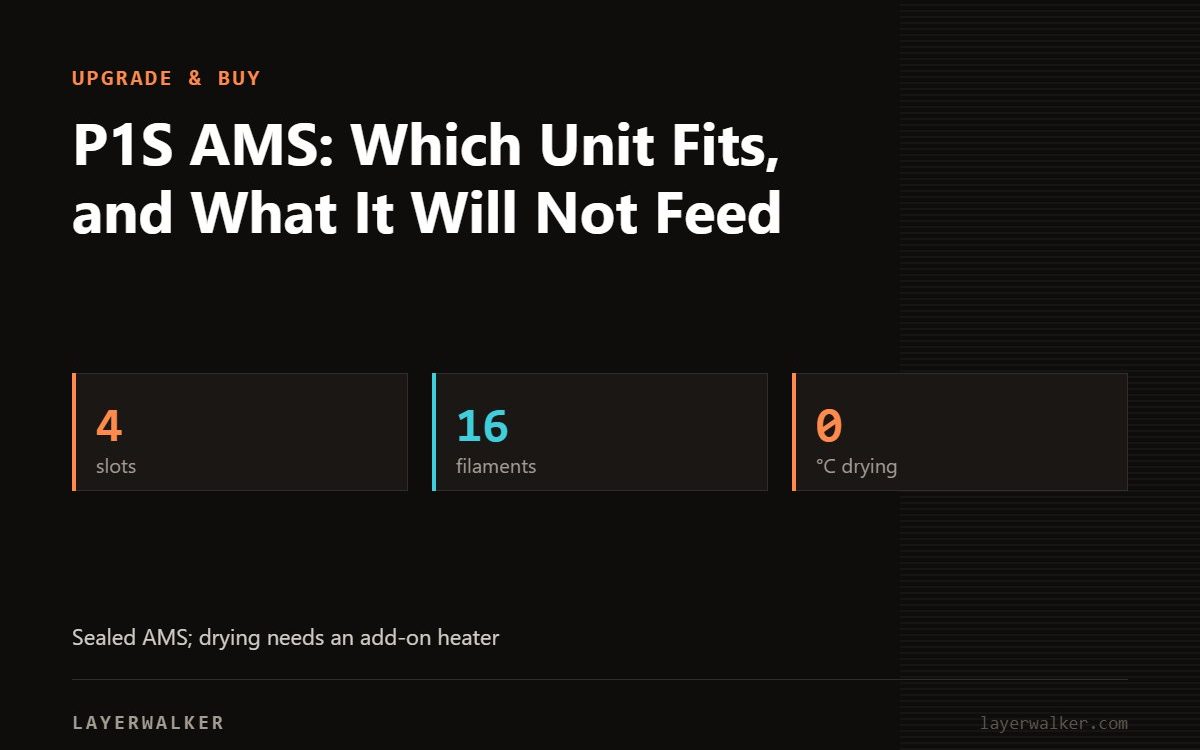
The P1S takes the enclosed four-slot AMS, and you can chain up to four units on a P1 or X1 series printer for sixteen filaments. Buying the P1S Combo is cheaper than buying the printer and an AMS separately. The AMS you get with it does not dry filament; if you want drying, either add a heater accessory to the Gen 1 unit or step up to the AMS 2 Pro, which holds up to 65 degC and needs an AMS Hub plus a switching adapter on a P1 series machine.
Multi-colour is the reason most people buy a P1S over a P1P, and the AMS is the part that does the work. It is also the part that generates the most support questions, because the sealed Gen 1 unit hides its own mechanism and is fussy about which filaments it will feed.
Here is what the AMS actually does on a P1S, what it refuses to touch, and whether the combo or the standalone route makes more sense.
Where to buy


SUNLU AMS Heater, Compatible with Bambu lab AMS Gen 1
Which AMS fits a P1S
The P1S uses the enclosed AMS, not the open AMS lite that ships with the A1 series. Four spools sit inside a sealed shell with desiccant, a filament hub feeds the extruder, and RFID tags on Bambu filament are read automatically so the printer applies the right profile.
Scaling up is supported: a P1 or X1 series printer accepts up to four AMS units for sixteen filaments total. The AMS 2 Pro can also be used, and Bambu states it is compatible across the printer range, but on a P1 series machine connecting a single AMS 2 Pro requires an AMS Hub (part SA002-N), and each AMS 2 Pro needs its own switching adapter if you want the drying function to work.
What the AMS will not feed
This is the part that catches people out. The sealed Gen 1 AMS is a mechanical path with tight bends, so soft and brittle filaments are out. Treat TPU and TPE as unsupported, along with wet PVA or BVOH, and be cautious with anything carbon or glass filled: those are abrasive and chew the path. Run flexibles from an external spool holder straight into the extruder instead, which the P1S supports.
Filament shape matters too, not just chemistry. Warped cardboard spools and out-of-spec widths cause feed errors, which is why Bambu publishes spool dimensions for its systems. If a third-party spool binds, that is usually the spool, not the AMS.
Drying: the Gen 1 gap
The Gen 1 AMS is an airtight box with desiccant. It slows moisture pickup; it does not remove moisture that is already in the filament. That is a real limitation with PETG, PA and PVA, which is why the AMS 2 Pro exists: it dries up to 65 degC, rotates the spools during drying so the heat reaches evenly, vents automatically, and reads RFID to pick the drying profile for Bambu filament.
If you already own a Gen 1 unit, an add-on heater is the cheaper route to the same goal. Either way, do not skip drying as a concept. Our guide to drying filament properly covers why a wet spool ruins surface finish long before it causes an outright failure.
Combo or add it later
Buy the combo if you already know you want multi-colour, because the bundle is priced below the sum of the parts and you avoid a second shipment. Buy the printer alone if you are unsure: the P1S is a complete machine without an AMS, and adding one later is a plug-in operation, not a modification.
One practical note about desk space. An AMS sits on top of the printer, so measure your shelf height before you order. Four units is a rack, not an accessory.
Living with it
Two habits prevent most AMS headaches. First, cut a clean 45 degree tip on the filament end before loading, because a blunt or bent end is the most common cause of a failed load. Second, do not leave a spool half-used in the AMS for months and then expect a clean print; take it out and dry it.
When a filament does snap inside a Gen 1 unit, clearing it means pulling all the spools and opening the shell with two screws, which Bambu itself describes as a three-to-five minute job. That is the single biggest ergonomic improvement in the AMS 2 Pro, where the tubes are reachable from the top without tools. If you print multi-colour every week, that difference adds up. Our AMS 2 Pro versus AMS comparison goes through the rest of the differences, and the P1S overview covers the printer itself.
Adding a second unit means adding an AMS Hub, which routes and powers up to four AMS units into one printer.
P1S AMS FAQ
How many AMS units can a P1S run?
Up to four on a P1 or X1 series printer, giving sixteen filaments.
Can the P1S AMS print TPU?
No. Feed flexibles from an external spool holder directly into the extruder.
Does the AMS dry filament?
The Gen 1 unit does not; it is a sealed box with desiccant. The AMS 2 Pro dries up to 65 degC.
Do I need the AMS for the P1S to work?
No. The P1S prints single-colour perfectly well on its own.

LayerWalker
Print defect diagnosis, calibration procedures and parts that actually fit. Corrections welcome through the contact page.