ABS Not Sticking to Bed: Chamber Heat First, Adhesive Second
LayerWalker is a participant in the Amazon Services LLC Associates Program. We may earn a commission when you buy through links on our site, at no extra cost to you.
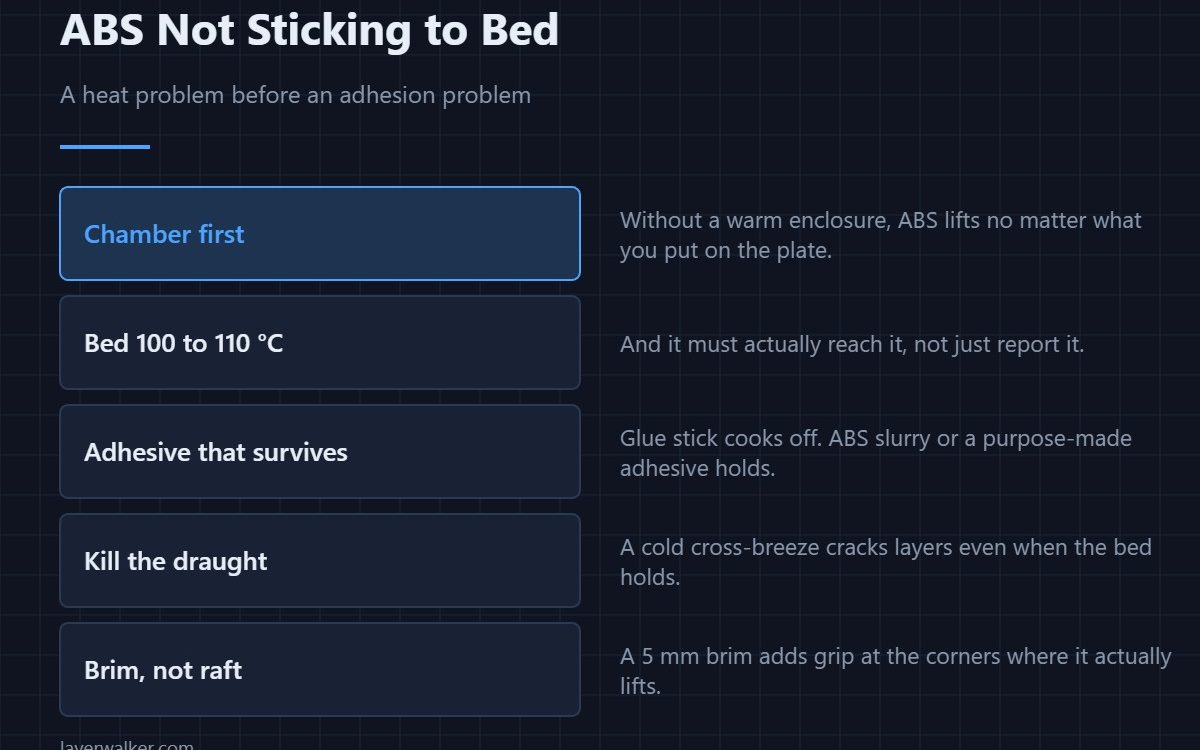
ABS not sticking to bed is a heat problem before it is an adhesion problem. ABS shrinks roughly three times as much as PLA, and as the upper layers cool they pull the corners off the plate. No surface or glue defeats that on an open frame. Get the air around the part warm, run the bed at 100–110 °C, use an adhesive that survives that temperature, and add a brim.
People arrive at this problem with a drawer full of adhesives, having tried all of them. The adhesives are not the variable. A part that lifts on an open printer will lift through glue stick, hairspray and tape alike, because the force pulling it up is the whole part contracting as it cools.
Where to buy


The chamber is the fix
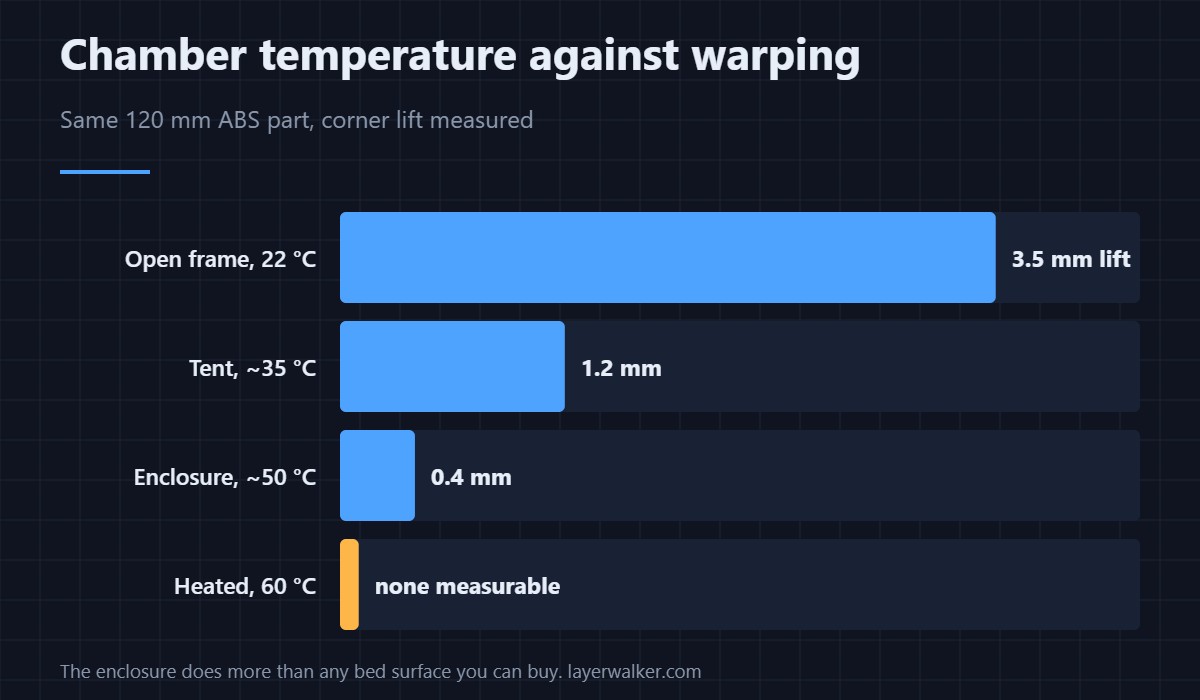
Warm air around the part slows cooling, which reduces the difference in contraction between the layer being printed and the layers below it. That is the entire mechanism. Even a cheap tent that holds 35–40 °C transforms ABS; a proper enclosure at 50 °C makes it routine. Options at both ends of the budget are in building an enclosure.
Bed heat, and whether it is real
Run the bed at 100–110 °C. Then check that it gets there: many 24 V beds sag 10–15 °C at the corners under load, and the thermistor sits in the middle. If your parts always lift at the same corner, measure that corner. The settings by material page has the starting numbers.
Adhesive that survives 110 °C
Ordinary glue stick softens and cooks off at ABS bed temperatures. What works is an ABS slurry — scrap ABS dissolved in acetone, painted thin — or a purpose-made high-temperature adhesive. Garolite is the other classic answer and needs nothing on top of it. On a magnetic plate, check the base is rated for 110 °C, because most stock ones are rated to 100 °C and degrade quickly above it.
ASA not sticking to bed: the same fixes, plus one
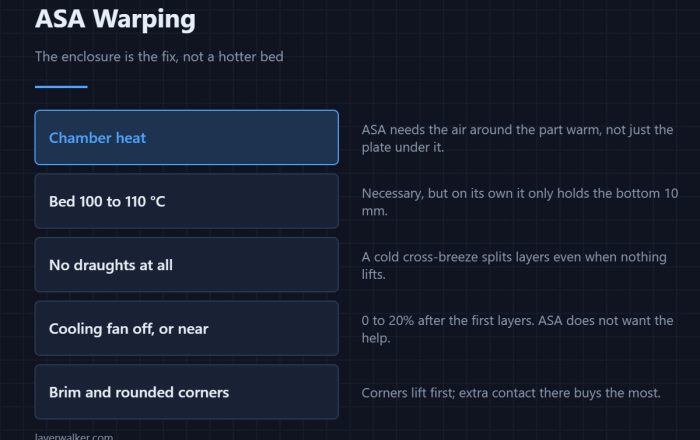
ASA behaves almost identically — same shrinkage, same chamber requirement — with slightly better UV resistance and a slightly wider temperature window. The one addition is cooling: turn the part fan down to 0–20% after the first layers, which matters more for ASA than for ABS. The differences that actually affect printing are in ASA vs ABS, and warping specifically in ASA warping.
Brim, not raft
A 5–8 mm brim adds contact area exactly where lifting starts. A raft adds a whole sacrificial layer that will itself warp, and costs material and time for less benefit. Round or chamfer sharp corners in the model if you can; corners concentrate the peeling force. If parts lift mid-print rather than at the start, that is warping proper.
ABS Not Sticking to Bed FAQ
Can I print ABS without an enclosure?
Small parts, yes, with a brim and no draughts. Anything over about 80 mm across will lift on an open frame regardless of what you put on the plate. A cardboard box over the printer works better than most people expect.
Why does ABS lift halfway up rather than at the start?
Because the force is cumulative. Each layer adds contraction, and at some height it exceeds what the base can hold. That is a chamber problem, not a first-layer one.
Is ABS slurry better than commercial adhesive?
It grips harder and costs nothing if you have scrap ABS and acetone. It is also messy, needs ventilation, and builds up over time. Commercial high-temperature adhesives are more convenient and nearly as good.
What bed surface is best for ABS?
Garolite, then smooth PEI with a high-temperature adhesive. Textured PEI works but grips less than it does with PLA. Whatever you choose, the chamber matters more than the surface.

LayerWalker
Print defect diagnosis, calibration procedures and parts that actually fit. Corrections welcome through the contact page.