PVA Filament: Water Soluble Support That Is Worth the Trouble, Sometimes
LayerWalker is a participant in the Amazon Services LLC Associates Program. We may earn a commission when you buy through links on our site, at no extra cost to you.
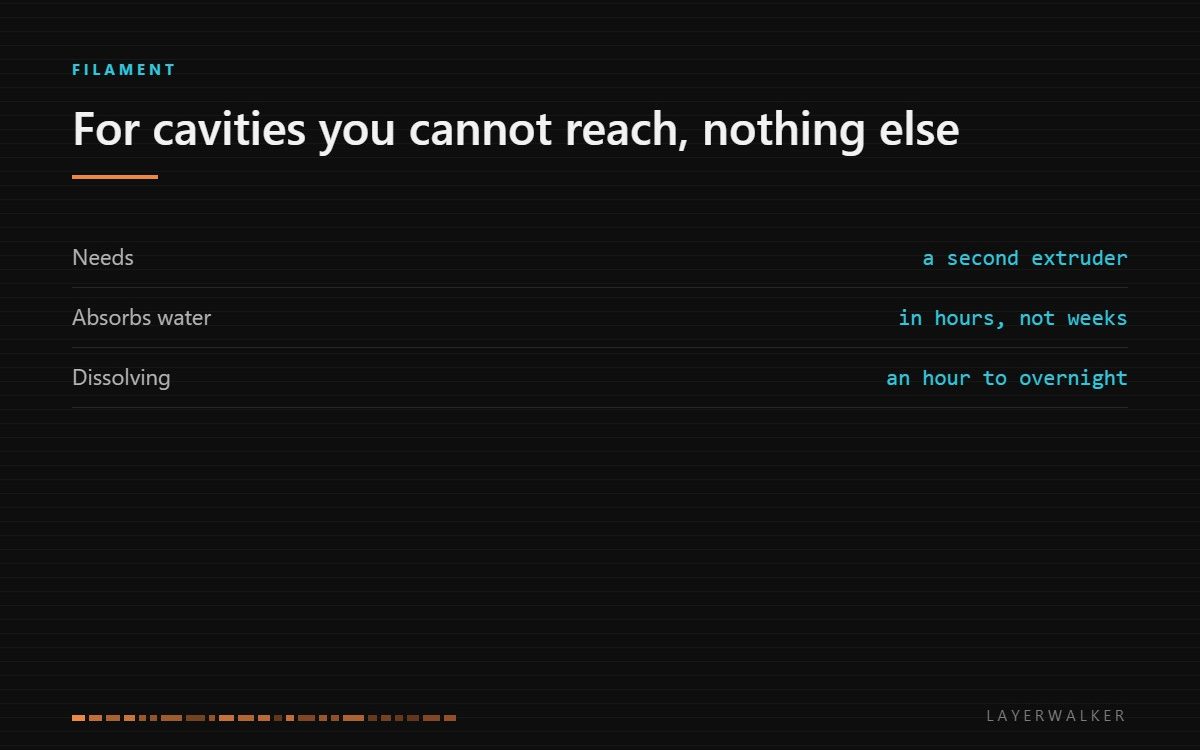
PVA dissolves in water and leaves no scars, which is its whole advantage. It also costs many times what PLA costs, absorbs moisture faster than any common filament, and needs a second extruder. Use it for internal cavities you cannot reach, not for ordinary overhangs.
Where to buy


What to look for
Buy a named brand and buy the smallest useful spool. PVA quality varies more than PLA quality does, and the failure mode of cheap PVA is not a bad print but a clogged hotend, because poorly made PVA chars at temperatures where good PVA is still flowing. Look for a stated print temperature range on the listing; vendors who do not publish one usually have a reason.
Spool size matters because of the shelf-life problem below. A 500 g or 750 g spool used within a few months is better value than a kilogram that absorbs moisture in the cupboard and prints badly for the second half. And a dryer is not optional with this material: PVA picks up water from the air faster than any filament in common use, and the first symptom is not stringing but a blocked nozzle.
What it is actually for
PVA earns its price in exactly one situation: support material in a place you cannot physically reach. Internal channels, enclosed cavities, lattices, a thread inside a housing. Anywhere pliers and a scraper can get to, a breakaway support costs a fraction as much and takes less total time once you count dissolving.
| Approach | Best for | Cost | Time after printing |
|---|---|---|---|
| PVA | Enclosed cavities, fine lattices | High | Hours of soaking |
| Breakaway support filament | Reachable overhangs, clean surfaces | Medium | Minutes with pliers |
| Same-material support | Most parts | Lowest | Minutes, sometimes scarring |
| Redesigning the part | Anything you control the geometry of | None | None |
The last row is the one people skip. Splitting a model into two pieces that each print without support, then gluing them, is usually faster and always cheaper than printing soluble support. Our page on tree and normal supports covers getting more out of ordinary support before you spend on PVA.
The moisture problem is worse than you expect
PVA is hygroscopic by design; being water-loving is how it dissolves. That means it absorbs atmospheric humidity within hours rather than weeks, and wet PVA behaves badly in a specific way: it foams and bubbles in the melt zone, then the bubbles collapse and leave gaps, and the softened material swells against the heatbreak and jams.
Practical consequences. Keep it sealed with desiccant from the moment it arrives, not from the moment it prints badly. Dry it before every session, not once when it was new. And print it straight from a dryer if you have one that feeds, because even a few hours on an open shelf is enough to undo the drying.
Dissolving takes longer than the packaging says
Warm water and agitation help; hot water helps more but can deform PLA parts, so there is a ceiling. A thin support structure on an exposed face can be gone in an hour. A dense support filling an internal channel can take overnight, and needs the water changed partway because the dissolved PVA saturates it and slows everything down.
Two things speed it up honestly. Reducing support density so there is less material to dissolve, and using PVA only for the interface layers with a cheaper material behind it, which most slicers support directly. That second trick cuts PVA consumption dramatically and is the single biggest saving available.
Do not pour the resulting water down a drain you care about in quantity; dissolved PVA is a gel that can build up. Dilute heavily or dispose of it outside the plumbing.
You need the hardware for it
PVA support needs a machine that can print two materials: a dual extruder, a toolchanger, or a multi-material feeder. On a single-extruder machine there is no way to use it for support at all. This is the practical reason most people never touch it, and it is worth saying plainly before anyone buys a spool.
FAQ
Does PVA work with PETG? Less well than with PLA. The temperature ranges overlap poorly and adhesion between them is inconsistent.
How long does a spool last? In sealed storage with desiccant, a long time. Left open, it can be unusable within days.
Can I use it on a single extruder printer? Not as support. There is no way to alternate materials within a layer.
Is BVOH better? It dissolves faster and tolerates more materials, at a higher price. Same storage problem.

LayerWalker
Print defect diagnosis, calibration procedures and parts that actually fit. Corrections welcome through the contact page.