The Best Glue for 3D Prints: What Bonds PLA, PETG and ABS Properly
LayerWalker is a participant in the Amazon Services LLC Associates Program. We may earn a commission when you buy through links on our site, at no extra cost to you.
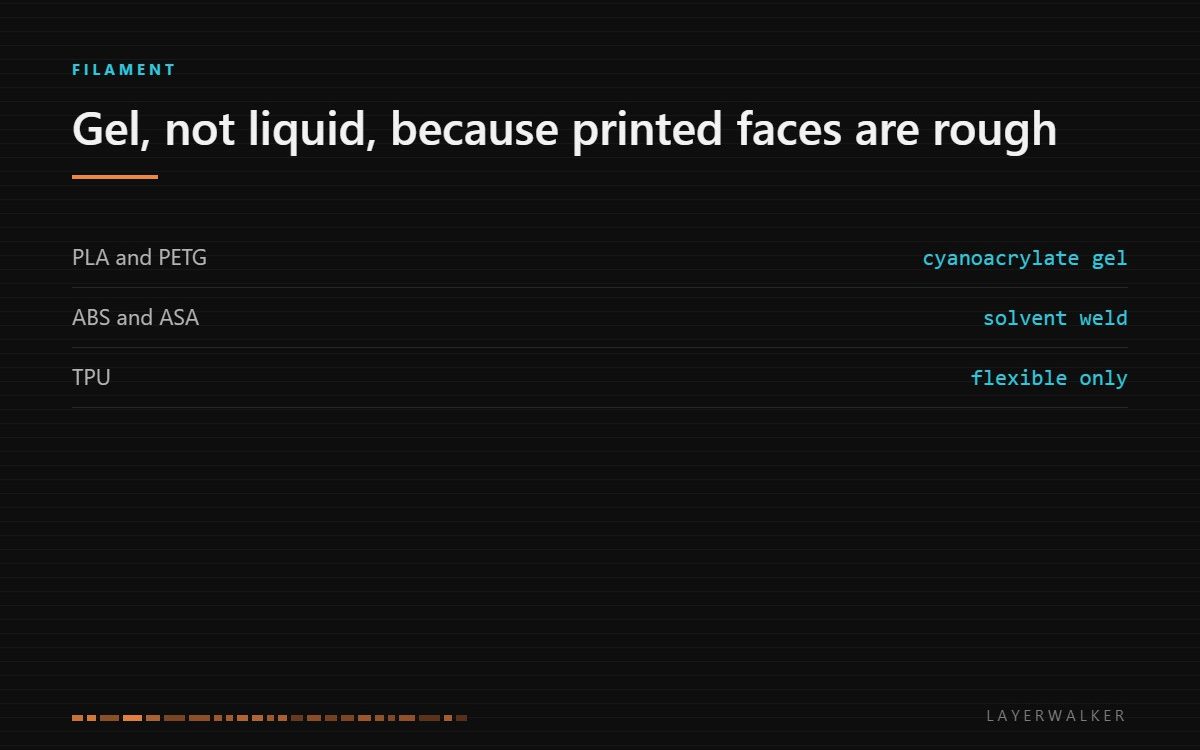
Cyanoacrylate gel is the right default for PLA and PETG: it fills the roughness of a printed face and sets in seconds. ABS bonds better with a solvent weld than with any glue. TPU needs a flexible adhesive, because a rigid one cracks at the joint.
Where to buy


What to look for
Buy the gel, not the liquid. Printed mating faces are never flat at the microscopic scale, and thin cyanoacrylate runs off the high spots and out of the joint before it can bridge the gaps. A gel stays where you put it and fills the layer texture, which is exactly the surface you are gluing.
A controlled applicator is worth more than the brand. Most of a small bottle of superglue is wasted through a nozzle that either floods or clogs shut, and a side-squeeze or precision tip pays for itself on the second use. Buy small bottles rather than one large one: cyanoacrylate begins curing from atmospheric moisture as soon as it is opened, and a half-used large bottle usually goes solid before it is finished.
Matching adhesive to material
| Material | First choice | Notes |
|---|---|---|
| PLA | Cyanoacrylate gel | Bonds well. Two-part epoxy for larger structural joints. |
| PETG | Cyanoacrylate gel | Slightly slower to grab; clamp for a minute rather than holding |
| ABS and ASA | Solvent weld with acetone | Dissolves and fuses the plastic; stronger than any surface glue |
| TPU | Flexible cyanoacrylate or polyurethane | A rigid joint cracks the first time the part flexes |
| Nylon | Two-part epoxy, after abrasion | Low surface energy; nothing sticks to it easily |
Why a solvent weld beats glue on ABS
Glue is a third material sitting between two surfaces, and the joint can only be as strong as its grip on each of them. A solvent weld is different in kind: acetone softens the surface of both ABS parts, they are pressed together, and as the solvent evaporates the two become one piece of plastic. There is no interface left to fail.
This is why ABS remains attractive for assemblies despite being harder to print than PLA. It is also why the same trick does not work on PLA: no household solvent dissolves PLA usefully, so every PLA joint is a glued joint. Work in ventilation, use the smallest amount that wets the surface, and clamp until it is firm.
Preparing the surface actually matters
Three things decide whether a joint holds, and the glue is only one of them. Fit is first: a gap larger than the glue can bridge is a gap the glue cannot bridge, and on printed parts that usually means designing the mating faces flat and solid rather than curved and sparse. Second is infill at the joint, because a face that is 15 percent infill under a thin wall is mostly air, and the glue can only hold the skin. Add wall count or a solid region where parts meet.
Third is cleanliness. Release agents, bed adhesive residue and fingerprints all reduce the bond, and a wipe with alcohol before gluing costs nothing. Do not confuse this with bed adhesive: that is about making a print stick to the plate while it is being made, and our bed adhesive page covers that separate job.
Epoxy, and when to reach for it
Two-part epoxy is slower, messier and stronger in the cases where cyanoacrylate falls short: large surface areas, joints under sustained load, gaps that need filling, and materials that superglue struggles with. It also tolerates a poor fit, because the epoxy itself has structural strength where a thin cyanoacrylate line does not.
For a printed part that will be handled or loaded, the practical rule is cyanoacrylate for alignment and speed, epoxy for anything that must not come apart. On a large model, tacking with gel and then running epoxy along the inside of the seam gives you both.
FAQ
Does superglue work on PLA? Yes, and gel works better than liquid because printed faces are rough.
Will acetone glue PLA? No. Acetone is for ABS and ASA. On PLA it does very little.
Why does my joint keep failing? Usually infill, not glue. A sparse interior means the bond only holds the outer skin.
Can I glue TPU? With a flexible adhesive. A rigid bond transfers all the flexing to the joint edge and splits it.

LayerWalker
Print defect diagnosis, calibration procedures and parts that actually fit. Corrections welcome through the contact page.