Heat Set Inserts for 3D Printing: Hole Size, Iron Temperature and Seating
LayerWalker is a participant in the Amazon Services LLC Associates Program. We may earn a commission when you buy through links on our site, at no extra cost to you.
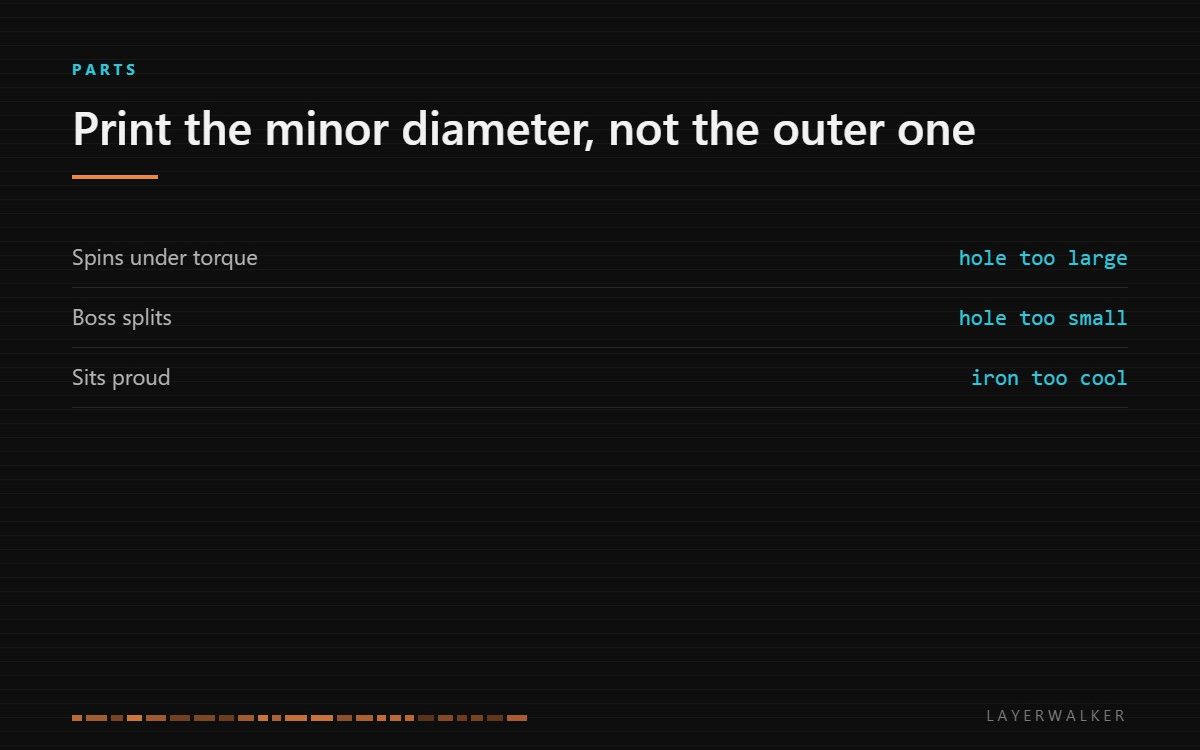
Print the hole at the insert’s minor diameter, not its outer diameter. Set the iron just above the plastic’s softening point, press straight down under the insert’s own resistance, and stop when the flange is flush. Most failures are an oversized hole.
Where to buy


What to look for
Buy an assortment box rather than one size. You will not know which thread a project wants until you are designing it, and the common metric sizes cost little together. Quality varies more than the price suggests: the knurling pattern is what grips the plastic, and cheap inserts with shallow, uniform knurls spin out under torque where a properly barbed insert does not.
For the tool, a soldering iron with dedicated insert tips is a real improvement over a bare conical tip. The tip sits inside the insert and presses on its top face, which keeps the insert square and stops it tipping as the plastic softens. A kit that bundles the iron with the inserts is the cheapest route in; if you already own a temperature-controlled iron, buy tips alone. A digital caliper belongs on this list too, because every problem below is a diameter problem and you cannot fix what you are not measuring.
The hole is the whole job
A heat set insert works by melting a small volume of plastic and letting it flow into the knurling, then solidify around it. That requires the right amount of plastic: too little and there is nothing to grip, too much and the insert will not seat without bulging the boss.
The number to print is the insert’s minor diameter, which is the smaller diameter between the knurl peaks, not the outer diameter across them. Manufacturers publish a recommended hole size and it is usually a few tenths below the outer diameter. Print a test coupon with three or four hole sizes before committing a real part, because the effective hole your printer produces differs from the one in the model by an amount that depends on your flow calibration.
| What happens | Cause | Fix |
|---|---|---|
| Insert spins under torque | Hole too large; nothing flowed into the knurl | Reduce hole diameter |
| Boss bulges or splits | Hole too small; displaced plastic has nowhere to go | Increase hole, add wall thickness around it |
| Insert sits proud | Not enough heat, or pushed too fast | Raise temperature slightly, slow down |
| Insert sinks crooked | Freehand pressure off axis | Use an insert tip; press straight down |
Temperature by material
Set the iron above the plastic’s softening point and no higher than you need. Too cool and you push rather than melt, which bulges the boss; too hot and the plastic scorches, smokes and loses strength around the insert. PLA softens lowest and needs the least; PETG needs more; ABS and ASA more again; nylon and polycarbonate are higher still and benefit from a fast, confident press.
Work up rather than down. Start low, try a coupon, and raise in small steps until the insert descends under light pressure. If you find yourself leaning on the iron, the temperature is too low, not the hole too small, and that is the single most common misdiagnosis.
Designing the boss
Give the insert material to grip. A boss with a single perimeter around the hole will split whatever you do; three or four walls, or a solid region defined in the slicer around the hole, gives the insert something to bite. Leave a small relief pocket at the bottom of the hole so displaced plastic has somewhere to go rather than pushing the insert back out.
Orientation helps too. An insert going into a face printed flat on the plate seats into solid layers. One going into a side wall is entering the layer stack edge-on, and under load it tends to split between layers rather than strip the plastic. Where you have the choice, put threaded bosses on horizontal faces.
When to use something else
Heat set inserts are the right answer for repeated assembly, for anything that will be taken apart, and for thread sizes that would strip in plastic. They are unnecessary for a part assembled once and never opened, where a self-tapping screw straight into a correctly sized pilot hole is quicker and holds well enough. They are also not the answer for high load in a thin wall, where a through bolt and a captive nut carries far more.
The failure mode worth planning for is pull-out rather than thread strip. Brass holds the thread easily; what gives way is the plastic around the knurling, so the design question is always how much plastic surrounds the insert rather than which insert to buy.
FAQ
What hole size for an M3 insert? Use the manufacturer’s stated hole size, then verify on a test coupon with your own flow settings.
What temperature should the iron be? Just above the material’s softening point. Start low and raise until the insert descends under light pressure.
Can I press inserts without a special tip? You can, and they go in crooked more often. The tip keeps the insert square.
Do inserts weaken the part? They strengthen the thread and slightly weaken the boss. Add walls around the hole to compensate.

LayerWalker
Print defect diagnosis, calibration procedures and parts that actually fit. Corrections welcome through the contact page.