ERYONE Thinker X400: A 400 mm Cube, and What That Envelope Costs You
LayerWalker is a participant in the Amazon Services LLC Associates Program. We may earn a commission when you buy through links on our site, at no extra cost to you.
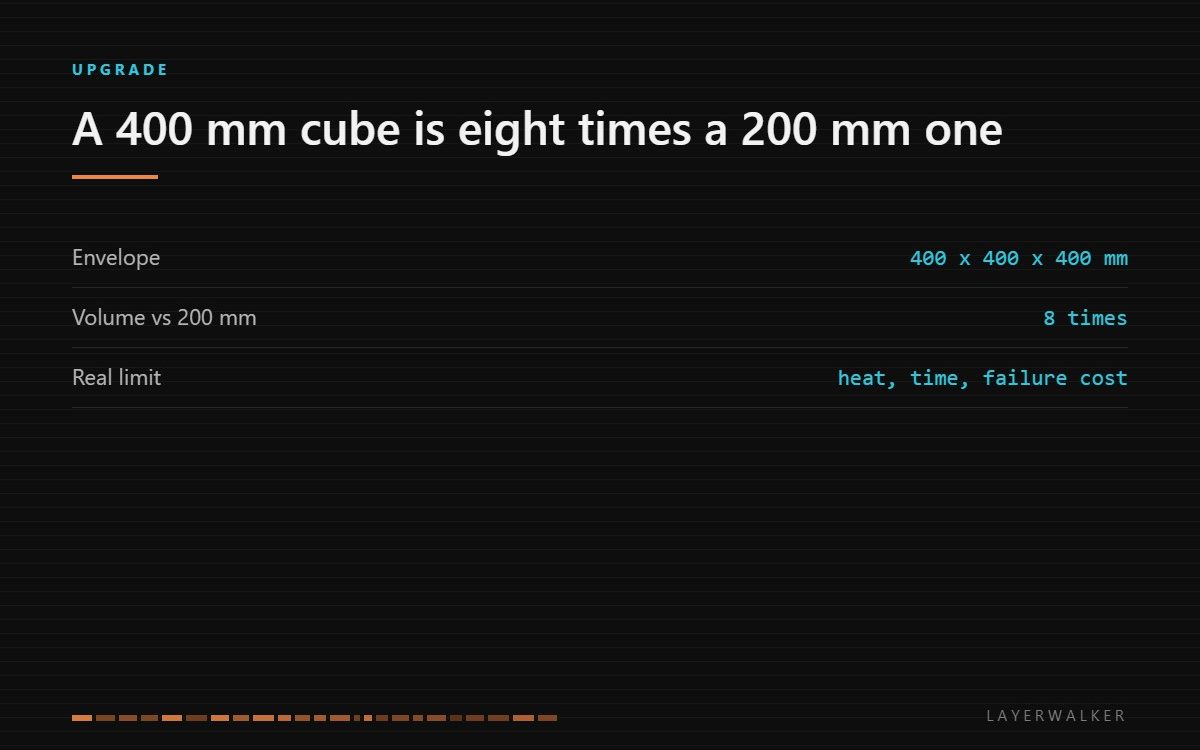
A 400 mm cube holds eight times what a 200 mm cube does. That sounds like the whole story and it is not: at this size the binding constraints become warping, print duration and what a failure costs you, not whether the part fits.
Where to buy


What the envelope genuinely buys
Parts that do not need splitting. Anything you would otherwise print in sections and glue comes out as one piece, which removes the joint, the alignment jig and the assembly time. For helmets, enclosures, brackets that span a machine, and full-size props, that is a real change in what you can make rather than a convenience.
It also buys batch capacity. Because an FDM layer takes time proportional to the path length, filling a large bed with many small parts is not free the way it is on a resin printer, but it does cut the number of times you have to come back and clear the plate.
The costs that are not on the spec sheet
Warping scales with the footprint. A part 350 mm long shrinks far more in absolute terms than one 150 mm long, and that shrinkage is what pulls corners off the bed. At this size an enclosure stops being optional for anything but PLA, and bed flatness matters more than any calibration routine can compensate for.
Time scales too. A tall part on a large machine is a multi-day print, and multi-day prints change your risk: a power blip, a spool tangle or a blocked nozzle at hour forty costs a lot more than the same fault at hour two. Plan for filament runout sensing and power-loss recovery rather than treating them as extras.
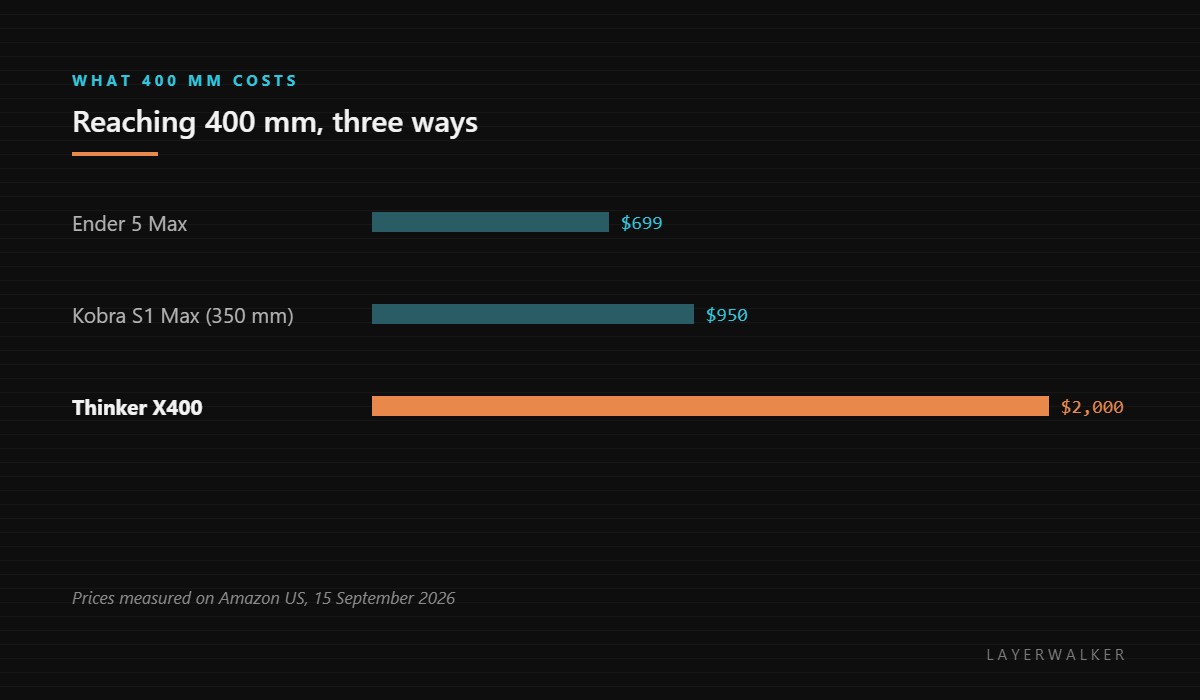
And failure cost scales worst of all. A failed 400 mm part is several hundred grams of filament and days of machine time. That is the real argument for paying more at this size: not features, but a machine that holds calibration and finishes what it starts.
Cheaper ways to the same result
Before buying the envelope, check whether the parts actually need it. Splitting a model and joining it with alignment pins and glue is often stronger than a single printed piece, because you can orient each section for strength rather than accepting one compromise orientation. Our page on joining printed parts covers doing that properly.
If the size is genuinely needed, our large format guide covers the trade-offs across the category and the largest machines available covers the tier above this one.
FAQ
Do I need an enclosure at this size? For anything that warps, yes. PLA can manage without; ABS and ASA cannot.
How long is a full-height print? Days rather than hours. Budget for interruptions.
Is a large printer slower? Per part, usually yes, because the gantry is heavier and acceleration is lower.
Should I split parts instead? Often. A well-designed joint can be stronger than a single print, and it de-risks the job.

LayerWalker
Print defect diagnosis, calibration procedures and parts that actually fit. Corrections welcome through the contact page.