Printing Nylon: What Your Printer Needs Before You Buy a Spool
LayerWalker is a participant in the Amazon Services LLC Associates Program. We may earn a commission when you buy through links on our site, at no extra cost to you.
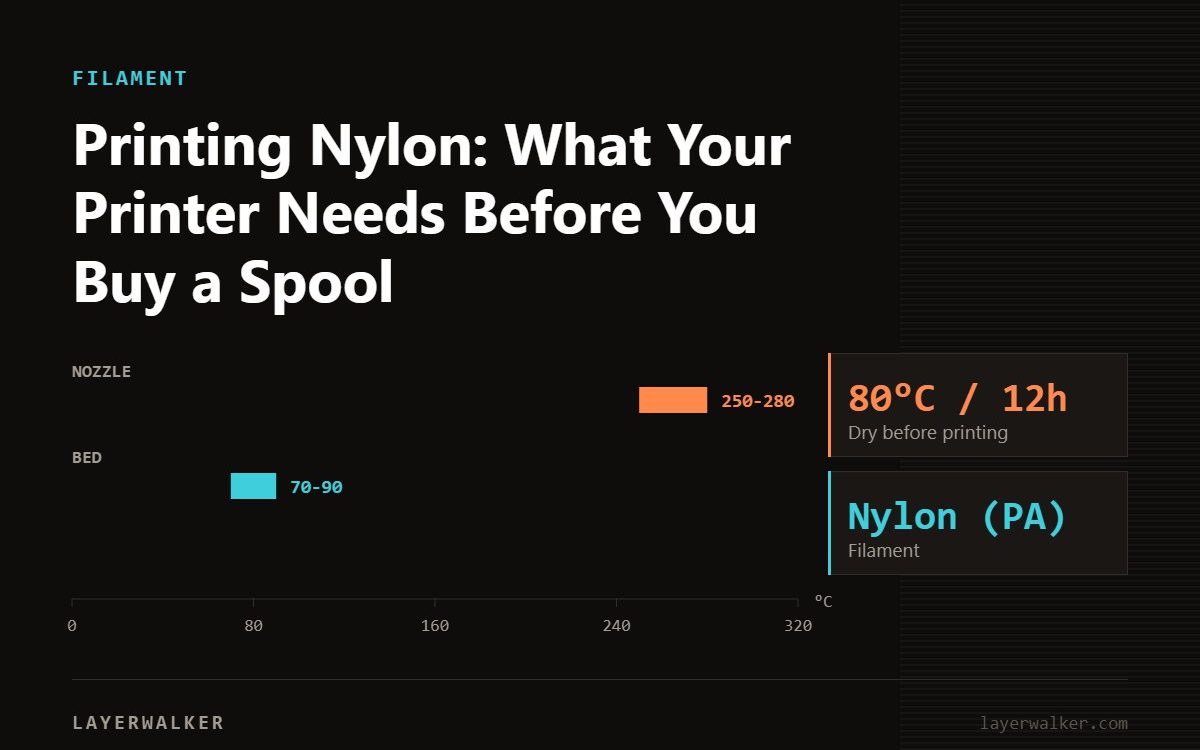
You can print nylon if your hotend reaches 260 °C reliably, you have a filament dryer with print-through feed, and you can enclose the printer or at least kill every draught. Start with an unfilled PA6 or PA12 for pure toughness, or a carbon-fibre nylon for stiff, dimensionally stable parts on a hardened nozzle.
Nylon is the material for gears, hinges, clips that live under load and parts that get hit. Nothing else printable at home combines its toughness, wear resistance and fatigue life. It is also the material that punishes a printer that is not ready for it: it absorbs water faster than anything else in the drawer, it needs heat that a stock PTFE-lined hotend cannot safely deliver, and it lifts off the bed like ABS on a cold day. Get the printer right first and nylon is repeatable.
Where to buy


Nylon Filament Black PA6 Nylon 6+66 3D Printer 1.75mm Polyamide 1KG

Polymaker Fiberon PA6-CF20 Carbon Fiber Nylon Filament 1.75mm, Black, 0.5kg
What the printer needs
- A hotend rated for 260 to 280 °C. All-metal or a modern high-temperature PTFE-lined design. Old PTFE liners degrade at these temperatures and release fumes.
- A hardened nozzle if the nylon is fibre-filled. Unfilled nylon is fine on brass; CF-nylon wears brass out in a spool. See the hardened nozzle guide.
- A dryer with print-through feed. Nylon absorbs enough water in a few hours to ruin a print. It must feed from a dryer or a sealed dry box, not an open spool holder.
- An enclosure or a draught-free room. Nylon shrinks and lifts. A bed at 70 to 90 °C and still air are the minimum; a warm chamber is better.
- A bed surface nylon sticks to. Garolite (G10) is the classic, or PEI with a PVA glue-stick layer. Bare PEI and glass often let go.
Which nylon to start with
- Unfilled PA6 or PA6/66 blends. Maximum toughness and wear resistance, most moisture-sensitive, most warp. The classic gear material.
- PA12. Absorbs less water, warps less, slightly less stiff. The easier first nylon.
- Carbon-fibre nylon (PA6-CF, PA12-CF). The fibres stop the warp and add stiffness; the part is dimensionally stable and has a matte finish. Needs a hardened nozzle, prints far more easily than unfilled nylon, and is what most people actually want.
The spools in the box
Overture’s nylon is an unfilled PA spool with a tight tolerance and a wide temperature window, a fair first nylon. The CHCKX PA6 and 6/66 blend is the tough gear-grade option. Polymaker’s Fiberon PA6-CF20 is the carbon-fibre nylon: 20 % fibre, stiff, low-warp, and the one to buy if the goal is a functional part rather than an experiment in printing nylon.
Settings that work
- Dry at 80 °C for 8 to 12 hours if your dryer reaches it, 70 °C for longer if not. See the drying guide. Then print from the dryer.
- Nozzle 250 to 270 °C unfilled, 260 to 290 °C for CF grades. Follow the spool.
- Bed 70 to 90 °C on glue-stick PEI or Garolite. Brim of 5 to 8 mm on anything with a flat base.
- Fan 0 to 20 %. Slow, 30 to 60 mm/s for unfilled; CF grades tolerate more.
- Warm the chamber. If corners lift, it was cold or draughty.
When nylon is the wrong choice
Parts that need to hold a tight dimension straight off the bed: nylon absorbs water after printing and swells slightly. Parts that must stay stiff under constant load: nylon creeps; CF grades much less. Anything you can make in PETG: make it in PETG first.
If you are choosing on strength rather than on material, the toughest filaments compared sets nylon against polycarbonate and the carbon-filled grades. For sustained heat, PPA-CF is the next step up.
Nylon 3D printing FAQ
Can I print nylon on a stock Ender 3?
Not reliably. The hotend limit and the open frame both work against it. An all-metal hotend and an enclosure change that.
Why are my nylon parts white and foamy?
Water. Dry the spool longer and print from the dryer.
Do I need to anneal nylon?
For maximum strength and stability, a few hours at 80 to 90 °C helps. For most parts it is optional.

LayerWalker
Print defect diagnosis, calibration procedures and parts that actually fit. Corrections welcome through the contact page.