PPA CF Filament (PPA-CF): Stiffer Nylon, Same Thirst for Water
LayerWalker is a participant in the Amazon Services LLC Associates Program. We may earn a commission when you buy through links on our site, at no extra cost to you.
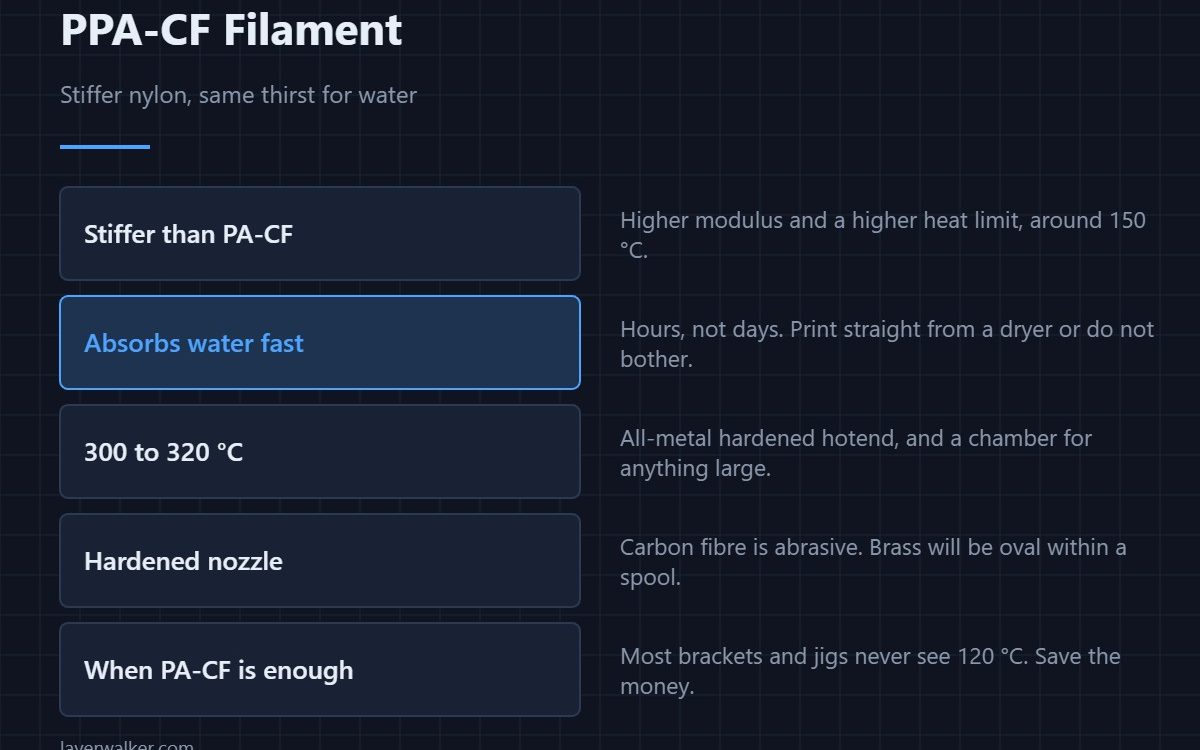
PPA CF filament, written PPA-CF on most spools, is carbon-filled polyphthalamide, a high-performance nylon. Against ordinary PA-CF it is stiffer and holds its shape to roughly 150 °C instead of 120 °C. It also absorbs water within hours rather than days, so it is a print-from-the-dryer material. It needs 300–320 °C, a hardened nozzle and, for anything large, a heated chamber.
PPA sits between ordinary nylon and the specialty polymers. It is the material Bambu and Qidi both push as their top engineering grade, and it is a reasonable ceiling for a well-equipped consumer machine — unlike PPS-CF, which really wants industrial hardware.
Where to buy


Moisture is the whole story
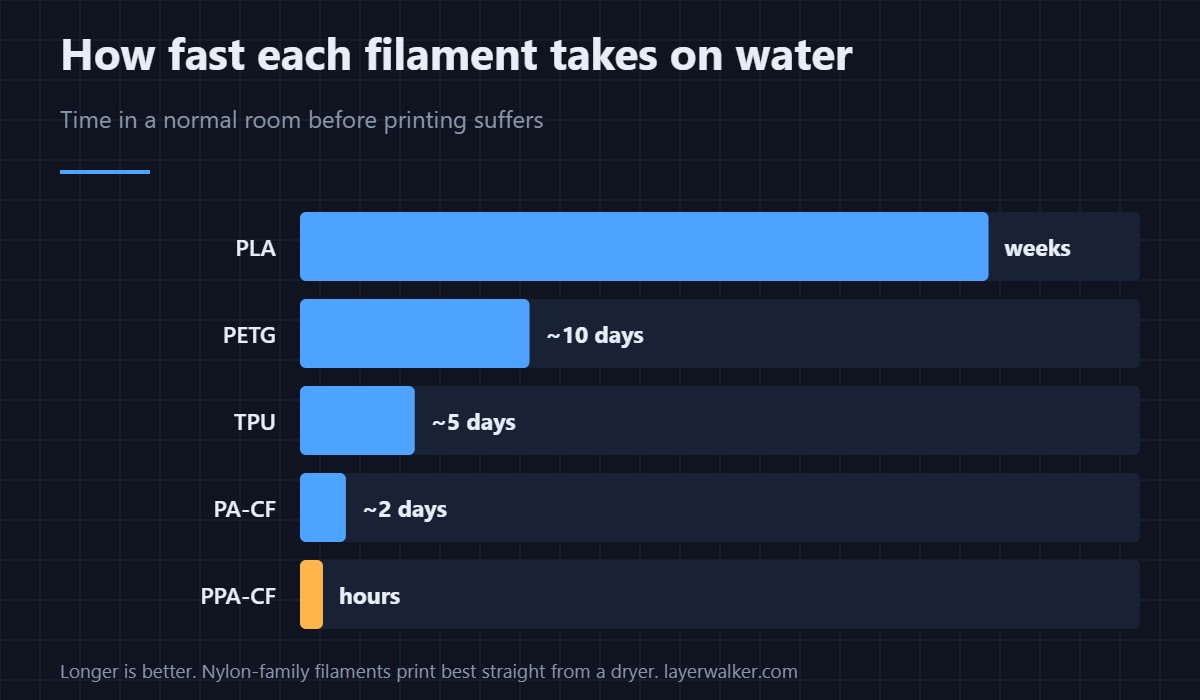
Every nylon drinks water, and PPA drinks it fastest. A spool left on the bench through lunch has already started. The symptoms are steam-popping at the nozzle, a rough matt surface where it should be satin, and parts that snap instead of bending. There is no setting that compensates. Print from a heated dry box, or dry at 90 °C and start immediately — the method is in drying filament, and keeping it dry is in storage.
What PPA CF filament needs from the printer
All-metal hotend at 300–320 °C, a hardened nozzle at 0.6 mm for preference, bed at 100–110 °C, and an enclosure. A heated chamber is not strictly required for small parts but makes large ones possible. Part cooling near zero, as with any nylon — cooling is what splits the layers.
PPA-CF or PA-CF
PA-CF is cheaper, easier, and enough for most brackets, jigs and drone frames. Step up to PPA-CF when the part sees sustained heat above about 120 °C, or when you need the extra stiffness and dimensional stability — PPA moves less with temperature and humidity than PA does. For everything else, PA-CF is the better value and the easier print.
Designing for it
Carbon fill makes it stiff but also more brittle than unfilled nylon: it resists bending and then cracks rather than yielding. Avoid thin unsupported features and sharp internal corners. Layer adhesion is the weak axis, as always, so orient loads across layers rather than along them. If impact is the main worry rather than heat, unfilled nylon or polycarbonate absorbs more energy.
PPA CF Filament FAQ
How long can PPA-CF sit out before it is too wet?
Hours in a normal room, not days. Treat any spool that has been open and unsealed as wet, and dry it before printing rather than testing your luck.
Do I need a heated chamber for PPA-CF?
For small parts, a passive enclosure is usually enough. For anything over about 100 mm, a heated chamber is what stops warping and layer splitting.
Is PPA-CF stronger than PA-CF?
Stiffer and more heat resistant, yes. Tougher under impact, no — PA-CF absorbs more energy before it breaks. Choose on the failure mode you expect.
Can I print PPA-CF with a 0.4 mm nozzle?
You can, but filled filaments clog more easily at 0.4 mm and the chopped fibres do not do fine detail any favours. 0.6 mm hardened is the practical choice.

LayerWalker
Print defect diagnosis, calibration procedures and parts that actually fit. Corrections welcome through the contact page.