Polymaker Filament: What Each Range Is Actually For
LayerWalker is a participant in the Amazon Services LLC Associates Program. We may earn a commission when you buy through links on our site, at no extra cost to you.
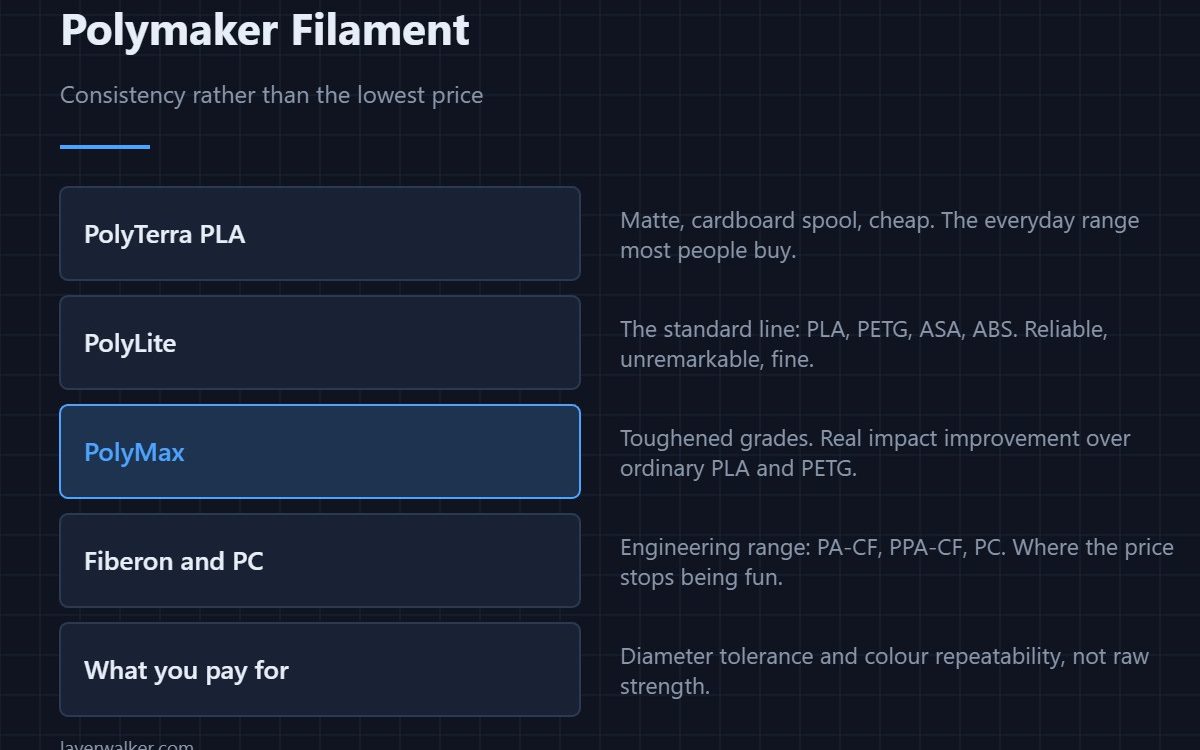
Polymaker filament is bought for consistency rather than for price or raw strength. The ranges split cleanly: PolyTerra is the cheap matte everyday PLA, PolyLite is the standard line, PolyMax is genuinely toughened, and the Fiberon and PC ranges are the engineering materials. What the premium buys is tight diameter tolerance and colours that match between orders.
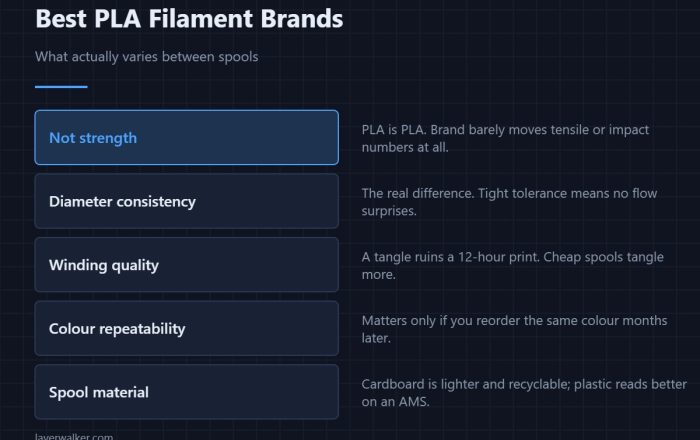
Filament brands mostly sell the same polymers from the same suppliers, so the differences that matter are industrial rather than chemical: how tightly the diameter is held, how well the spool is wound, and whether the colour is the same next time. Polymaker is one of the few brands whose reputation rests squarely on those.
Where to buy

Polymaker PolyLite PLA Pro Filament 1.75mm 1KG Black


The ranges, briefly
- PolyTerra PLA. Matte finish, cardboard spool, cheapest in the lineup. The everyday choice, and the matte hides layer lines well.
- PolyLite. The standard line across PLA, PETG, ASA and ABS. Unremarkable in the good way.
- PolyMax. Toughened grades. The impact improvement over ordinary PLA and PETG is real, not marketing.
- Fiberon and PC. PA-CF, PPA-CF, polycarbonate. Engineering prices.
Where the money actually goes
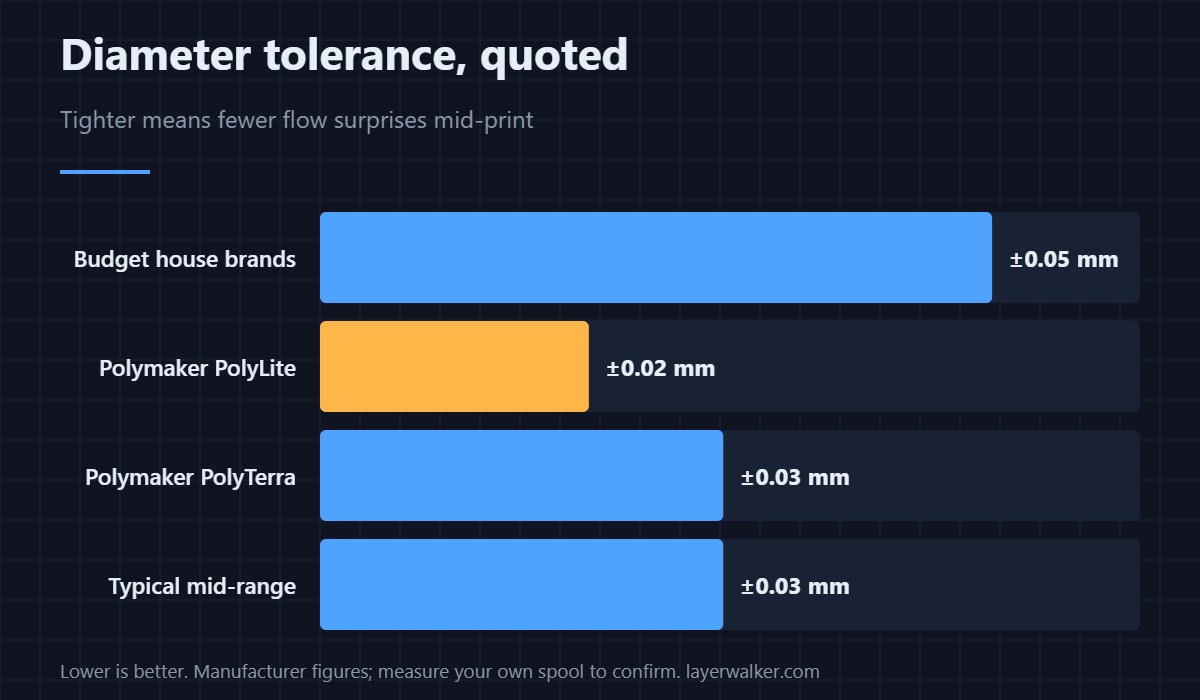
Not into strength. PLA is PLA, and a Polymaker spool will not print a stronger bracket than a budget one. It goes into diameter held to roughly ±0.02 mm, which means the flow rate you calibrated at the start of a print still applies at the end, and into winding that does not tangle at hour nine. The same argument, applied across brands, is in best PLA filament brands.
Where to save money instead
For prototypes, draft parts and anything you will throw away, a cheap house brand such as Inland does the job. Save the consistency premium for long prints, multi-colour work where a tangle wastes a whole plate, and parts where dimensions matter. The wider brand comparison is in best filament brands, and Overture PETG is the usual mid-range alternative.
Practical notes
PolyTerra ships on cardboard spools, which are lighter and recyclable but read less reliably on AMS-style RFID systems, and can go soft if stored somewhere damp. PolyMax PETG is noticeably easier to print than most PETG. And Polymaker publishes real datasheets, which matters far more once you move into the engineering grades than it does for PLA.
Polymaker Filament FAQ
Is Polymaker worth the extra over a budget brand?
For long prints and dimensional parts, yes — fewer tangles and steadier flow. For draft prints, no. Buy cheap filament for iteration and good filament for the final part.
What is the difference between PolyLite and PolyTerra?
PolyTerra is matte, on a cardboard spool, and cheaper. PolyLite is the standard glossy line with a wider material range. Neither is stronger than the other in any way you will notice.
Is PolyMax actually tougher?
Yes. It is a modified formulation, not a marketing label, and the impact difference against standard PLA is measurable. Whether you need it depends on whether your parts get dropped.
Do the cardboard spools work with an AMS?
Mechanically yes, though they lack the RFID tag that lets the system identify the material automatically, so you set it by hand. Keep them dry; cardboard sags in humidity.

LayerWalker
Print defect diagnosis, calibration procedures and parts that actually fit. Corrections welcome through the contact page.