Polycarbonate Filament: Strongest Common FDM Plastic, and the Fussiest
LayerWalker is a participant in the Amazon Services LLC Associates Program. We may earn a commission when you buy through links on our site, at no extra cost to you.
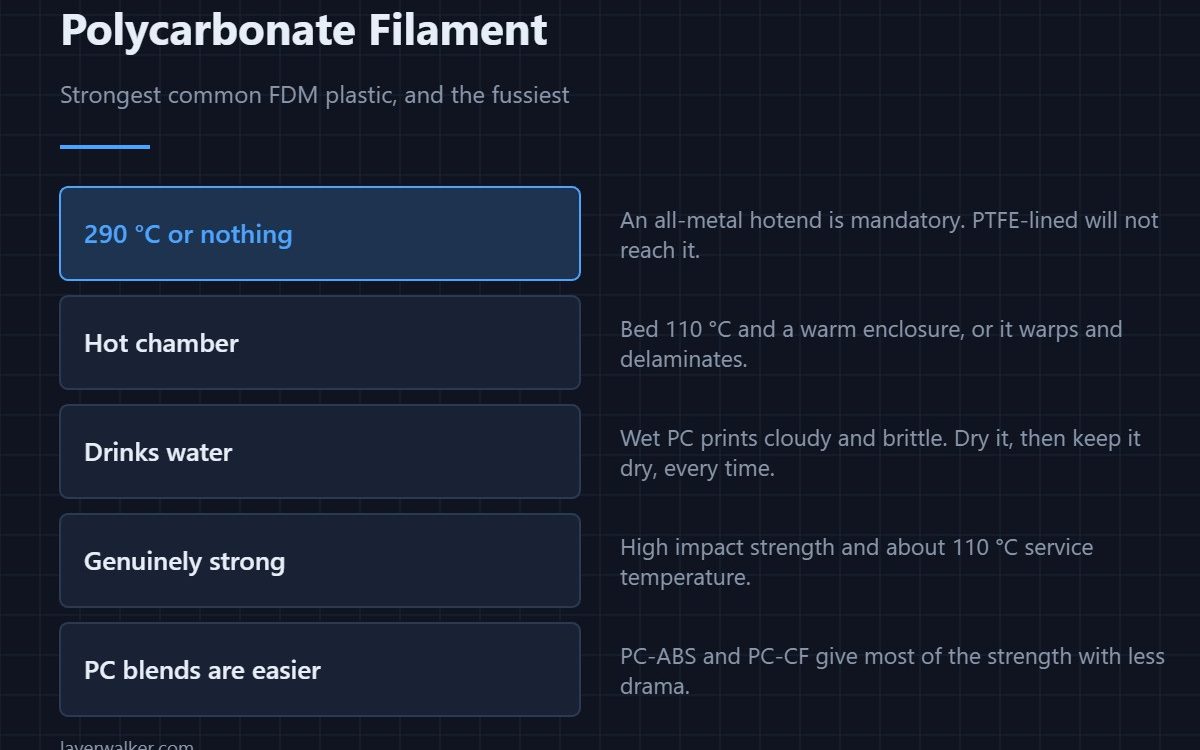
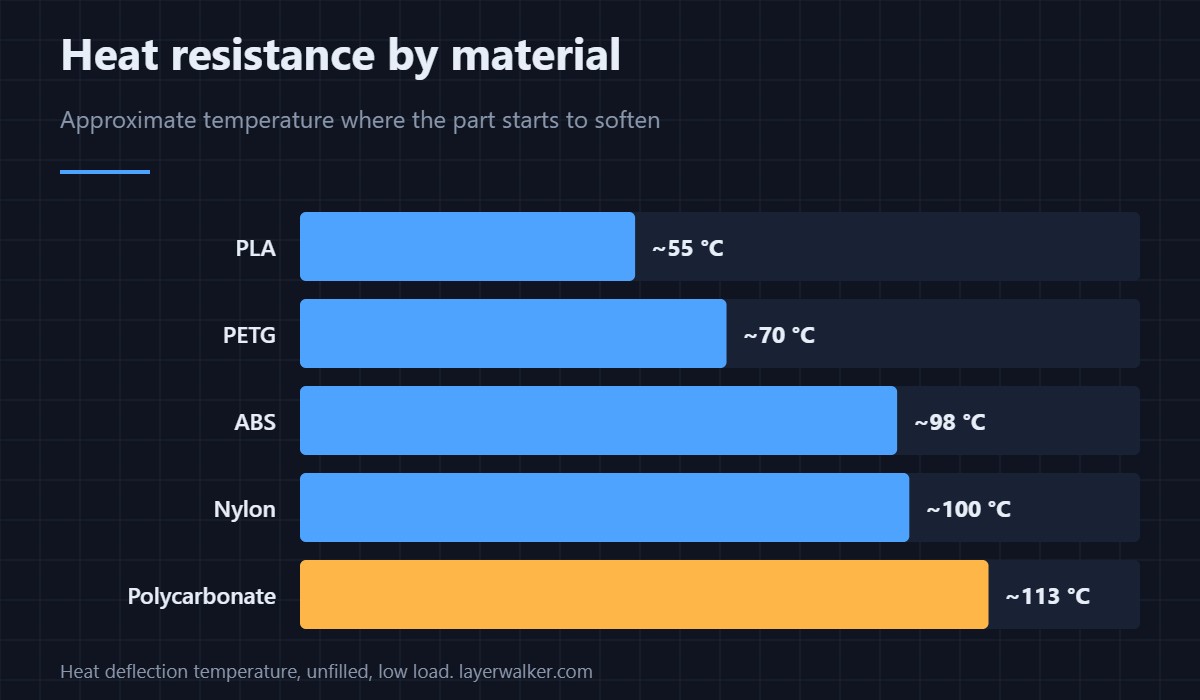
Polycarbonate filament, often sold as PC filament, is the strongest and most heat-resistant plastic most hobby printers can handle: about 110 °C service temperature and very high impact strength. It demands 280–300 °C, an all-metal hotend, a bed at 110 °C and a warm enclosure. Print it wet and it comes out cloudy and brittle, which is how most people’s first attempt goes.
PC is what riot shields and safety glazing are made from, and printed parts genuinely inherit some of that. It is also the material that punishes every shortcut: the wrong hotend, an open frame, or a spool left out overnight each ruin it in a different way.
Where to buy


8Pcs 3D Printer Upgraded Hardened Steel MK8 Nozzles w/DIY Tool Storage Box

The hardware it demands
An all-metal hotend is mandatory — a PTFE-lined one cannot safely reach 290 °C, and the liner will degrade and off-gas before you get there. The bed needs 100–110 °C and an adhesive that survives it. And the chamber needs to be warm: PC shrinks in the ABS range, and a large part on an open frame will delaminate rather than simply lift.
Moisture is the usual failure
PC absorbs water quickly and the symptom is distinctive: the part comes out cloudy instead of translucent, and it snaps instead of bending. People conclude the filament is bad when it was merely damp. Dry it at 80 °C for at least six hours, print straight from a dryer if you can, and store it sealed. The routine is in drying filament and storage.
Blends are usually the better buy
Straight PC is hard work. PC-ABS trades some heat resistance for much easier printing and far less warping. PC-CF adds carbon fibre for stiffness and dimensional stability, at the cost of needing a hardened nozzle. For most people wanting “strong and heat resistant”, a blend delivers 80% of the benefit with a fraction of the difficulty.
Where it earns its place
Parts that live in a hot car, in an engine bay, near a heat source, or that take repeated impact. For outdoor use specifically, PC yellows under UV unless stabilised — ASA is usually the better outdoor choice. And if the requirement is toughness rather than heat, compare the options in toughest 3D filament.
Polycarbonate Filament FAQ
Can I print polycarbonate on an Ender 3?
Only after an all-metal hotend upgrade, and only small parts, and only in an enclosure. The stock hotend cannot reach the temperature safely. PC-ABS is a more realistic target for that class of machine.
Why are my polycarbonate prints cloudy and brittle?
Moisture, almost certainly. Wet PC loses its transparency and its impact strength at the same time. Dry the spool at 80 °C and reprint before changing anything else.
Is polycarbonate stronger than nylon?
Stiffer and more heat resistant, and better under impact. Nylon wins on repeated flexing and abrasion. Which is stronger depends entirely on how the part fails.
Does polycarbonate need a hardened nozzle?
Unfilled PC, no — brass is fine at these temperatures. PC-CF, yes, because carbon fibre wears brass out within a spool.

LayerWalker
Print defect diagnosis, calibration procedures and parts that actually fit. Corrections welcome through the contact page.