Best Filament for Outdoor Use: ASA, PETG or Polycarbonate, Compared Honestly
LayerWalker is a participant in the Amazon Services LLC Associates Program. We may earn a commission when you buy through links on our site, at no extra cost to you.
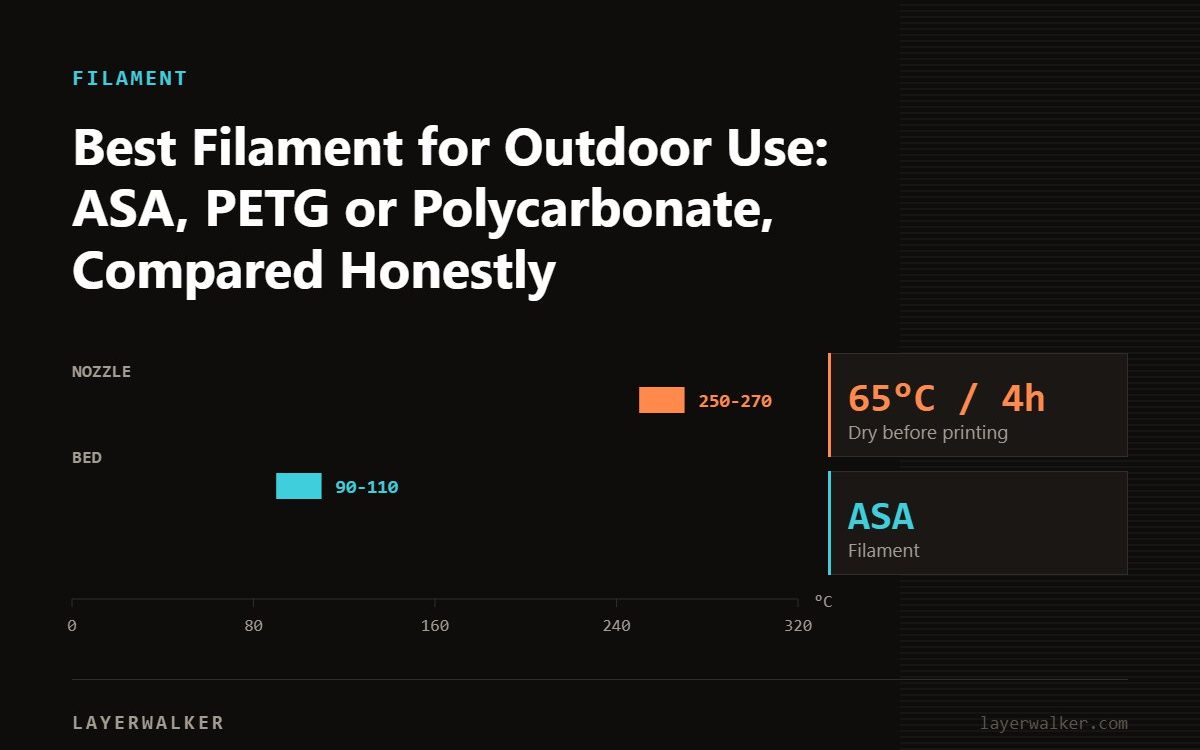
For anything that lives in sunlight, ASA is the filament to buy: UV stable, rain-proof and good to about 95 °C. PETG survives outdoors in shade and mild heat but yellows and softens in full sun over a summer. PLA lasts a season at most. If the part must carry load in heat, polycarbonate, on a printer that can handle it.
Outdoors is three separate attacks: ultraviolet light, water and heat. UV breaks polymer chains and turns tough plastic chalky and brittle; water gets into hygroscopic materials and swells them; heat softens anything near its glass transition. A garden hook, a bird feeder, a car-mounted bracket and a fence sensor housing each face a different mix, and the right filament is the one that resists the attack the part will actually see.
Where to buy

Polymaker ASA Filament 1.75mm Black 1KG, UV & Weather Resistant


How the common materials hold up
| Material | UV | Water | Heat | Verdict |
|---|---|---|---|---|
| PLA | Poor | Fine | Softens at 55 °C | Indoors only; a season outside at most |
| PETG | Fair; yellows over a summer | Good | To about 75 °C | Shade, rain, mild heat; not a sunny dashboard |
| ASA | Excellent | Good | To about 95 °C | The outdoor default |
| ABS | Poor; chalks and cracks | Good | To about 95 °C | Indoors; use ASA instead |
| Polycarbonate | Fair to good | Fair; absorbs slowly | To 110 °C and more | Structural parts in heat; hard to print |
| Nylon | Poor unless stabilised | Poor; swells | Good | Only UV-stabilised, CF grades, and not wet |
Choose by the part
- Full sun, any exposure: ASA. Garden fixtures, exterior brackets, drone frames, anything on a car.
- Under a roof or in shade, gets wet: PETG is fine and easier to print. Read PLA versus PETG.
- Load-bearing in heat, such as an engine-bay or greenhouse bracket: polycarbonate, or a CF-nylon if it stays dry.
- Anything you will replace next season anyway: PLA is fine and cheap.
Why ASA is the pick
ASA is ABS with an acrylate replacing the UV-vulnerable butadiene, so it keeps its colour and toughness outdoors for years where ABS chalks in months. It prints like ABS: 240 to 260 °C, a hot bed, an enclosure, and ventilation for the styrene. The ASA versus ABS guide covers the differences; the short version is there is no reason left to choose ABS for anything that sees daylight.
The spools in the box
Polymaker’s ASA in black and in orange is the reference outdoor filament with a stated UV and weather rating; black is the workhorse, orange is for anything you need to see in a garden. The iSANMATE ASA bundle is the volume option for a project that will use several kilograms; check one spool before committing to four.
Print it so it lasts
- Enclose the printer and warm the chamber; ASA lifts at the corners in a draught.
- Use more perimeters, four or more, and 40 % or more infill. Outdoor parts fail at thin walls first.
- Round the corners in the model; sharp corners concentrate UV cracking.
- Dark colours absorb more heat; white or grey runs cooler on a sunny mount.
Two materials that come up in this conversation and deserve their own pages: polycarbonate, strong but UV-sensitive unless stabilised, and polypropylene, chemically inert and almost impossible to stick down.
Best filament for outdoor use FAQ
Can I just paint PLA for outdoors?
Paint slows UV damage; it does nothing about heat. A painted PLA part still sags on a hot day.
Is PETG waterproof?
Water-resistant for a solid part with enough perimeters; layer lines are not a seal under pressure.
Does ASA smell outdoors?
Only while printing. Once cured it is inert and odourless.

LayerWalker
Print defect diagnosis, calibration procedures and parts that actually fit. Corrections welcome through the contact page.