Auto Bed Leveling for a 3D Printer: What a CR Touch Fixes and What It Doesn’t
LayerWalker is a participant in the Amazon Services LLC Associates Program. We may earn a commission when you buy through links on our site, at no extra cost to you.
An auto bed leveling probe such as the Creality CR Touch measures the bed at 9 to 25 points and lets the firmware follow the surface, so a slightly warped or tilted bed still gets an even first layer. It does not level the bed for you: you still tram the four corners once and set the Z-offset after fitting it.
Most first-layer failures on a bed-slinger come down to two things: the bed is not parallel to the nozzle path, and the nozzle height varies across the bed because the aluminium plate is not flat. Manual tramming with the four wheels fixes the first problem for a day, then thermal cycling undoes it. A probe fixes the second problem permanently by measuring a mesh and adjusting Z as the head moves. It is the single most useful upgrade on a printer that ships without one.
Two probe families are common. The CR Touch and the original Antclabs BLTouch are contact probes with a metal pin that touches the bed; they work on every bed surface including glass and PEI. Inductive and strain-gauge sensors are built into newer printers and are not a retrofit item.
Where to buy


What to check before you order
- Your mainboard and firmware. The kit needs a firmware build with bed-leveling enabled. Creality publishes CR Touch firmware for the Ender 3, Ender 3 V2, Ender 3 Pro and several others; for other boards you compile Marlin or use Klipper, which supports these probes natively.
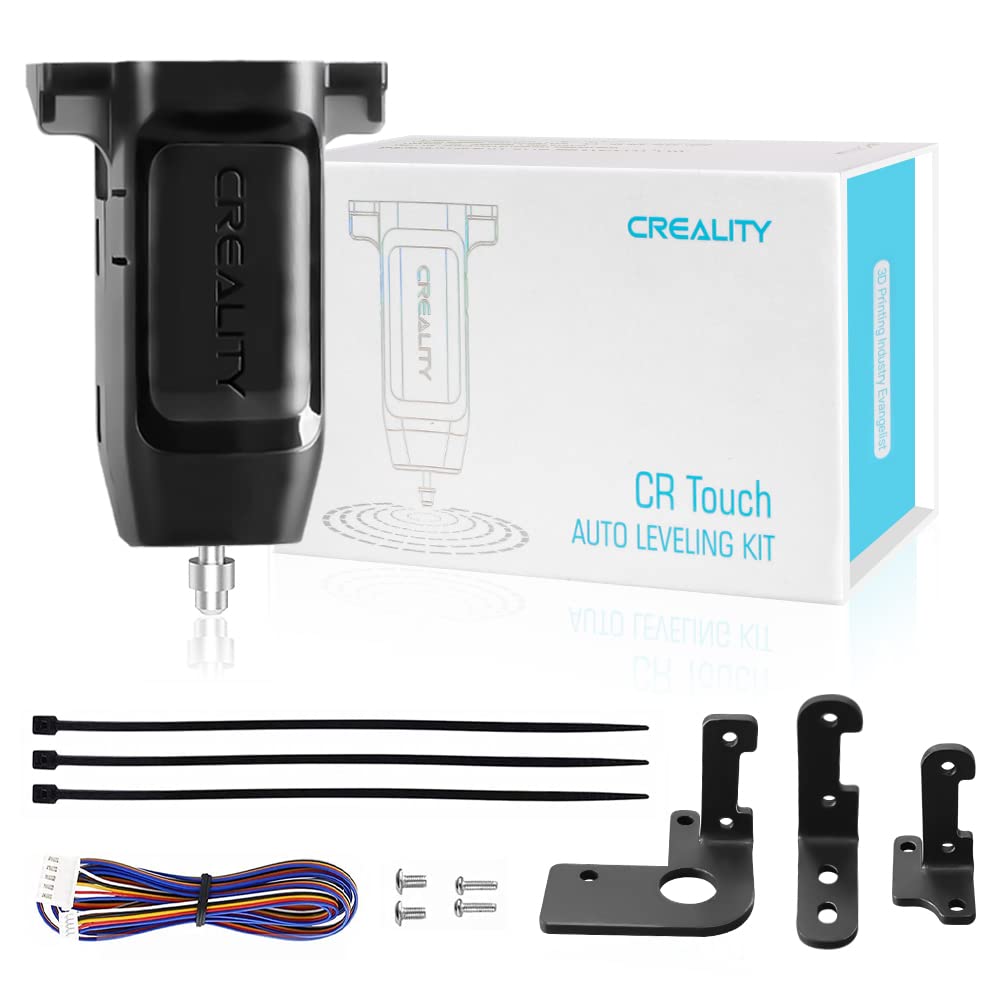
- The adapter cable. Older 8-bit boards use a 27-pin adapter that occupies the display header; 32-bit boards have a dedicated 5-pin probe port. Kits ship with both, but confirm which board revision you have before you open the electronics bay.
- Mounting bracket. The probe must sit at a fixed offset from the nozzle and its pin must be 2 to 3 mm above the nozzle tip when retracted. A bracket for your exact hotend carriage matters more than the probe brand.
- Metal pin versus plastic pin. The CR Touch pin is steel and survives a crash; cheap clones with plastic pins bend and then read a false mesh.
Why these kits are in the box
The three listed kits are all the Creality CR Touch with cables and brackets for the Ender range; the Comgrow-branded one is the same sensor sold through a reseller with the same metal push pin. Choose by which bracket set matches your carriage and which cable your board needs, not by the name on the bag.
Setup that people skip
- Tram the bed manually first. Bring the nozzle to about 0.1 mm above each corner with a sheet of paper. The probe can only compensate a few tenths of a millimetre; a tilted bed that exceeds its range prints one side too high anyway.
- Set the Z-offset with the probe fitted. Home, probe a mesh, then dial the offset in live on a first-layer test until the lines join with no gaps and no ridges.
- Probe hot. Heat the bed to your printing temperature before running the mesh; an aluminium bed changes shape by a couple of tenths between cold and 60 °C.
- Save the mesh and enable it in your start G-code. Many printers probe a mesh and then never load it; add
M420 S1afterG28on Marlin, or useBED_MESH_PROFILE LOAD=defaulton Klipper. Our mesh leveling guide covers this in detail.
When the probe will not fix it
If the first layer will not stick in one corner only after a good mesh, the problem is usually a loose bed wheel or a dirty spot on the plate, not leveling. A bed warped by more than about 0.5 mm end to end needs a flatter plate; a mesh will hide it but the part will have a visible bulge on the bottom.
Two follow-ups if you are still deciding: the BLTouch and CR Touch compared, including which control board each one needs, and the manual procedure for levelling an Ender 3 by hand, which you should do once before any probe goes on.
Bed leveling 3D printer FAQ
CR Touch or BLTouch?
Same function. The BLTouch is the original and slightly more precise on paper; the CR Touch is cheaper, has a metal pin and ships with Creality firmware. On an Ender, take the CR Touch.
How often do I re-probe?
Once per print in the start G-code is the safe default and adds about a minute. If you never move the printer, a saved mesh reloaded each print is enough.
Does a probe replace a good build surface?
No. It makes the height correct; adhesion is a separate problem solved by a clean PEI sheet and the right bed temperature.

LayerWalker
Print defect diagnosis, calibration procedures and parts that actually fit. Corrections welcome through the contact page.