Toughest 3D Filament: It Depends Entirely on What Breaks It
LayerWalker is a participant in the Amazon Services LLC Associates Program. We may earn a commission when you buy through links on our site, at no extra cost to you.
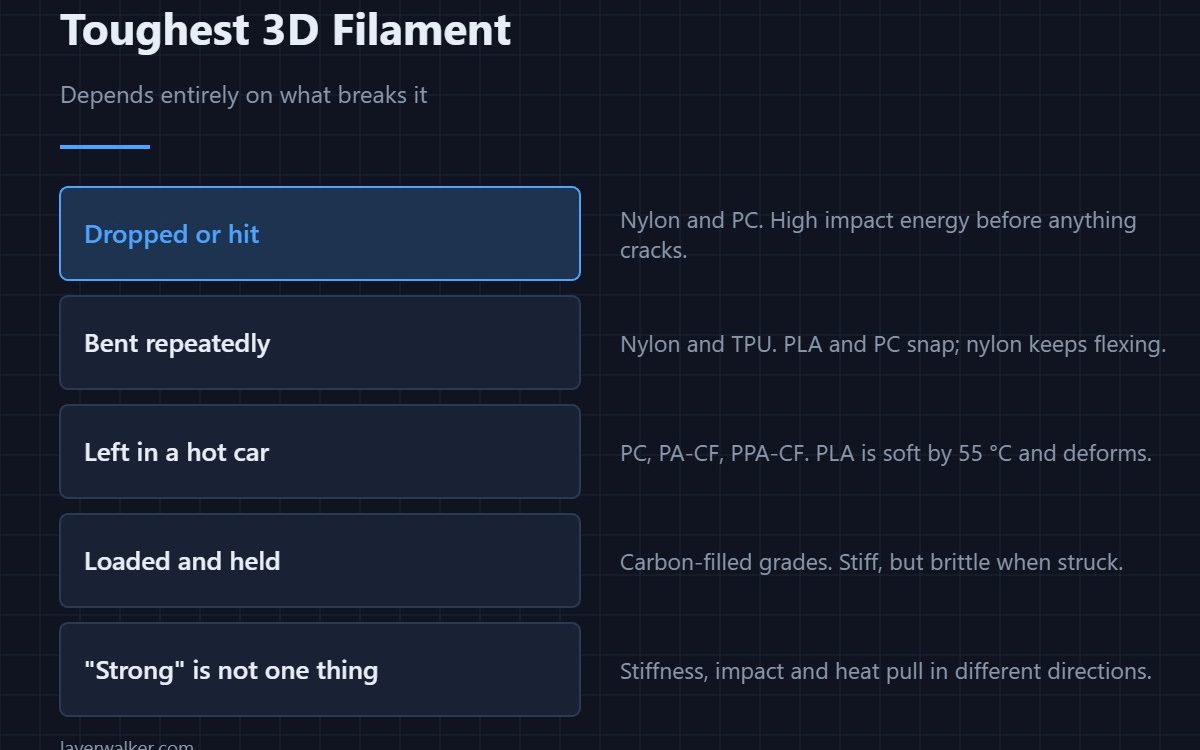
There is no single toughest 3D filament, because “tough” means different things depending on how the part fails. Dropped or struck: polycarbonate, then nylon. Bent repeatedly: nylon and TPU. Left somewhere hot: PC and the carbon-filled nylons. Loaded and held rigid: carbon-filled grades, which are stiff but crack rather than bend. Pick by failure mode, not by a single number.
Most filament marketing collapses four different properties into the word “strong”, and they pull against each other. Stiffness resists bending. Tensile strength resists pulling. Impact toughness absorbs a sudden blow. Heat deflection resists sagging when warm. A material that is excellent at one is often mediocre at another.
Where to buy


If the part gets dropped or hit
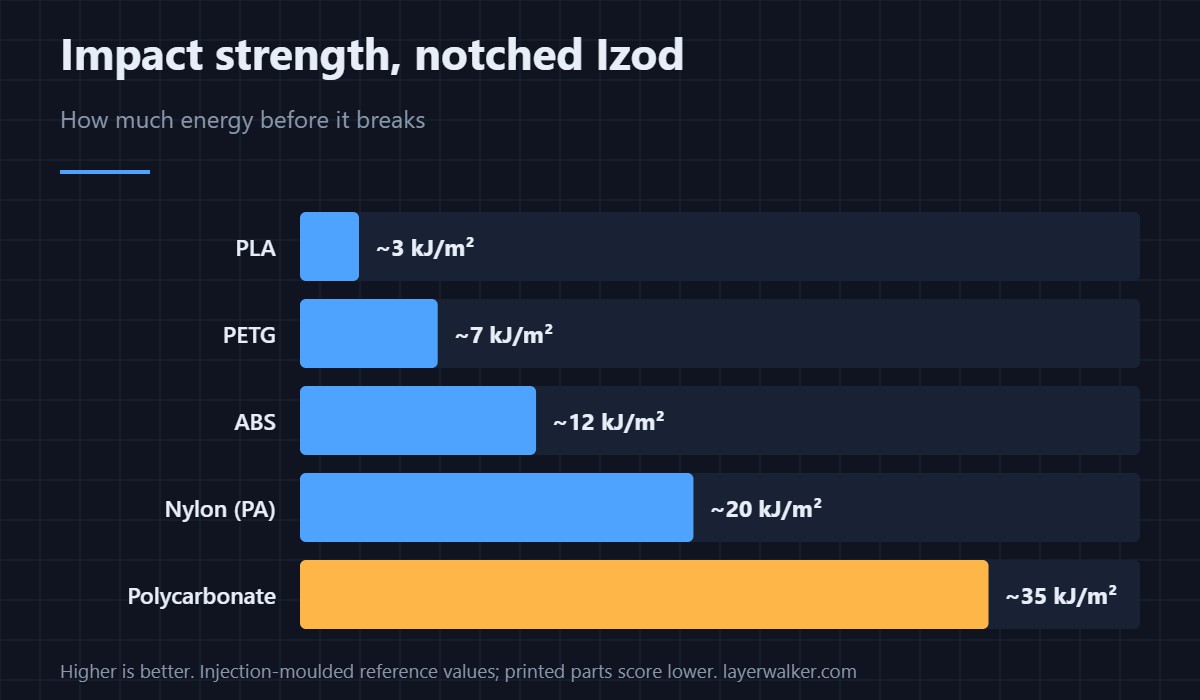
Impact toughness is what you want, and polycarbonate leads the common materials by a wide margin, with unfilled nylon behind it. Both absorb energy by deforming rather than cracking. PLA is at the bottom of this list and it is not close — it is stiff and it shatters.
If the part gets bent over and over
Fatigue resistance, which is a different property again. Nylon is the answer for hinges, clips and anything that flexes thousands of times. TPU flexes further but is far less stiff. Polypropylene is excellent here too and the reason living hinges are made from it — see polypropylene filament. PC is tough under a single impact but will eventually crack under repeated flexing.
If the part lives somewhere hot
PLA is soft by about 55 °C, which rules it out of a car in summer. PETG buys you to roughly 70 °C, ABS and ASA to around 98 °C, PC to about 113 °C, and the carbon-filled nylons past that — PA-CF to roughly 120 °C and PPA-CF to about 150 °C. Beyond that you are into PPS-CF and specialty machines.
If the part must not flex under load
That is stiffness, and carbon-filled grades win: PA-CF, PC-CF, even carbon-filled PETG. The trade is brittleness — chopped fibres raise the modulus and lower the energy the part can absorb before cracking. A carbon-filled bracket holds its shape better and survives a drop worse.
The part nobody mentions
Printed parts are weakest between layers, regardless of material. A well-oriented PETG part beats a badly oriented nylon one, and no filament purchase compensates for loading a part along its layer lines. Orientation, wall count and infill usually matter more than the choice between two decent materials.
Toughest 3D Filament FAQ
Is PETG stronger than PLA?
Tougher, not stiffer. PETG absorbs roughly twice the impact energy and bends before it breaks, while PLA is stiffer and snaps. For most functional parts PETG is the better default.
Is carbon fibre filament the strongest option?
Stiffest, not strongest. Carbon fill raises rigidity and lowers impact toughness. If the part gets knocked about, filled filament is the wrong direction.
What is the toughest filament I can print on a basic printer?
PETG, easily, with no hardware changes. Nylon and PC both need an all-metal hotend and an enclosure before they are realistic.
Does higher infill make a part tougher?
Up to a point, and more walls help more than more infill. Past about 50% infill the returns are small, while adding perimeters improves both stiffness and impact resistance for less material.

LayerWalker
Print defect diagnosis, calibration procedures and parts that actually fit. Corrections welcome through the contact page.