PA-CF Filament: Carbon-Fibre Nylon for Parts That Have to Survive Heat and Load
LayerWalker is a participant in the Amazon Services LLC Associates Program. We may earn a commission when you buy through links on our site, at no extra cost to you.
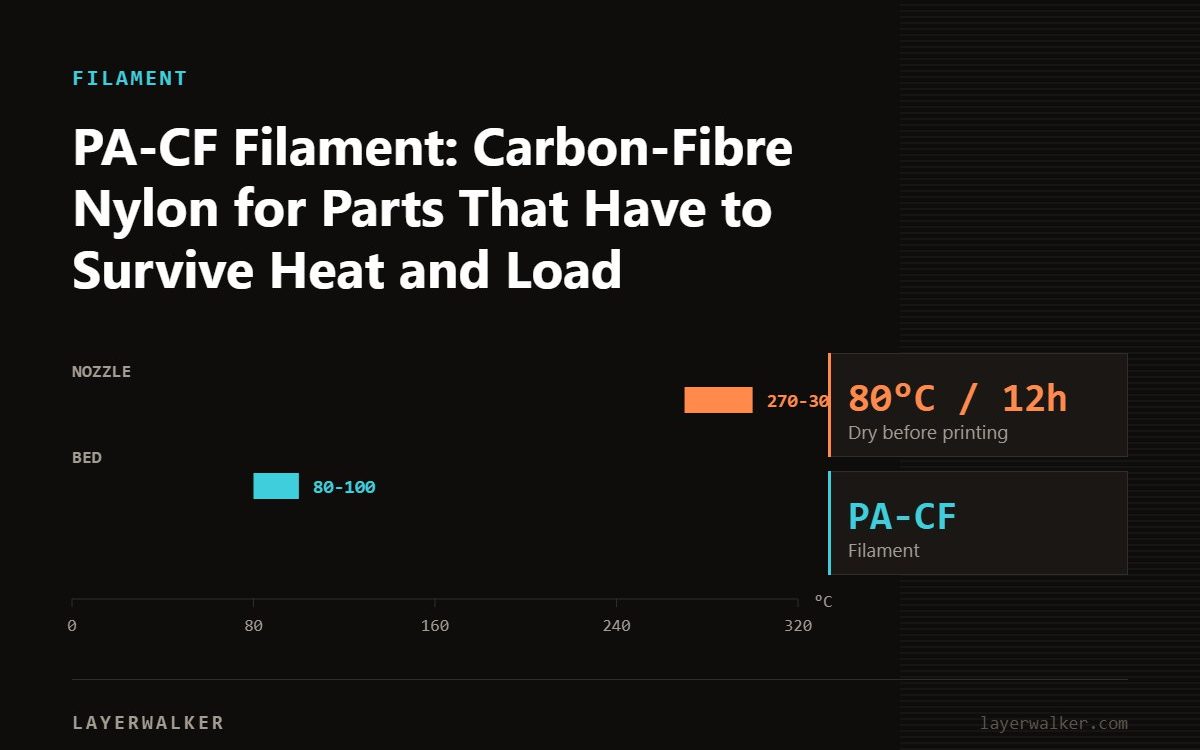
PA-CF is the filament for parts that would fail in PETG-CF: mounts near heat, structural brackets under sustained load, drone arms, tool holders. It needs a hotend that holds 270 to 290 °C, a hardened steel nozzle, a dryer with print-through feed, and a bed at 80 to 100 °C. Get those right and it is far easier to print than unfilled nylon.
Carbon fibre transforms nylon from the hardest common filament to print into one of the more predictable engineering materials. Unfilled nylon warps, sags and drinks water; add 15 to 20 % chopped fibre and the warp mostly disappears, the part comes off stiff and flat, and the surface is a matte charcoal that hides layers. What remains is nylon’s water problem and its temperature demands, which are hardware questions with clear answers.
Where to buy

Polymaker PolyLite PLA Pro Filament 1.75mm 1KG Black

Polymaker ASA Filament 1.75mm Black 1KG, UV & Weather Resistant

What PA-CF gives you
- Stiffness and strength well above PETG-CF, with nylon’s toughness underneath.
- Heat resistance to 120 °C or more depending on the base nylon; PA12-CF a little lower, PA6-CF higher.
- Dimensional stability once dry; parts hold size under load.
- Chemical resistance to oils and fuels.
What your printer needs
- All-metal or high-temperature hotend that holds 270 to 290 °C without PTFE in the hot zone.
- Hardened steel nozzle, 0.4 or 0.6 mm. Abrasive filament rules apply fully.
- Dryer with print-through feed. PA-CF absorbs meaningful water in two hours of open air. Dry at 80 °C for 8 to 12 hours and print from the dryer.
- Bed to 100 °C with Garolite or PEI plus glue stick. An enclosure or a dead-still warm room helps; PA-CF tolerates open printing far better than unfilled nylon.
- Dual-gear extruder with hardened gears for regular use.
The spools in the box
Polymaker’s Fiberon PA6-CF20 is the reference PA-CF: 20 % fibre, published drying and printing data, and consistent results. The other spools listed are carbon-fibre nylons from other makers; compare stated fibre content, base nylon and drying instructions.
Settings that work
- Dry at 80 °C for 8 to 12 hours. Then print from the dryer at a holding temperature.
- Nozzle 270 to 290 °C. Follow the maker’s figure; PA-CF is less forgiving of too cold than too hot.
- Bed 80 to 100 °C on glue-stick PEI or Garolite. Brim on flat parts.
- Fan 0 to 20 %. Too much cooling causes layer splits.
- Speed 30 to 60 mm/s on a bed-slinger; CoreXY printers with high-flow hotends go faster.
- Anneal at 80 to 90 °C for two hours if you need maximum strength and stability.
When PA-CF is the wrong choice
Parts that PETG-CF can do: PETG-CF is easier. Parts that need impact toughness above all: unfilled nylon. Any printer without an all-metal hotend and a dryer.
Two neighbours worth knowing: PPA-CF, stiffer and good to about 150 °C, and PPS-CF, which keeps working at 200 °C and shrugs off solvents.
Pa CF filament FAQ
PA6-CF or PA12-CF?
PA6-CF is stiffer and more heat resistant but absorbs more water. PA12-CF is easier to keep dry and slightly less stiff. For most parts either works.
Why are my parts white and rough?
Water. Dry longer and feed from the dryer.
Can I print PA-CF on a Bambu Lab printer?
Yes on the enclosed models with the hardened nozzle and gears; the A1 series is open and marginal.

LayerWalker
Print defect diagnosis, calibration procedures and parts that actually fit. Corrections welcome through the contact page.