Cleaning a 3D Printer Bed: What Works on PEI, Glass and Textured Plates
LayerWalker is a participant in the Amazon Services LLC Associates Program. We may earn a commission when you buy through links on our site, at no extra cost to you.
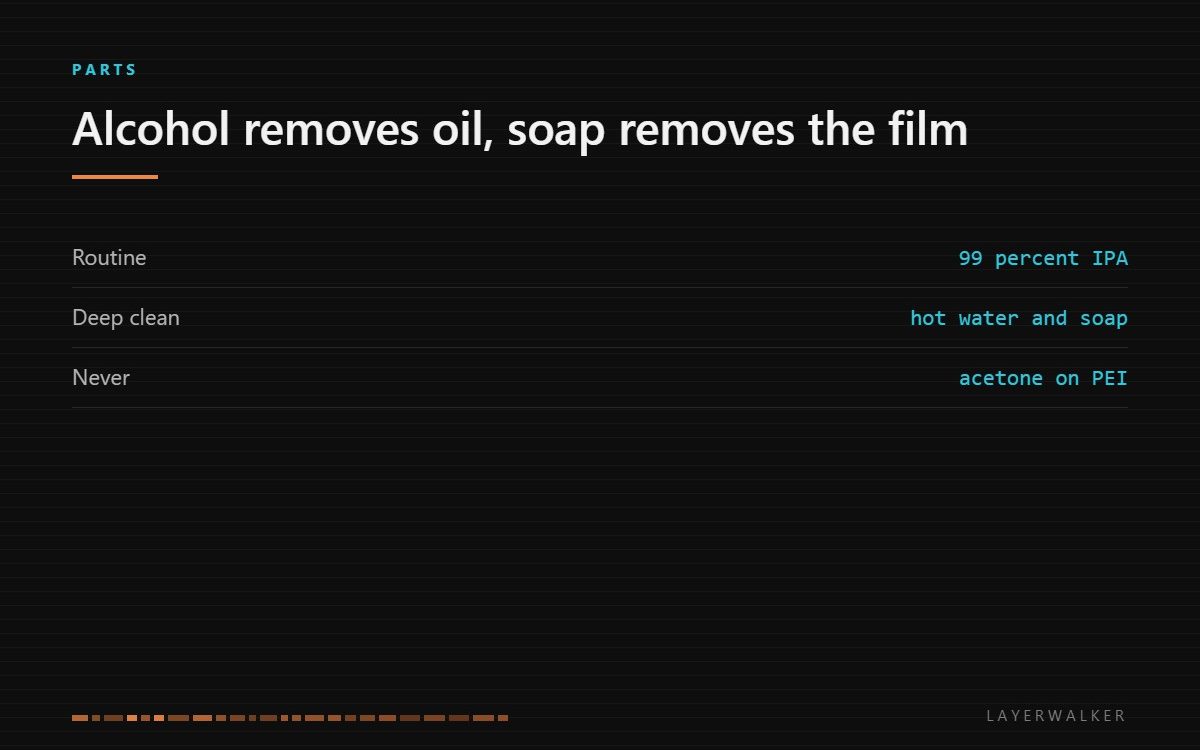
Isopropyl alcohol removes oil but leaves the film that builds up over months. When a plate stops working despite a wipe with alcohol, wash it in hot water with dish soap; that is the step most people never take.
Where to buy


What to look for
Buy isopropyl alcohol at 99 percent rather than the 70 percent sold as a disinfectant. The 30 percent water in the cheaper bottle is the problem: it evaporates slowly, leaves whatever was dissolved in it behind as a ring, and on a warm plate it flashes off before it has lifted anything. A spray bottle is worth having over a pour bottle, because the failure mode of cleaning a bed is using too much liquid and pushing the contamination around rather than removing it.
Size the bottle to how you will use it. Alcohol is the routine wipe between prints, so a small spray lives next to the printer, while a larger refill bottle is better value if you also wash resin parts or clean tools. What you do not need is anything branded as a printer bed cleaner; the active ingredient is the same alcohol at a higher price.
Why alcohol stops working
Two different things accumulate on a print surface, and alcohol only removes one of them.
The first is oil, mostly from fingers. It arrives every time you pick the plate up by its face, it is the usual reason a part lifts in one spot and sticks everywhere else, and alcohol removes it completely. The second is a polymer film: a thin layer of plastic and additives left behind by every print, built up over hundreds of hours. Alcohol does not dissolve it. You can wipe a contaminated plate until the cloth comes away clean and still have a surface that will not grip, because what is left is not oil.
That film is what soap and water removes. Take the plate to a sink, run it hot, use ordinary dish soap and a soft sponge, and work the whole surface rather than the middle where you print most. Dry it with a clean cloth or let it air dry, and do not touch the printing face afterwards. A plate that has been written off as worn out will often come back from this.
Matching the method to the surface
| Surface | Routine | Deep clean | Never |
|---|---|---|---|
| Smooth PEI | Alcohol wipe | Hot water and dish soap | Abrasive pads, acetone |
| Textured PEI | Alcohol wipe | Hot water, soap, soft brush into the texture | Scraping with metal, wire brushes |
| Glass | Alcohol wipe | Soap, or a glass cleaner with no additives | Cleaners containing wax or shine agents |
| Garolite or FR4 | Alcohol wipe | Light abrasion with fine paper | Soaking; the laminate absorbs water |
Textured plates need the extra step of a soft brush, because the whole point of the texture is a surface full of small recesses, and those recesses hold exactly what you are trying to remove. A cloth passes over the tops and leaves the valleys loaded.
Things that quietly destroy a plate
Acetone attacks PEI. It is the correct solvent for smoothing ABS parts and the wrong thing anywhere near a print surface, and the damage is not always visible at once; the coating goes soft, then cloudy, then stops gripping.
Metal scrapers used at a shallow angle gouge the coating, and once there is a scratch, parts key into it and pull harder on that spot every time. If a part will not come off, let the plate cool completely first. PLA and PETG both release on their own as the plate contracts past about 30 degrees, and waiting is faster than the twenty minutes of levering that follows a gouge.
Glass cleaners that promise streak-free shine leave a deliberate residue, which is the opposite of what a print surface needs. Read the label, or use soap.
How often
Wipe with alcohol whenever you have handled the plate, and before any print you care about. Wash with soap and water when adhesion starts getting unreliable rather than on a schedule: for most people that lands somewhere between monthly and quarterly, and it is the step to take before concluding the plate is finished.
If adhesion is still poor on a genuinely clean plate, the problem has moved elsewhere. Our page on first layer adhesion covers nozzle height and bed levelling, and bed adhesives covers the cases where a clean surface is genuinely not enough on its own.
FAQ
Can I use 70 percent alcohol? It works poorly. The water content leaves residue and evaporates too slowly on a warm plate.
Does washing with soap ruin PEI? No. It is the recommended deep clean. Rinse fully and do not touch the face afterwards.
Why does my plate only fail in one patch? That pattern is oil, usually a fingerprint, or a scratch from a scraper. Both are local; wear is not.
Is a worn plate recoverable? Often. Try the soap wash before buying a replacement; genuine wear looks like a visibly dulled or scratched coating.

LayerWalker
Print defect diagnosis, calibration procedures and parts that actually fit. Corrections welcome through the contact page.

