Micro Swiss All Metal Hotend: Which Kit Fits Your Printer
LayerWalker is a participant in the Amazon Services LLC Associates Program. We may earn a commission when you buy through links on our site, at no extra cost to you.
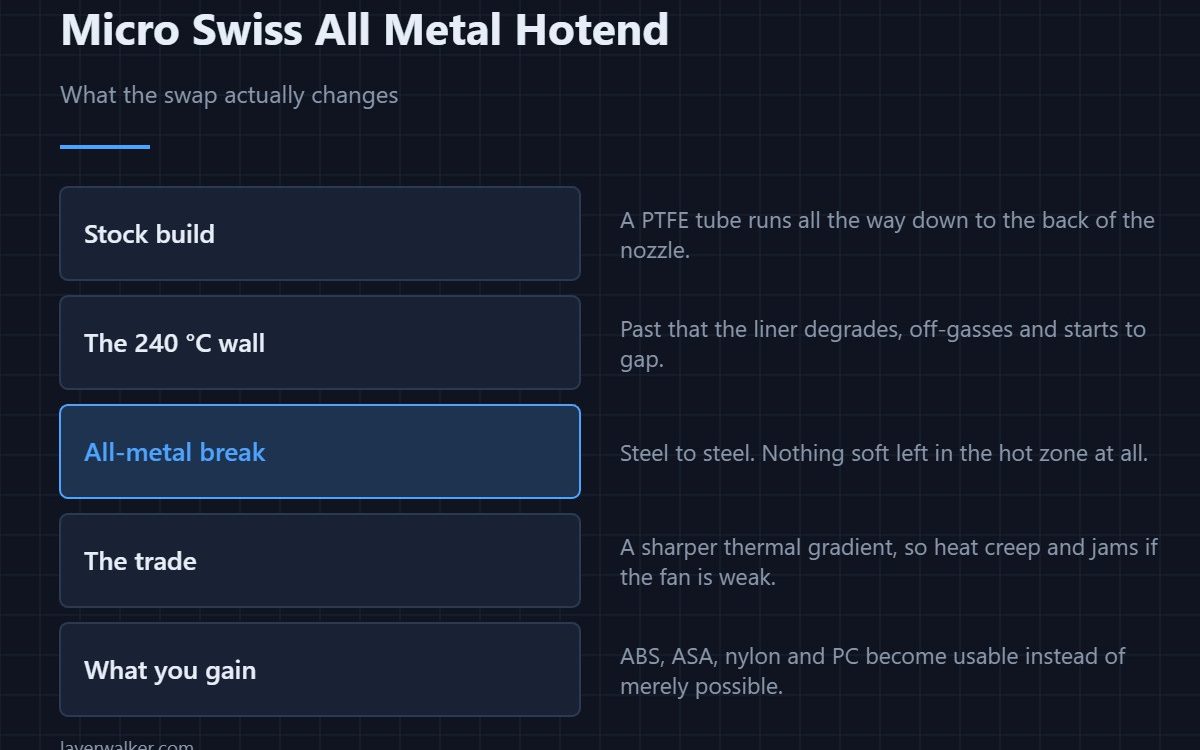
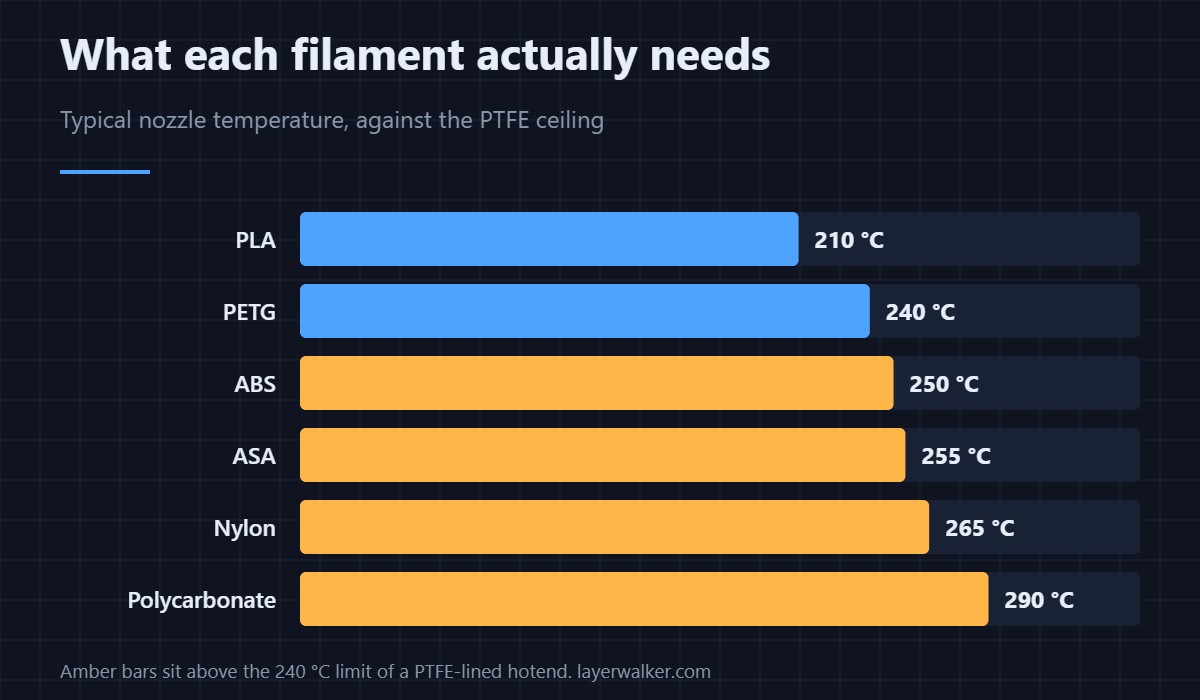
A Micro Swiss all metal hotend replaces the PTFE tube that runs down to the nozzle with a steel heat break, so nothing soft is left in the hot zone. That lifts the safe ceiling from about 240 °C to around 300 °C, which is what makes ABS, ASA, nylon and polycarbonate practical. It does not make the printer faster, and it makes heat creep more likely if your heatsink fan is tired.
Micro Swiss sells kits rather than a single hotend, and the kits are printer-specific. That is the whole value proposition: instead of a bracket-and-fan-duct project, you get parts that bolt into the carriage you already have.
Where to buy


What the swap actually changes
On a stock Creality hotend the PTFE tube passes through the heat break and butts against the back of the nozzle. It works, it is forgiving, and it is cheap. Above roughly 240 °C the liner starts to degrade: it discolours, it off-gasses, and it slowly shrinks back from the nozzle leaving a gap where filament pools and carbonises. That gap is the source of most mystery jams on printers pushed past their material range.
An all-metal break removes the liner entirely. The trade is a sharper thermal gradient, so the transition from soft to solid happens over a shorter distance and heat creep becomes the failure mode instead. A healthy 30 mm fan and sane retraction settings deal with it.
Which kit fits what
Match the kit to the machine, not to the brand. Micro Swiss publishes separate kits for the Ender 3 family, the CR-10 family, and the newer enclosed CoreXY machines, plus the FlowTech line for Sovol and Creality K-series printers. The parts are not interchangeable between them even though the marketing photographs look identical.
- Ender 3, 3 Pro, 3 V2. The classic all-metal kit bolts into the stock carriage with the stock fan duct. The most common upgrade on the platform.
- Direct-drive conversions. The NG kit combines the all-metal hotend with a dual-gear direct drive, which is a bigger job and a different set of trade-offs.
- K-series and Sovol. FlowTech kits, which are high-flow as well as all-metal — a genuinely different product from the classic kit.
When to skip it
If you print PLA and PETG and nothing else, a Micro Swiss all metal hotend will not improve a single print. PETG at 240 °C sits right at the edge of what PTFE handles, so there is a mild reliability argument, but no quality one. Spend the money on a hardened nozzle if you print filled filaments, or on the bed surface, before you touch the hotend. The broader question of what a hotend swap buys you is set out in this comparison of all-metal and high-flow.
After fitting
Tighten the nozzle hot, at printing temperature, or it will leak. Re-check the Z-offset, because the new assembly is rarely the same height as the old one. Then raise your printing temperature by about 5 to 10 °C: with the liner gone, the melt zone is shorter and the same number on the display is no longer the same amount of heat in the plastic. If you would rather have the industry-standard version of the same idea, the E3D V6 is the design everyone else copied.
Micro Swiss All Metal Hotend FAQ
Will it make my prints faster?
No. The classic all-metal kit has roughly the same flow rate as the stock hotend; it raises temperature, not throughput. The FlowTech kits are the high-flow product, and those do increase speed.
Do I need to change my retraction settings?
Usually yes, slightly shorter. A long retraction pulls softened filament up into the cold zone where it swells and sticks, which is the classic all-metal jam. Start by trimming half a millimetre and test.
Is the genuine kit worth it over a cheap all-metal break?
The break alone is a reasonable half-step if you are careful about the bore. The kit buys you matched parts, a fan duct that fits, and a nozzle that seals — worth it if you would rather not diagnose a leak at the block.
Can I still print PLA with it?
Yes, with no change at all in quality. Watch for heat creep on long prints and keep the heatsink fan clean; that is the only practical difference day to day.

LayerWalker
Print defect diagnosis, calibration procedures and parts that actually fit. Corrections welcome through the contact page.