Ender 3 Build Plate: The 235 mm Size, PEI vs Glass, and What Fits
LayerWalker is a participant in the Amazon Services LLC Associates Program. We may earn a commission when you buy through links on our site, at no extra cost to you.
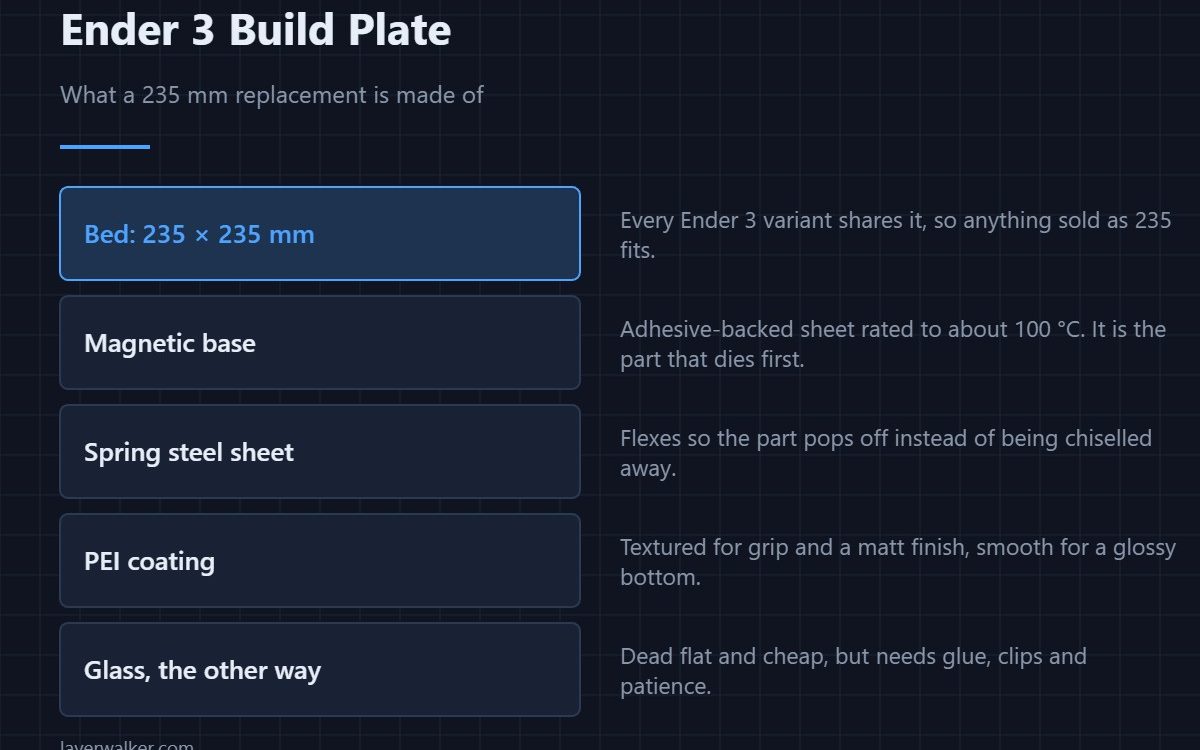
The Ender 3 build plate is 235 × 235 mm across every variant, so anything sold as a 235 mm sheet will fit. Textured PEI on spring steel is the upgrade most people want: it grips hard when hot, releases when cold, and survives being flexed. Glass is flatter and cheaper but needs glue and clips. The stock magnetic sticker wears out and is the reason your adhesion got worse.
Bed surface is the highest-return cheap upgrade on this printer, and unlike the hotend it improves prints you are already making. It is also the part with the shortest life: the adhesive magnetic base under a stock plate is rated to around 100 °C and degrades every time you run ABS temperatures.
Where to buy


What a replacement is made of
Three layers. An adhesive-backed magnetic base that sticks to the aluminium heatbed, a flexible spring steel sheet that sits on it, and a coating on that sheet. When people say a plate has “gone off”, it is almost always the magnetic base that has failed, not the coating — and the base can be replaced on its own.
PEI, glass, or the stock sticker
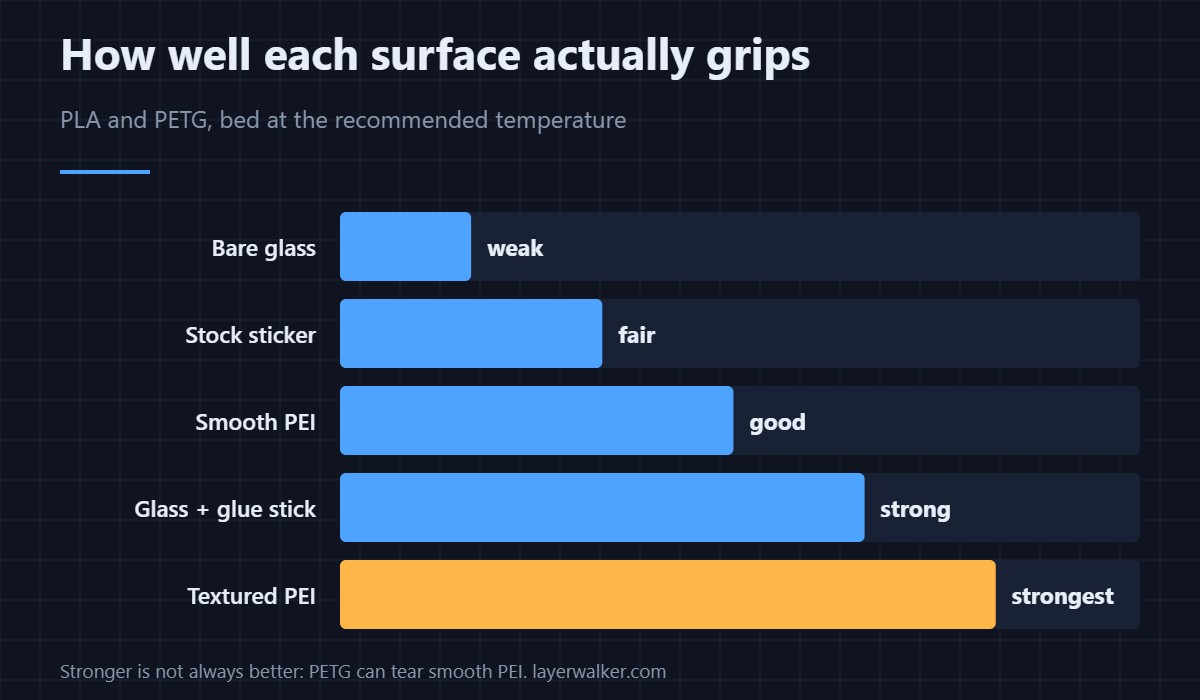
- Textured PEI. The default recommendation. Strong grip hot, clean release cold, matt bottom surface, and it tolerates being flexed thousands of times.
- Smooth PEI. Glossy bottom finish and slightly less grip. PETG can bond to it hard enough to tear the coating — use a glue stick as a release layer, not as adhesive.
- Glass. Dead flat, which is its real advantage, and cheap. Needs a glue stick for anything but PLA, needs clips that the nozzle can crash into, and will not flex to release a part.
- Stock magnetic sticker. Fine when new, and consumable. Replace rather than fight it.
The fuller comparison of coatings and when each one fails is in the PEI build plate guide.
What actually stops parts sticking
Surface choice matters less than cleanliness. PEI works by a mixture of chemical and mechanical adhesion, and a fingerprint defeats both. Wash with warm water and washing-up liquid, then wipe with isopropyl alcohol before printing — not the other way round, because alcohol alone smears oil rather than removing it. The full routine, and what not to use, is in cleaning a print bed.
If parts still lift at the corners after that, it is not the plate. That is thermal, and the fix is draughts and bed temperature. And if adhesion varies across the plate rather than being uniformly bad, the problem is levelling, not surface.
Buying notes
Check that the sheet is 235 mm and not 220 mm; both are sold for “Ender 3” by sellers who have not checked. Confirm the magnetic base is rated for your maximum bed temperature if you print ABS. And measure your Z-offset again after fitting, because a spring steel plate on a magnetic base is about 1 mm taller than a bare sticker — the commonest reason a new plate appears to make everything worse.
Ender 3 Build Plate FAQ
Is the Ender 3 build plate the same size on every model?
Yes, 235 × 235 mm on the Ender 3, 3 Pro, 3 V2 and the V3 line. Only the larger Ender 5 and CR-10 machines differ, so a sheet sold for those will not fit.
Do I have to re-level after fitting a new plate?
Yes, and re-set the Z-offset. A magnetic base plus spring steel adds roughly a millimetre of height, which is enormous in first-layer terms.
Why does PETG stick too well to my PEI plate?
Because PETG genuinely bonds to PEI. Use a glue stick as a release layer, lower the bed to 70 °C, and let the plate cool fully before flexing it. Pulling a hot PETG part off smooth PEI is how coatings get torn out.
Is glass better than PEI for an Ender 3?
Glass is flatter, which helps if you have no probe. PEI is more convenient and releases without glue. If you have a probe fitted, flatness matters less and PEI is the better choice.

LayerWalker
Print defect diagnosis, calibration procedures and parts that actually fit. Corrections welcome through the contact page.