PEI Build Plate: Smooth or Textured, Which Size Fits, and When to Replace It
LayerWalker is a participant in the Amazon Services LLC Associates Program. We may earn a commission when you buy through links on our site, at no extra cost to you.
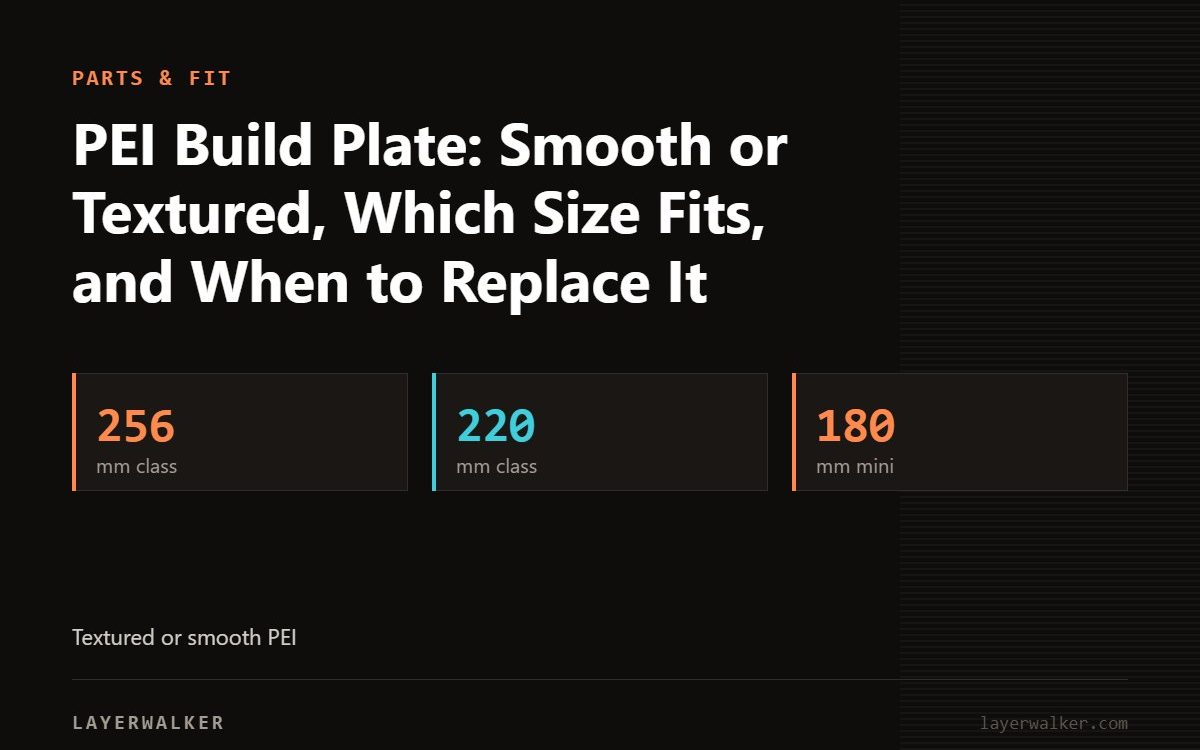
Buy a textured PEI spring-steel plate as your everyday surface: PLA and PETG stick hot and pop off cold, and it hides first-layer flaws. Add a smooth PEI plate when you want a glossy bottom on PLA, and keep PETG off it without a glue-stick release layer. Match the plate exactly to your printer’s bed size and magnet layout.
Polyetherimide on a flexible steel sheet replaced glass, tape and glue for a reason: it grips at bed temperature and lets go when cool, and flexing the sheet pops the part off without a scraper. Two finishes exist and they behave differently enough that most people end up with one of each. The smooth versus textured comparison goes deep; this guide is about buying and living with a plate.
Where to buy


Smooth or textured
- Textured (powder-coated). Grips PLA, PETG, ABS and TPU without help, releases everything when cool, and leaves a matte pebble finish on the bottom. Forgiving of a slightly high Z-offset. The everyday plate.
- Smooth. Glossy bottom surface. PLA grips well; PETG and TPU grip too well and can tear the coating off unless you add a glue-stick layer. Needs a more precise Z-offset.
- Double-sided plates put one of each on a single sheet and are the sensible first purchase.
What to check before you buy
- Exact dimensions. Plates are not universal. Common sizes are around 235 mm for Ender-class printers, 256 mm for the Bambu Lab P and X series and many CoreXY machines, and 180 mm for small printers. A plate a few millimetres oversize fouls the frame.
- Magnet compatibility. The plate is steel and sits on a magnetic base; if your printer has no magnetic base, buy the plate with the adhesive magnetic sheet included.
- Locating tabs or cut-outs. Bambu-style plates have front tabs and a rear cut-out; Prusa plates have a different notch. A plate without the right tabs slides.
- Coating thickness. Cheap textured plates have thin powder coat that wears through in months. Reputable makers state the coating and back it with reviews that mention longevity.
The plates in the box
The three listed are textured PEI spring-steel plates in the common sizes: check each listing’s dimensions against your bed and confirm the tab layout matches your printer before ordering. One of them is a double-sided smooth-and-textured sheet, the right first buy if you do not yet know which finish you prefer.
Keeping it working
- Wash with dish soap and hot water, dry, and do not touch the surface. Finger oil is the number one cause of a first layer that will not stick. Isopropyl alcohol alone smears the oil around.
- Let it cool fully before removing PETG; pulling hot PETG off smooth PEI takes the coating with it.
- Re-set Z-offset when you swap plates; smooth and textured differ by a couple of tenths.
- Replace when parts stop sticking after a proper wash, or when the coating is visibly bald where you print most.
If the printer refuses to start because it cannot see the sheet at all, that is error 13109 rather than a surface problem.
PEI build plate FAQ
Can I use a PEI plate on a glass bed printer? Yes, with the magnetic base sheet stuck to the glass. It raises the bed by about 2 mm; re-home Z.
Do I still need glue stick?
On textured PEI, no, for PLA and PETG. On smooth PEI, only as a release layer for PETG and TPU.
Why does my plate warp?
Thin steel sheets bow if stored bent or heated unevenly. Store flat and let it cool on the printer.
A first layer that is good on one side and poor on the other is not always the sheet. On a CORE One the gantry itself can sit out of square, reported as Prusa error 31111.

LayerWalker
Print defect diagnosis, calibration procedures and parts that actually fit. Corrections welcome through the contact page.