Best Filament for Cosplay: PLA for Armour, PETG for Props That Get Dropped, TPU for Anything Worn
LayerWalker is a participant in the Amazon Services LLC Associates Program. We may earn a commission when you buy through links on our site, at no extra cost to you.
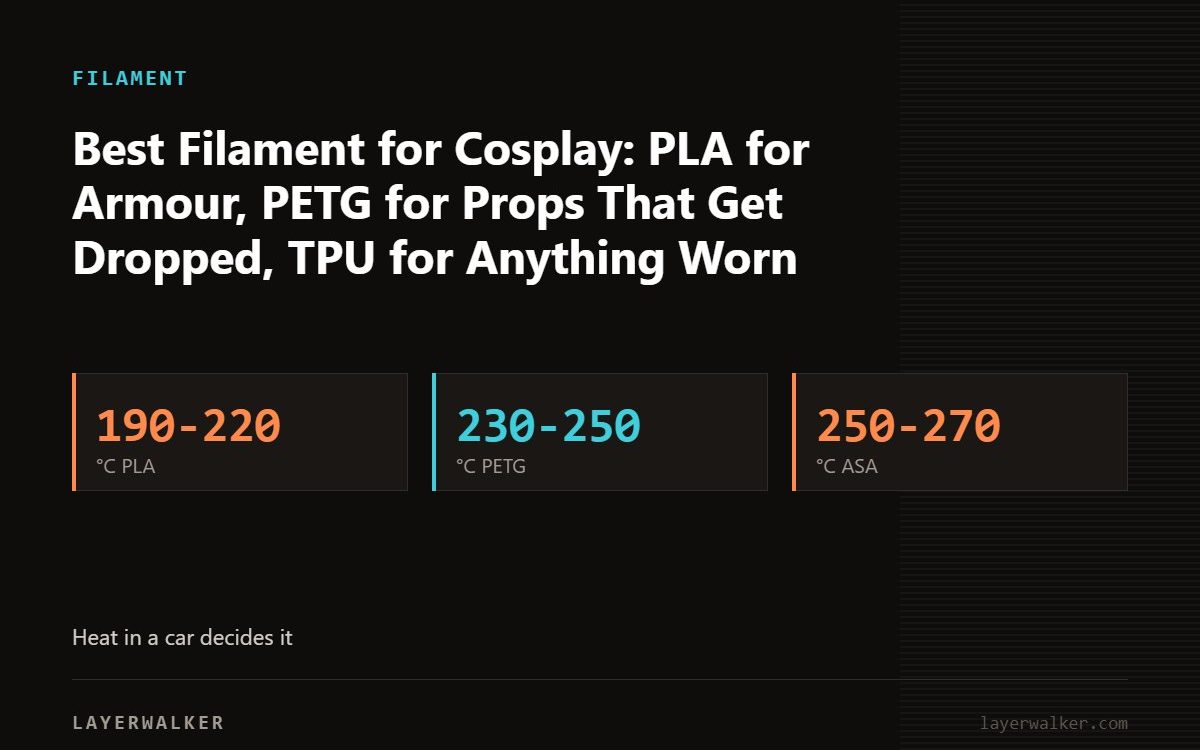
Print armour plates and helmets in PLA or PLA+: it is light, cheap in bulk, holds detail, and sands and fills to a paint-ready surface. Use PETG for props that will be swung or dropped, and TPU 95A for anything that has to flex against a joint. Buy in bulk in one colour, because primer covers everything.
Cosplay is the one hobby where filament colour does not matter and filament volume does. A full armour set can use ten kilograms, every surface gets sanded, filled and painted, and the parts must be light enough to wear for a day. That pushes the choice toward the cheapest well-made PLA you can buy in bulk, with PETG and TPU reserved for the parts that get abused or need to bend.
Where to buy


SUNLU PLA+ 3D Printer Filament, 16 Color Bundle Multicolor, 1.75mm
By the part
- Armour plates, helmets, shoulder pieces: PLA or PLA+. Light, stiff, easy to sand. PLA+ if the piece is thin or will be strapped tight.
- Props that get swung, dropped or leaned on: PETG. Tougher than PLA and it survives a hot car boot on the way to the convention, where PLA sags; see PLA versus PETG.
- Parts that flex against the body, such as knee and elbow segments, gaskets, grips: TPU 95A.
- Large hollow pieces: PLA in vase mode or with two walls and minimal infill; weight is the enemy.
What to look for
- Bulk price with stated tolerance. Buy 5 to 10 kg of one colour; you will paint over it.
- Consistent diameter between spools, so the profile you tuned on spool one still works on spool eight.
- Light or neutral colour, which primes with fewer coats than black.
- Plastic spools for a multi-material unit or dryer; cardboard is fine on an open holder.
The spools in the box
The listed PLA and PLA+ spools are the bulk workhorses: plain PLA for the bulk of armour, PLA+ for thin or load-bearing pieces. Add a spool of PETG for props and TPU for flexible sections from their own guides.
Printing large cosplay parts
- Split the model at hidden seams so each piece fits the bed with a flat face down; glue with cyanoacrylate and fill the join.
- Two or three walls, 5 to 10 % infill, 0.28 mm layers. Sanding removes the layer lines anyway.
- Print PLA at the cool end, 195 to 205 °C, for cleaner overhangs on helmet curves; see overhangs.
- Avoid drafts on tall PETG props or they split.
Finishing
Sand at 120 grit, fill with a filler primer or a thin coat of resin, sand at 220 and 400, then paint. PLA sands fast; PETG gums up sandpaper and prefers filler. Heat-forming PLA with a heat gun to fit a curve works well below 70 °C.
Best filament for cosplay FAQ
Will PLA armour melt at a summer convention?
In a hot car, yes. Worn on a body in the shade, no. Keep it out of parked cars.
Is PETG harder to sand?
Yes; it smears. Use filler primer and sand the primer.
Can I print a whole helmet in one piece?
On a 256 mm or larger bed, often. Split it otherwise; the seam disappears under filler.

LayerWalker
Print defect diagnosis, calibration procedures and parts that actually fit. Corrections welcome through the contact page.