Bambu Lab P2S Upgrades: The New Hotend Family, Nozzle Sizes, and What Carries Over From the P1S
LayerWalker is a participant in the Amazon Services LLC Associates Program. We may earn a commission when you buy through links on our site, at no extra cost to you.
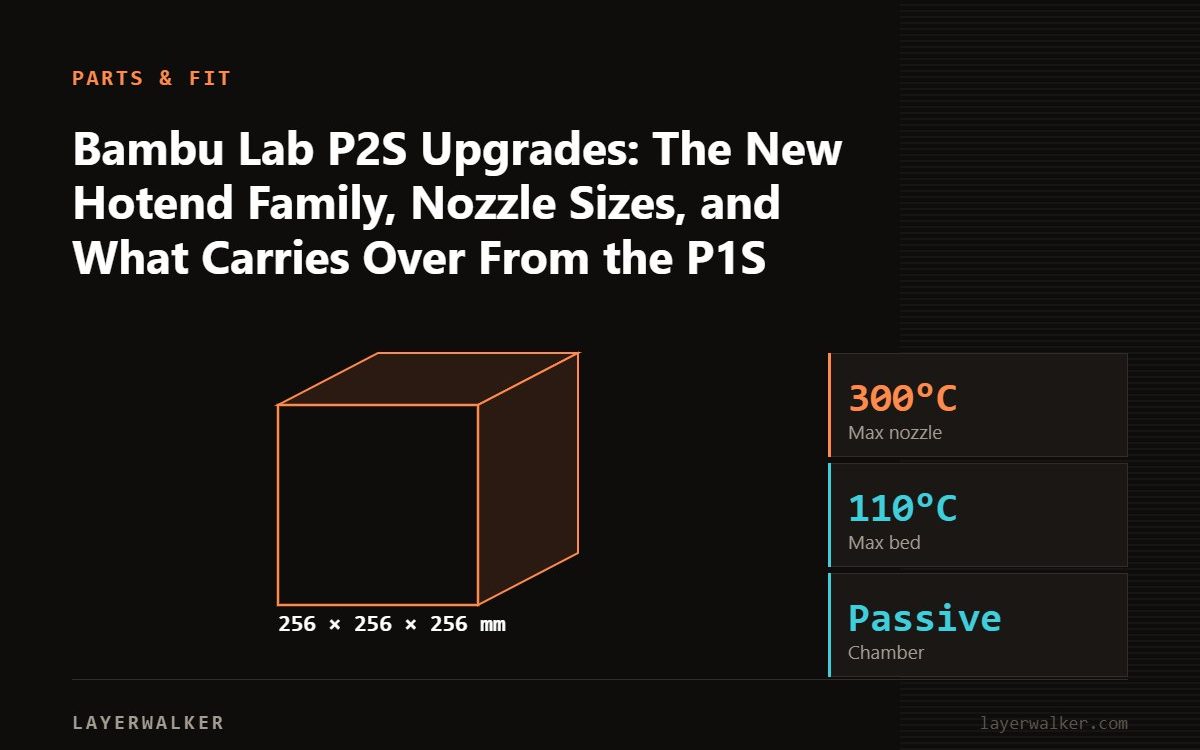
The P2S shares its hotend with the H2 series, not with the P1S, so any hotend you buy must be listed for the P2S, H2D, H2S or X2D. The upgrades that matter are the same as on every Bambu printer: a hardened-steel hotend before abrasive filament, extra sizes in 0.2 and 0.6 mm, a high-flow hotend if you print big parts fast, a dryer, and a spare plate.
The P2S moved to the hotend design introduced on the H2 series: a tool-less quick-swap unit that is not interchangeable with the P1S and X1C hotends. That is the one thing to know before ordering anything, because a lot of listings still say P1S and P2S in the same breath. Once you have the right family, the choices are the familiar ones: material, size and flow.
Where to buy


What is worth buying
- Hardened-steel hotend before any carbon-fibre, glow or sparkle filament. See abrasives. Add hardened gears for regular abrasive use.
- Extra sizes. 0.2 mm for detail, 0.6 mm for fast strong parts, 0.8 mm for large drafts. Quick-swap makes size a per-job choice.
- High-flow hotend. The P2S has the motion system for it; a high-flow unit with a 0.6 or 0.8 mm nozzle cuts big-part times noticeably.
- A filament dryer feeding the AMS or the external port; see drying.
- A second 256 mm plate; the P2S shares the plate size with the P1S and X1C.
What to skip
- Anything that adds mass to the toolhead for looks.
- Aftermarket cooling ducts; the stock profiles are tuned.
- P1S hotend spares; they do not fit.
The hotends in the box
The listed kits are P2S-family hotends: a four-pack covering 0.2 and 0.4 mm listed for the X2D, H2D and P2S; a four-pack of 0.2, 0.4, 0.6 and 0.8 mm for the size-swap use; and a high-flow hotend kit with a hardened-steel nozzle for abrasive filament at speed. Confirm the listing names the P2S.
Swapping
- Cool and unload; the P2S hotend releases tool-lessly at the toolhead front.
- Fit the new unit, close the latch, confirm the connector.
- Set nozzle type and size in the printer and Bambu Studio.
- Run calibration; the P2S measures flow. A clog after a swap is usually a poorly seated connector.
Bambu Lab P2S Upgrades FAQ
Do P1S hotends fit the P2S?
No.
Do P1S build plates fit the P2S?
Yes; both are 256 mm.
Is a high-flow hotend worth it on the P2S?
For big functional parts in 0.6 or 0.8 mm, yes. For detail at 0.4 mm, the standard hotend is enough.

LayerWalker
Print defect diagnosis, calibration procedures and parts that actually fit. Corrections welcome through the contact page.